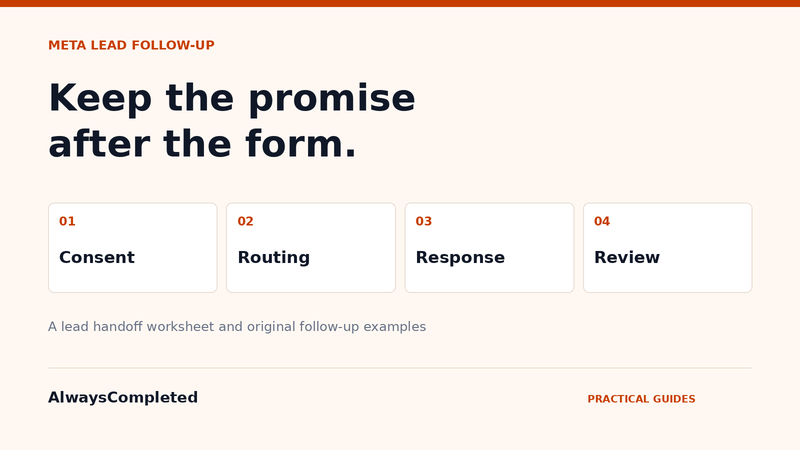
Meta Lead Form Follow-Up: From Submission to a Qualified Enquiry
A Meta lead-form submission becomes useful when someone can continue the conversation the advertisement started. Pass the offer, source, answers and next responsibility together. A name in a download is not enough: the person replying needs to know what was promised, what the prospective customer already supplied and what remains uncertain.
Build the handoff around one enquiry first. Confirm that an authorised person can retrieve it, identify its context and make the appropriate first contact. Record what happened after that contact. This gives a small team a workable process before it adds more forms, routing rules or campaign volume.
The downloadable tools include a handoff card, six operational statuses, four complete first-reply scenarios and a fictional agency-audit example. The example contains no real personal information or conversion results. Native lead retrieval, messages and CRM connections were not tested in a private account for this article; the worksheet leaves those checks as NOT_RUN.
Preserve the promise and the source
Save the exact offer attached to the submission. An advertisement offering a brief website audit creates different expectations from an advertisement offering a consultation about a paid project. The follow-up should recognise that distinction before introducing a new question or asking for a meeting.
Record the campaign or advertisement reference available to the authorised team, the form name and version, the submission time and the promised next step. Keep a readable summary of the offer alongside the identifiers. Someone answering from a queue should not need to reconstruct the meaning of an old advertisement from a number alone.
Preserve the destination as well. Meta distinguishes instant forms that open from the advertisement from forms on the advertiser's website. That difference affects where the submission is retrieved and what the team needs to verify. It does not determine whether the person is a qualified customer. Meta: lead ads with forms
If the form itself still needs redesign, use the separate instant forms versus website forms guide. Here, the starting point is a submission that already exists. Preserve its original context even when a later version of the form asks better questions.
Check what the person actually supplied
Read the received fields before composing a reply. Distinguish a supplied answer from an inference, an empty field and a question the form never asked. “Budget not collected” is different from “the prospect has no budget.” “Website address missing” is different from “the business has no website.” These distinctions prevent the team from rejecting a plausible enquiry on an invented assumption.
Mark the fields needed for the promised next action. A website audit may require a page address and the area the person wants reviewed. It does not necessarily need a detailed purchasing timetable before the promised review can begin. Ask for the information that changes the immediate decision, then collect additional context when it becomes relevant.
Avoid copying personal contact details into every team document. Keep the authorised lead record in the appropriate restricted location and use its reference in the working handoff where possible. The downloadable example uses role descriptions and synthetic identifiers; replace these with approved records, not a public list of real people.
Check whether another team member has already contacted the person. Two replies that make different promises can create more confusion than a short, deliberate assignment step. Keep the current owner visible and record an owner change explicitly rather than letting an enquiry disappear between two inboxes.
Verify retrieval separately from later reporting
Choose a route the team can actually use. Meta describes CRM access, Leads Centre and lead downloads among its lead-management routes. Availability, permissions and integrations still need inspection in the relevant account. If an automated connection is unavailable, a named person can maintain a controlled manual retrieval and assignment process. Meta: lead ads that click to message
Do not confuse retrieving a lead with sending later outcome information back to Meta. Meta's forms guidance treats CRM lead retrieval and CRM-based Conversions API feedback as different connections. An existing website connection does not by itself prove that CRM outcomes are connected, and choosing a conversion-leads goal does not complete an integration automatically. Meta's forms and CRM guidance
For a practical handoff test, use an authorised test submission and trace its reference from the source to the intended owner's working queue. Confirm that the expected fields survived, the offer can be identified and the owner knows what to do. Record the observed route and time. Do not write “CRM working” merely because a connector appears in a settings menu.
If the test cannot be run, preserve the proposed route and its owner with NOT_RUN beside the result. A clear manual fallback can be planned in the meantime, but it should not be described as an operating integration until someone has actually checked it.
Assign the next contact and a realistic time
An enquiry needs a named responsible person or an unambiguous staffed role. “Sales will handle it” is incomplete if nobody monitors that queue. The handoff should state who accepts ownership, which contact channel is appropriate and when the next action will be reviewed.
Separate the submission time, retrieval time, assignment time and actual first-contact time. These observations reveal where a delay occurred. They also prevent a team from reporting a fast response simply because the advertisement captured the form quickly while the message remained unsent for two days.
Choose a timing commitment the real team can meet. If the offer promises a reply within a stated period, the follow-up process needs an owner and coverage that can honour it. If the team is unavailable, give an accurate next contact window rather than inserting an impressive but unsupported response promise into a template.
Meta's messaging guidance recommends explaining the next contact, including who will contact the person and how or when. Apply that principle to the handoff without pretending that a form submission and an active chat are the same interaction. In a chat, unnecessary channel changes can interrupt the conversation; after a form, use the contact route the person reasonably expects. Meta's messaging follow-up guidance
Ask only the question that changes the next step
A first reply should connect to the offer, acknowledge useful information already supplied and explain the next action. Ask for the missing detail that makes that action possible. A long qualification questionnaire can accidentally replace the small task the advertisement promised.
In the DEMO agency-audit example, a fictional studio requested a review of its portfolio enquiry page and supplied the page reference, objective and preference for a written response. The first reply acknowledges that preference and confirms that the review should focus on the enquiry path and form. It does not ask them to repeat information already supplied or imply that a paid project has been agreed.
If the page reference is missing, ask for that reference first. If the stated task falls outside the team's service, explain the boundary. If the requested timing is impossible, say what is feasible before proposing a meeting. The four downloadable replies cover these situations with complete wording that can be adapted to the real offer.
Qualification should remain connected to a concrete task. Define what makes the next step appropriate: the request fits the service, the necessary material is available and the person agrees to the proposed action. Do not substitute a guessed job title or an enthusiastic message for evidence that the work is suitable.
Use six statuses that describe observed progress
The worksheet uses six manual statuses. They are an original operating vocabulary, not a claim about the labels in Meta or a particular CRM. Map them to the system you actually use and retain the meaning of each transition.
| Status | Evidence required |
|---|---|
| Received | Submission is accessible and its source is identified |
| Assigned | A named owner has accepted responsibility and checked context |
| Contacted | A first contact was actually sent or made, with time and channel recorded |
| Clarifying | A specific unanswered question is holding up the next decision |
| Next step agreed | The task fits the stated criteria and the person has agreed to a concrete next action |
| Closed | The enquiry is no longer active, with a factual reason recorded |
These states are not a compulsory six-step funnel. An out-of-scope enquiry can close after a helpful reply. A complete enquiry may move from Contacted to Next step agreed without a clarification stage. A person who asks for no further contact should not remain in a repeated follow-up routine.
“Contacted” does not mean the person read the message. “Next step agreed” does not mean a sale. “Closed” may mean duplicate, unsuitable request, withdrawn interest or a completed limited task. Preserve the reason, and keep a paid agreement or revenue event separate if it later occurs.
Review missing handoffs before increasing volume
At the review point, inspect unresolved enquiries by their actual blockage. Was the submission inaccessible, unassigned, missing context, awaiting a necessary answer or waiting for a promised action? A total lead count cannot distinguish those operational problems.
Select a few actual records and trace the timestamps and decisions. If the same essential field is repeatedly missing, revise the form brief. If people expect a different service, revise the advertisement or first-contact explanation. If assignments are unclear, repair ownership. Avoid adding more form questions to solve a staffing problem.
Keep changes versioned. A clearer form may start collecting a page address from a particular date; earlier enquiries will still lack it. Record the version rather than comparing mixed records as if the same information had always been requested. No conversion percentage is needed to document a specific broken handoff.
Once someone becomes a client, the social media client onboarding checklist covers a different stage: agreeing access, responsibilities and delivery. A lead-form record should not silently become proof that onboarding or a purchase has happened.
Finish one traceable test before adding promotion
Use the fictional worksheet to rehearse the roles, then run the permitted test in your real process. The useful completion is a traceable submission, a responsible owner, an appropriate first contact and a documented next state. Mark any step that has only been discussed as planned.
The AlwaysCompleted Facebook service guide and advertising service guide describe separate promotion options. They do not establish a CRM integration, lead qualification service or sales outcome. Compare a relevant listing only after defining the destination and follow-up responsibility, and confirm its actual scope with technical support.
