Small-Budget Marketing Tests: When to Stop, Fix or Scale
A small-budget marketing test should answer one decision: what should the project do next with its limited time and money? Write that decision, choose one change, define the observation that would matter and set a spending cap before launching. At review, check whether delivery and measurement worked before judging the message or offer.
The result can be stop, fix, continue with a bounded next step, or inconclusive. A small test does not owe you a winner. It should leave a clearer record of what was tried, what was observed and which uncertainty remains.
Use the editable one-page plan, printable PDF, decision tree and worked comparison CSV. All numbers and business situations in this guide are fictional teaching examples. No campaign, account or live tracking implementation was tested.
Start with the next decision
“Find out whether marketing works” is too broad for a limited attempt. A useful question names an action that the project can change: whether to rewrite a promise, repair a destination, produce another creative or allocate a defined amount to another comparison.
For a fictional workshop business, the question might be: “Does a clearer invitation to view workshop dates produce enough relevant enquiries to justify another limited promotion?” That still needs a precise outcome. A visit, an enquiry about a suitable date and a paid booking are different observations.
Before launch, finish this sentence: “If we observe ___ under ___ conditions, we will ___.” Also write what you will do when the observation is missing. If every possible result leads to more spending, the plan is not yet a decision rule.
Google Ads recommends setting a hypothesis tied to a business goal, choosing success metrics in advance and keeping records of experiments. We adapt those planning principles here. Google’s guidance concerns its advertising experiments; applying the principles does not turn an ordinary small campaign into a randomized experiment. Google Ads experiment-design guide.
Choose one change you can interpret
Pick a specific variable: the headline, the order of information, one destination-page explanation or one audience condition. Record what should remain consistent and what cannot realistically be controlled.
If you change the offer, creative, audience and page together, you may learn whether the new package is operationally promising. You cannot confidently identify which change explains the difference. Label it a concept comparison instead of claiming to have isolated the effect of a headline.
Method matters. A randomized platform experiment has a defined allocation and analysis process. Two organic posts published on different days are an observational comparison: timing, exposure and audience composition may differ. A before-and-after page comparison can have similar limitations. State the method on the first line of the record.
Google's design guide explicitly warns that changing several variables makes the source of a difference harder to identify. That is a useful reason to narrow the question, not a promise that changing only one visible element removes every source of bias. One-variable experiment guidance.
For a project with very little traffic, a review of the promised destination may be the best first test. Confirm that a visitor can understand the offer and complete the intended action before paying to investigate a small difference between two headlines.
Set a cap, a review point and an outcome window
Record the maximum amount authorized, its currency and what it includes. Separate media spending, service charges and production work. A “$100 test” can mean very different things when design, setup and handling are omitted.
Set the review time, timezone and observation window. Also allow for the outcome's normal delay: an immediate page action and a later booking cannot be assessed on the same clock without explanation. Use actual knowledge of the project rather than inventing a universal seven-day rule.
The spending cap is a business constraint. It is not a statistical sample-size calculation. If the cap cannot buy enough relevant observations to answer the proposed question, narrow the question, change the method or postpone the attempt. Do not make the cap disappear because the first results look interesting.
Write operational stop conditions separately from the performance decision. A wrong destination, a broken form or an unsupported offer should trigger a pause and correction. That does not prove the underlying marketing hypothesis failed; it means the intended test was not delivered correctly.
The music promotion budget template can help distinguish planned, actual and remaining spending. For different charging units, use the CPM, CPC and CPE comparison guide before treating two quoted prices as equivalent.
Keep delivery and outcomes in separate rows
A delivery record answers what ran: asset version, destination, dates, audience settings, amount spent and relevant service scope. An outcome record answers what happened: the exact event, its source, the observation window and any quality review.
Do not make one counter serve both jobs. A delivered view does not establish a useful visit. A visit does not establish a qualified enquiry. A completed service order does not establish sales attributable to the activity.
Buffer's reporting guide emphasizes choosing metrics and timeframes around the reporting goal. For this test plan, that means preserving the definition and scope of each observation instead of combining unlike counts into one success score. Reporting goals and timeframes.
Before accepting a conversion count, inspect the path and the recording method. Does the event fire on an actual accepted submission, or on a button click? Can one person trigger it repeatedly? Is the outcome recorded by the website, the advertising platform or a manual review? These questions specify what the number can support.
If a field is unavailable, mark it missing. If no outcomes were observed, report zero observed outcomes alongside the spend and window. Positive spending divided by zero outcomes is not a zero cost per outcome. It also does not prove that the true underlying response probability is zero.
A worked comparison that stays honest about uncertainty
Imagine a fictional workshop campaign testing two headline framings in consecutive periods. The offer and intended destination stay the same, but the periods are not randomized. The project defines an enquiry as a completed request asking about a workshop date. Qualification and eventual bookings require separate review.
Its illustrative plan allows $180 of media spend and $30 for production, giving a $210 project cap. It also sets a project-specific provisional media-cost limit of $12 per enquiry. These amounts are teaching assumptions, not recommended budgets, market prices or universal success thresholds.
| Observation | Version A | Version B |
|---|---|---|
| Recorded eligible page visits | 100 | 80 |
| Completed date enquiries | 5 | 6 |
| Media spend | $60 | $60 |
| Enquiries ÷ eligible visits | 5.0% | 7.5% |
| Media cost per enquiry | $12 | $10 |
| Business qualification | Not reviewed | Not reviewed |
The observed enquiry-rate difference is 2.5 percentage points. The relative difference is 50%, but “50% better” hides the small counts and the sequential design. B has one more enquiry, from fewer recorded visits, under conditions that may differ. This is a descriptive comparison, not a demonstrated causal lift.
The budget arithmetic is also explicit: $120 media plus $30 production has been spent, leaving $60 within the $210 cap. The $10 and $12 figures are media cost per enquiry, not the total cost of acquiring a customer.
Both versions meet the illustrative media-cost limit, but the business-quality review is missing. The immediate decision is inconclusive for scaling. Inspect the enquiries and the measurement, then decide whether the remaining authorized $60 can address a useful question. Spending it is optional; the unspent balance is not an obligation.
Use the decision tree in the right order
The downloadable decision tree is an original planning aid. Its questions are intentionally about evidence and project limits rather than universal conversion-rate thresholds.
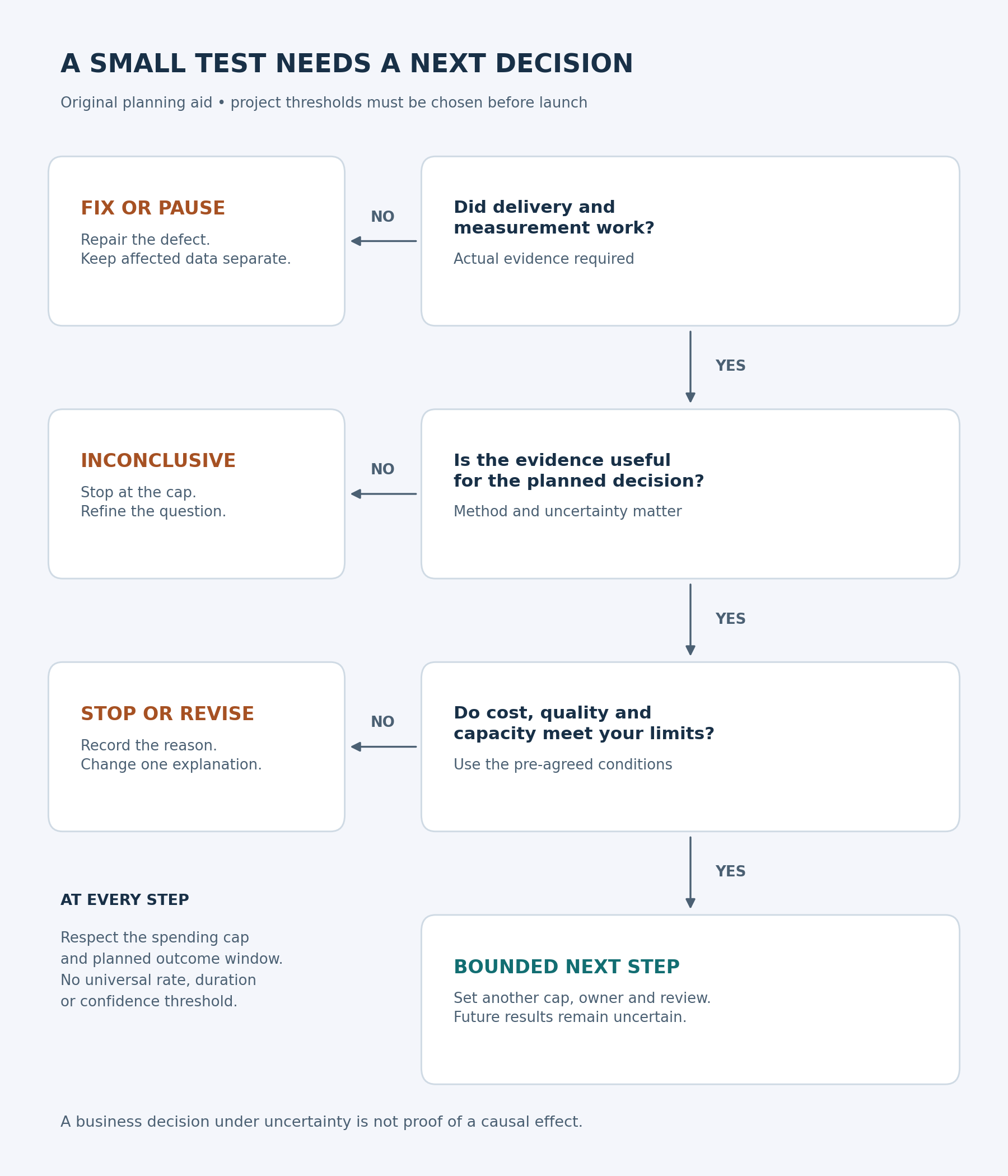
1. Did the intended activity and measurement work?
If no, fix or pause. Record the defect, preserve the affected data separately and repeat only after verifying the correction. A fictional form that never confirms a successful request cannot fairly test whether the headline attracts enquiries. Do not pool the broken period with the corrected period and silently call it one clean result.
If the answer is unknown, investigate before interpreting performance. “Tracking installed” is not the same as an observed end-to-end check. The plan has a field for the actual evidence, which starts blank.
2. Is the evidence useful enough for this decision?
If no, mark the result inconclusive. The next step may be a better comparison, a less demanding question or stopping at the cap. Different types of decisions require different evidence: fixing a confirmed wrong URL is straightforward; forecasting profitable growth from a few enquiries is much harder.
Google Ads' experiment reporting distinguishes estimated differences, confidence intervals and results with no clear winner. That illustrates why a higher displayed number alone is not a full experimental conclusion. Use the actual method's reporting rules; do not borrow a confidence label for an observational exercise. Understanding experiment results.
3. Do cost, quality and capacity meet the pre-agreed conditions?
If the evidence is interpretable but the activity fails the project's conditions, stop or revise. Identify the specific issue. Is the offer attracting irrelevant requests? Is the destination unclear? Is the cost unacceptable under the project's economics? A new attempt should address an explanation you can test.
If the conditions are met, consider a bounded next step. Define the additional amount, what remains unchanged, the next review and the conditions for stopping. Check that the team can handle the extra enquiries and deliver the promised service.
This is a spending decision under uncertainty, not a claim that results will continue at the same rate. A larger effort may operate under different conditions. Preserve the new period as a separate record and review it on its own evidence.
Know what “not enough data” means
There is no single number of clicks or days that resolves every small-budget test. Enough depends on the outcome, baseline, comparison method, size of difference that would matter and the consequence of being wrong.
For a formal experiment, plan sample size and the analysis around the design before launch, then use that method consistently. Avoid switching between metrics until one looks favorable. For a directional operational test, state the uncertainty and choose an affordable action that does not require pretending the result is definitive.
An inconclusive result can still reveal that the question was too broad, the event was too rare, the page was not ready or the reporting window was poorly chosen. Record the specific limitation. “Need more data” without identifying what would change the decision can become an excuse for unlimited spending.
Close the test with a decision record
Write five lines: original question, verified observations, important limitations, decision and next owner. Include the spend and remaining authorization. Keep the result even if it is unexciting; it can prevent the next person from repeating the same unclear test.
A useful conclusion for the fictional comparison is: “B had a lower observed media cost per date enquiry, but sequential periods and unreviewed enquiry quality prevent a scaling conclusion. Review those enquiries before authorizing another bounded comparison.” It says what happened and what remains unresolved.
Define the question before selecting a campaign format. The promotion platform guide directs readers to compare the described activity and current listing; the advertising promotion guide is a starting point for reviewing a proposed scope. A service's deliverable and a marketing hypothesis remain different things. Choose the work that can inform the decision, then apply the cap and review process you wrote in advance.
