CPM, CPC and CPE: How to Compare Promotion Quotes
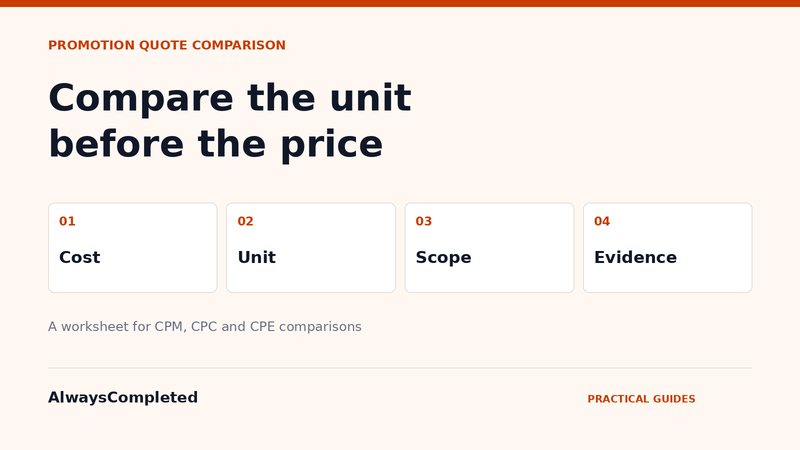
Compare promotion quotes by their defined outcome, counting method and included work before comparing the price. CPM measures cost per thousand impressions, CPC measures cost per click, and CPE needs an explicit definition of engagement. A smaller number beside one of those labels does not make it cheaper than a different label.
Google Ads distinguishes paying for ad clicks from paying for impressions, and its engagement definitions vary with the ad format. Those are useful reference points, but they do not turn every seller’s “1,000 actions” package into a standard advertising metric. Source: CPC definition. Source: CPM definition. Source: engagement reporting.
Use the original three-offer comparison workbook, worked-example CSV or blank quote register. The workbook also includes a clearly labelled click-rate scenario exercise. Every offer and number in this article is fictional; none is a current price, benchmark or promised result. Definitions were checked on 25 November 2026.
1. Choose the decision the quote must support
Write the objective as an observable event and a business question. “Send interested listeners to our release page” is more useful than “get promotion.” It identifies the destination and lets you ask what evidence will show that people arrived. If the real goal is purchases, also ask how purchase evidence will be collected; a traffic quote alone cannot answer that question.
| Your question | Potentially relevant measure | What it does not establish by itself |
|---|---|---|
| How often was the campaign displayed? | Defined impressions, with viewability where relevant | Unique people, attention or recall |
| Did people use the destination link? | A precisely defined link/outbound click | A loaded site session or a completed action |
| Did people interact with the content? | Specified engagement events, with a breakdown | Unique engaged people or buying intent |
| Did the campaign generate qualified enquiries? | Verified enquiries under an agreed attribution method | Incremental sales or profit |
The closest measurable event is not always the final objective. You may choose to pay for distribution while judging a later audience response. Keep both fields: what the supplier is being paid to deliver, and what your business will evaluate afterwards. This prevents a proposal from quietly substituting a large activity count for the result you intended to assess.
Define the audience and setting at the same time. A campaign in the wrong language or location can have a low unit cost while answering none of the relevant commercial questions. Record geography, audience criteria, placement, device restrictions if relevant, creative format and campaign dates. Treat an unsupported audience label as a question to resolve, not a verified targeting capability.
2. Translate each quote into an exact unit
CPM: a thousand of which impressions?
The reporting formula is CPM = included cost ÷ impressions × 1,000. Google’s definition concerns advertising impressions and separately describes viewable CPM. If one quote uses served impressions and another uses viewable impressions, their denominators differ. Do not silently put them in the same column. Source: impressions and viewable CPM.
Ask which system records the impression, what filtering applies and whether the number is an estimate or a contractual delivery quantity. Also ask whether reach or frequency evidence is available. Forty thousand impressions do not establish forty thousand distinct people. A video-view package has its own view definition; relabelling its price per thousand as CPM does not make it an impression buy.
CPC: a click is not a maximum bid
The reporting formula is CPC = included click cost ÷ recorded clicks. Google defines average CPC from the actual cost and click count; maximum CPC is a bid, not the same reported average. A seller’s estimate, your bid setting and a completed campaign’s observed CPC should occupy separate fields. Source: average CPC versus maximum CPC.
Specify the click: all clicks on the creative, a link click, an outbound destination click, or another defined event. A click that expands an ad is not interchangeable with a click to your website. Keep the destination and source report beside the metric so the team can reconstruct what was counted.
Do not convert click delivery into website sessions by changing the label. Google’s discrepancy guidance explains that clicks and sessions are different metrics; multiple clicks may occur within a session, and a visitor can leave before analytics loads. A mismatch deserves investigation under the relevant definitions, not an automatic accusation or a claim of equivalent delivery. Source: clicks and sessions.
CPE: define the event before using the abbreviation
The working formula is CPE = included cost ÷ defined engagement events. Write the event set in full. In a social-content comparison, you might choose likes + comments + saves during seven days. That is your specified reporting definition, not a universal platform standard.
Google Ads provides a concrete reason to be precise: some video engagements depend on a watch threshold or an ad click, while Lightbox expansion is another engagement type. Its Average CPE concerns the engagement defined for that ad format. Do not combine those events with social likes and call the result a comparable audience-response rate. Source: format-dependent engagement definitions.
Even within a single social post, an event total is not necessarily a unique-person total. One person may like, comment and save. Keep the component counts and any deduplication rule. An offer promising “600 engagements” needs a definition before 600 becomes a meaningful denominator.
3. Align cost, reporting status and observation period
Put every quote in one currency and record what the cost includes. Media spend, setup, creative production, management, reporting and tax can sit in different parts of a proposal. Comparing a media-only price with a fee covering production and publication is useful only if the difference remains visible.
For example, a fictional USD 240 media budget with 40,000 planned impressions gives a planned media CPM of USD 6.00. If the same plan requires another USD 60 of management, its included campaign-cost CPM would be USD 7.50 on that same assumed quantity. Both calculations can be correct; they answer different cost-scope questions.
Use separate records for forecast, contracted quantity and observed result. A forecast of 300 clicks is not a promise to deliver 300, and a fixed placement fee is not automatically a per-engagement billing arrangement. After delivery, retain the original quote and add a new observation rather than overwriting the estimate with an actual result.
- Currency and cost basis: which fees and taxes are included, and which remain unknown?
- Quantity status: forecast, contractual deliverable or measured result?
- Counting scope: event definition, dates, timezone, source and filtering?
- Commercial scope: what work, revision, access and reporting are supplied?
- Decision gap: what evidence is still missing for the intended outcome?
Missing values should stay missing. A blank click count does not mean zero clicks, and an unknown fee does not mean free service. A genuine zero has a different meaning and should be entered deliberately. The workbook suppresses a rate when its cost is missing or its denominator is missing, zero, negative or non-numeric.
4. Compare three fictional offers without inventing a winner
Assume a musician is considering three proposals for a release. Each has USD 240 in the quoted cost field, but the scope differs. All quantities below are planning estimates, not guaranteed delivery. Offer C is an invented sponsored creator-content arrangement; it is not a description of any AlwaysCompleted listing.
| Offer and quoted scope | Forecast quantity | Calculable planning rate | Not comparable without |
|---|---|---|---|
| A — USD 240 media budget | 40,000 served impressions | CPM: USD 6.00 | Compatible click evidence, audience and full fee scope |
| B — USD 240 media budget | 300 outbound clicks | CPC: USD 0.80 | Verified click definition, audience and destination evidence |
| C — USD 240 production/posting fee | 600 specified social events | CPE: USD 0.40 | Compatible site-click evidence and a common cost basis |
The arithmetic is straightforward: A is 240 ÷ 40,000 × 1,000; B is 240 ÷ 300; C is 240 ÷ 600. Ranking C first because 0.40 is smaller than 0.80 and 6.00 would compare different denominators. Converting every quantity to “per 1,000” would not solve that problem: a thousand saves, clicks and impressions remain different events.
If the decision is site traffic, B supplies the nearest forecast unit, but it is not automatically the best purchase. Its audience, click definition, reporting and actual destination experience still need verification. A might become competitive with credible click evidence. C might be appropriate when the primary objective is content creation and a relevant creator placement, rather than a predictable click quantity.
The useful output is a short list of questions, not a fabricated common score. For A, request a compatible traffic forecast and full cost scope. For B, verify what qualifies as an outbound click and how the destination will be measured. For C, ask for the content agreement, audience evidence, reporting breakdown and whether any destination-click information will be available.
5. Use a common-unit scenario only when assumptions are explicit
You can explore what would have to be true for an impression plan to match a click plan. That is a scenario calculation, not evidence that the impression campaign will achieve the assumed click rate. Use the same cost basis and the same click definition before doing the calculation.
For fictional A at USD 6.00 CPM, the implied CPC is CPM ÷ (1,000 × click-through rate), with the rate entered as a decimal. At 0.5%, the decimal is 0.005, giving 6 ÷ (1,000 × 0.005) = USD 1.20 per click.
| Assumed compatible click-through rate | Implied CPC for A | Comparison with B’s USD 0.80 forecast |
|---|---|---|
| 0.25% | USD 2.40 | Higher under this assumption |
| 0.50% | USD 1.20 | Higher under this assumption |
| 1.00% | USD 0.60 | Lower under this assumption |
The break-even assumed rate is 6 ÷ (1,000 × 0.80) = 0.0075, or 0.75%. This is an algebraic condition, not a market benchmark or prediction. It says what compatible click rate A would need at the stated cost to equal B’s forecast CPC. It says nothing about whether either proposal reaches the desired audience or produces qualified enquiries.
The workbook’s scenario sheet lets you edit CPM, comparator CPC and the assumed click rates. It rejects rates outside 0%–100% and leaves impossible divisions blank. No observed campaign data is loaded. If you have no defensible assumption, keep the scenario illustrative and request evidence rather than adopting its most attractive row as the expected result.
There is no equivalent shortcut from C’s 600 social events to site clicks without another supported relationship. A user who saves a post need not visit the release page. Inventing a fixed “engagement-to-click” multiplier would conceal the missing evidence rather than make the comparison more rigorous.
6. Keep advertising, creator agreements and service packages distinct
A native advertising campaign, a sponsored creator post and a catalogue activity package can involve different parties, controls and reporting. Establish what is actually offered. A familiar platform name in a service title does not prove that you receive an advertising account, a named creator’s endorsement, creative production or access to the platform’s campaign reporting.
The current AlwaysCompleted advertising guide makes this distinction explicitly: catalogue labels alone do not establish a verified ad network or continuing campaign management, and influencer-related engagement wording does not establish a creator-content agreement. Read the particular listing and resolve its scope before applying an advertising metric to it.
When comparing website traffic options, confirm the destination, unit, source of evidence and any stated geography or device conditions. Do not assume that a unit labelled traffic equals a Google Ads click, an analytics session, a qualified visitor or an order. Each requires its own definition and evidence.
For a real creator arrangement, separately confirm the post, creative responsibilities, publication duration, usage permissions and report. For an ad-management arrangement, separate media budget from management and identify which account owns the evidence. For a catalogue package, use the actual service terms. Similar-looking unit prices do not establish equivalent work or equivalent audience behaviour.
7. Ask these questions before approving the quote
- What exact event or work item triggers billing or fulfils the delivery quantity?
- Is the quantity a forecast, a contractual commitment or an already measured result?
- Which system counts it, over which dates, with what filtering and repeat-event rules?
- What audience, geography, placement and destination are specified, and what evidence supports them?
- Which fees, production tasks, access and reports are included?
- What happens if delivery is incomplete, the destination fails or reporting is unavailable?
- Which later business outcome will we assess separately, and what remains unattributed?
Use the answers to fill the workbook’s “Missing for comparison” column. Mark unresolved information as unresolved. The register is deliberately not a winner-selection algorithm: a mathematically valid rate can still be irrelevant to the campaign’s objective.
After a campaign, calculate aggregate rates from compatible totals rather than taking a simple average of daily or placement rates. For example, fictional spends of USD 40 for 100 clicks and USD 180 for 300 clicks produce USD 220 ÷ 400 = USD 0.55 overall CPC. Averaging 0.40 and 0.60 would give 0.50 and underweight the larger record. Combine only records with the same unit and appropriate cost scope.
An approval note can be precise without promising results: “We are considering B for its defined outbound-click objective, subject to audience, tracking and fee verification. The other offers cannot yet be ranked for that objective. The quoted quantities are forecasts, and sessions, enquiries and sales will be reviewed separately.” That gives the buyer a concrete basis for the next decision.
