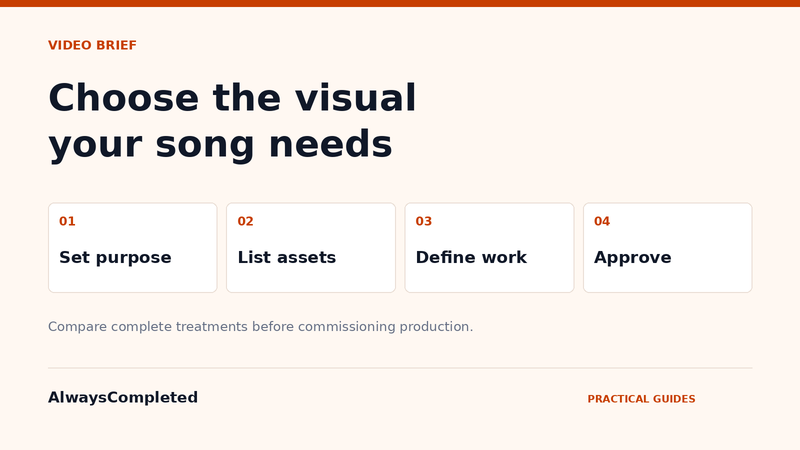
Music Video, Lyric Video or Visualizer? Write the Production Decision Brief
Choose a music video format by the job the visual needs to do. A performance or narrative video can show the artist and a story. A lyric video can make the words central. A visualizer can provide a coherent moving environment around the recording. Each choice creates different production and review work.
The useful comparison is between complete briefs for the same song, with materials, responsibilities and acceptance criteria visible. “Make a video” is too vague to establish what a producer should quote or what the artist should approve.
This guide includes three original fictional treatments for one recording, plus a decision matrix. Practitioner sources were reviewed on 26 November 2026. No finished video, production quote or performance result is claimed.
Download three DEMO production briefs, the comparison matrix and acceptance checks
Decide what the visual should communicate
Write a single purpose before selecting a format. For example: show how the two performers interact, help listeners follow the central lyric, or give the release a recognizable visual atmosphere. These are different creative tasks, even if they all use the same master recording.
Then identify where the finished work will be used. A full-song destination, a short promotional excerpt and a platform-specific loop require separate acceptance decisions. Do not assume that one export fits every use or that a full-length video can be cropped without losing the main action.
CD Baby's video guide distinguishes official videos, lyric treatments and non-narrative visualizations. The production comparison below uses those categories without adopting the guide's audience-performance figures or predicting which format will produce more views.
Compare three treatments for one recording
The fictional song in the download is Canal Room's “Night Platform.” Its creative premise is a quiet departure and a repeated melodic figure. The three briefs solve different parts of that premise.
| Treatment | Primary creative job | Main production dependency | Key review question |
|---|---|---|---|
| Performance with a small narrative | Show the duo's interaction and a departure motif | Approved location, performers, footage and edit plan | Does the sequence communicate the intended relationship? |
| Lyric-led edit | Let the listener follow the words | Approved lyric text, timing and readable design | Can the intended viewer read the correct words at the right moment? |
| Visualizer | Sustain a consistent moving atmosphere | Original or licensed visual elements and motion design | Does the movement support the recording without distracting repetition? |
These are candidate briefs, not a cost ranking. A complex animation can require more work than a simple performance shoot. A lyric treatment can become demanding if every line needs bespoke motion or several language versions. Price the actual scope rather than assuming that a category name determines the budget.
Inventory the source materials and permissions
List the approved audio master, artwork, lyrics, footage, photographs, logos and typefaces the project will use. Record the version and the person who can approve each item. A shared folder containing many drafts is not an approved source list.
For a shoot, identify performers, location arrangements, any third-party artwork visible in the scene and the person responsible for the necessary permissions. For animation, identify whether visual elements are original, commissioned or licensed, and whether their permitted use covers the intended release and promotional versions.
Keep rights evidence in the appropriate project record. The production brief should identify the custodian and relevant constraints without exposing private agreements. If permission is unresolved, mark that dependency before the quote is treated as ready to commission.
Lock the audio version before detailed synchronization. If the master later changes, record the duration and structure differences and ask the editor what work must be revisited. A new mix with an altered intro can affect many visual cues even when the title is unchanged.
Define revisions as decisions, not an unlimited promise
Break the production into meaningful review points: treatment, representative sample or rough sequence, complete edit and final exports. Specify who gathers feedback and who makes the final decision at each point.
Distinguish a correction from a change in direction. Fixing a misspelled approved lyric is different from replacing the whole visual concept after animation is complete. Both may be legitimate work, but the brief should say how additional scope is agreed.
Ask reviewers to describe the problem and reference the relevant moment. “The second verse is difficult to read on my phone” is actionable. “Make it more premium” needs clarification before another version is produced.
The download leaves revision counts, budget and schedule as fields to agree with the actual producer. They are not disguised market estimates. A quote becomes comparable only when the work, dependencies and acceptance points are clear.
Give lyric accuracy its own reviewer
CD Baby's lyric-video walkthrough emphasizes readable text, timing and proofreading. It is a 2022 practitioner example; its historical price headline is not a current production budget.
Use an approved lyric document as the source of truth. Check spelling, deliberate stylistic choices, line breaks and the sung version. Then review the actual timing against the final audio. Correct text can still be difficult to follow if it appears too late, disappears too soon or competes with a busy background.
Have someone other than the person entering the text proofread the complete export. Watch at the intended display size, including a phone where relevant. Review the file itself after export, not only the editing timeline, because the deliverable is what the viewer receives.
If the brief includes translations or alternate lyrics, assign a reviewer for each version. Do not treat those as automatic by-products of the first edit.
Check the visualizer's continuity and the video's framing
For a visualizer built from a repeating sequence, inspect the transition from the last frame to the first. A visible jump may be an intentional artistic choice, but it should be approved. Check whether a slow drift, light change or object movement accumulates awkwardly over repeated cycles.
Also watch enough of the full-song assembly to judge repetition. A loop that looks attractive once may become distracting when repeated throughout the recording. The asset contains a continuity checklist and a place to record an approved exception.
For performance footage, review the intended crops before assuming a vertical version is included. Faces, instruments and visual cues may need a separate edit. For every format, record the dimensions, duration, audio treatment and destination requirements from the actual commissioned use.
The YouTube format guide covers a separate publishing decision. It can help define the destination, but it does not replace the production brief or the current specifications for a particular placement.
Approve a specific deliverable and its campaign use
The final brief should identify the selected treatment, approved materials, required roles, unresolved dependencies, review owners and included exports. Attach the completed decision matrix so the producer can see why that treatment fits the task.
For the fictional song, the artist might choose the lyric treatment now because the words are central and approved footage is unavailable. That is a decision based on present materials, not a universal claim that lyric videos are cheaper or more effective. A performance video can remain a later project with its own brief.
The AlwaysCompleted music release page describes audio-related production and release work. It does not automatically establish music-video production. Similarly, an advertising listing may require supplied creative without including its manufacture. Ask technical support to confirm the selected service's actual creative scope and accepted format.
Finish by approving the exact output and the conditions that make it acceptable. A well-defined video commission gives the artist room for creative judgment while keeping the producer, reviewer and campaign operator aligned on what will actually be delivered.
