DJ Promo Campaign Case Study: Reading Two Reports 39 Days Apart
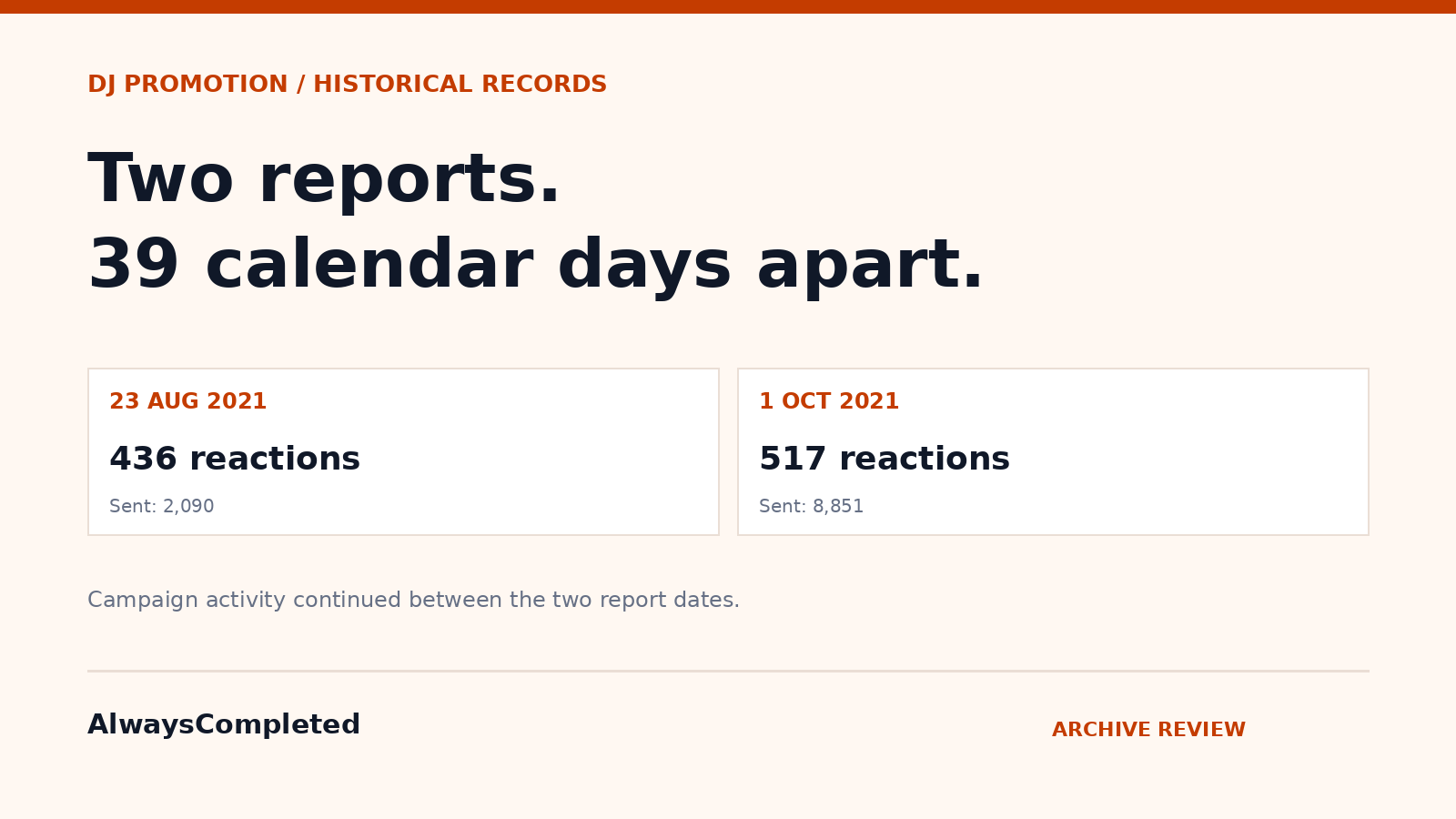
Two reports from a real DJ promo campaign show how easily a growing response count can be mistaken for a lasting result after promotion ends. The first report recorded 304 responses marked Supporting. The second recorded 357. In the same interval, the Sent counter rose from 2,090 to 8,851, and archived messages show that promotion was still being distributed. The extra responses belong to a period of continuing exposure. E-R1, E-R2, E-DISPATCH
We call this historical example Campaign E. Its two report dates, 23 August and 1 October 2021, are 39 calendar days apart. The records support a useful review of delivery, responses and reporting decisions. They do not establish what happened during a full month after the campaign stopped.
Use the case to decide what to ask before accepting a report, approving another batch or describing a campaign publicly. The editable comparison CSV contains the actual snapshot values. The methodology and review worksheet includes anonymized source extracts and a reusable evidence ledger.
What survives in the campaign record
AlwaysCompleted reviewed these historical records from the PromoRing archive. The source material consists of correspondence and two exported campaign reports. Campaign E is an editorial pseudonym. Recording details, recipient identities, private links and payment references have been removed from the public material; the reported counts and dates have been preserved.
The archive contains a build notice and launch correspondence on 2 August, a client request for PDF reports on 23 August, the two report exports, and later promotional messages. The initial order was quoted at $19, followed by the client’s statement that payment had been made. A payment-processor receipt was not available in the reviewed evidence. E-BUILD, E-LAUNCH, E-REQUEST
These records answer a bounded question: what changed between two snapshots of a continuing DJ promotion? They contain no streaming-platform results, revenue ledger or verified broadcast log. The historical price is part of this case, not a current service offer.
Put report dates on an activity timeline
Start with the events around each export. A PDF can be produced because somebody asks for it, even while work continues.
| Date in 2021 | Recorded event | Source |
|---|---|---|
| 2 August | Package built; launch correspondence; $19 quoted and payment reported by the client | E-BUILD, E-LAUNCH |
| 23 August | Client requested PDF copies of recent promotions; the first report was supplied | E-REQUEST, E-R1 |
| 18 September | A promotional email for the same campaign was received | E-DISPATCH |
| 1 October | Second report exported and supplied as an example in a separate platform discussion | E-R2, E-CONTEXT |
| 2 October | An “Expiring soon” promotional reminder for the same campaign was received | E-REMINDER |
The August report was generated in response to a request for copies. Nothing in that exchange establishes a campaign stop. The October report was shared to illustrate the platform’s reporting; that purpose also does not establish completion. E-REQUEST, E-CONTEXT
The 18 September email and 2 October reminder refer to the same campaign identifier as the original build notice. That identity check matters: a familiar track title alone would be weaker evidence, especially where several editions or repeat orders exist. Identifiers were compared privately and are omitted from the public extracts. E-BUILD, E-DISPATCH, E-REMINDER
The title’s 39 days describes the difference between calendar dates. The reports also print times, but no timezone. We therefore do not present the interval as exactly 39 complete 24-hour periods or reconstruct an hourly delivery schedule.
Compare the snapshots without adding them together
The following values are transcribed from each report’s summary. The difference column is the later value minus the earlier value. It is not a third report or a separately measured audience.
| Report field | 23 August: E-R1 | 1 October: E-R2 | Difference |
|---|---|---|---|
| Sent | 2,090 | 8,851 | +6,761 |
| Opened | 1,066 | 2,186 | +1,120 |
| Reacted | 436 | 517 | +81 |
| Supporting | 304 | 357 | +53 |
| Not Supporting | 132 | 160 | +28 |
| Didn’t Say | 630 | 1,669 | +1,039 |
Two simple checks help catch transcription errors. In E-R1, Supporting plus Not Supporting equals Reacted: 304 + 132 = 436. Reacted plus Didn’t Say equals Opened: 436 + 630 = 1,066. The corresponding checks also balance in E-R2: 357 + 160 = 517, and 517 + 1,669 = 2,186.
Those arithmetic relationships describe these reports. They do not independently validate the tracking system, establish unique people or prove that every recorded opening included listening to the music. Preserve the report’s field names when copying the figures into another document.
Likewise, adding 436 and 517 would double-count overlapping snapshots. A comparison of the extracted feedback records matched all 436 earlier entries in the later report, with 81 additional entries. The matching method is described in the companion; it does not establish unique people. The defensible comparison is a net increase of 81 recorded reactions, accompanied by a net increase of 6,761 in Sent.
That distinction changes the renewal conversation. “Responses increased” is supported. “The original audience kept generating responses after we stopped” requires a stop event and a subsequent observation period that these records do not provide.
The delivery change prevents a retention claim
The two reports do not describe an unchanged exposure window. Sent increased substantially, and a promotional email was received between the report dates. A further reminder arrived after the second report. These are concrete reasons to classify the comparison as continuing campaign activity. E-R1, E-R2, E-DISPATCH, E-REMINDER
The archive does not provide a complete send schedule, recipient history or verified final delivery date. We cannot split the additional reactions between people contacted early, people contacted later and people receiving reminders. Nor can we determine from the two summary tables how much of the Sent increase represents new recipients versus repeated deliveries.
For the same reason, the difference is not an isolated test of a new mailing list, creative change or follow-up tactic. Several mechanisms could produce a later response. Without the action log, assigning the change to one mechanism would go beyond the evidence.
If the intended question is persistence after promotion ends, first establish the last promotional action, including scheduled reminders. Save a snapshot at that point and observe the same metrics over the following full month. Record any additional promotion during that month. A later export date alone cannot supply the missing stop event.
Read Supporting as a response category
Supporting increased by 53 between the reports. That is useful evidence about recorded responses, but it does not establish 53 additional broadcasts, playlist placements or public performances. The source names a response category; the reviewed records do not include a verified log of subsequent use.
A campaign manager can still act on the information. Review the underlying feedback privately, identify responses that warrant a relevant follow-up, and record what happened next. A request for an alternate mix, an explicit broadcast plan and a general positive comment would lead to different actions. These are examples of review decisions, not additional findings from Campaign E.
To substantiate an actual broadcast, preserve the programme or station, date, recording identity and supporting evidence. To substantiate a placement, preserve the destination, date checked and evidence that the intended recording was present. Keep these outcomes in separate fields rather than upgrading every Supporting entry to a completed placement.
Not Supporting also deserves an accurate label. The 28-count increase records the change in that category. It does not by itself explain a recipient’s reason, the recording’s quality or the audience fit of every delivery. The summary is a starting point for reading feedback, not a replacement for it.
What the $19 figure can and cannot tell you
The order correspondence supplies a specific historical amount: $19. The client then reported payment. That supports describing an agreed initial price with a client-reported payment, while preserving the distinction from an independently checked transaction receipt. E-LAUNCH
The build notice separately lists a cost of 1 Credit. A platform credit is not a dollar amount. The reviewed notice supplies no conversion rate, and the credit must not be treated as $1 or added to the client’s order price. E-BUILD
We also lack a full campaign cost ledger covering staff time, fees and any additional expenditure. The archive therefore cannot support a complete cost-per-result calculation or return on investment. Dividing $19 by 357 would attach a narrowly documented initial charge to a later accumulated response count while leaving the cost scope unresolved.
For a future campaign, distinguish the agreed price, payment status, platform charges and total actual cost. Give every amount a currency, date and evidence reference. A blank amount means unknown; entering zero would make a stronger claim than the records support.
Reuse the review on your next campaign
The comparison CSV keeps both dates, source codes, values, differences and metric limits in each row. The activity timeline CSV separates exports from promotional actions. The methodology worksheet provides blank fields for your own delivery, cost and outcome records.
Work through the review in this order:
- Match the campaign. Confirm the same recording, version and campaign record. Do not combine releases simply because they appear in one email thread.
- Preserve the exports. Record the printed date, timezone if available, original field names and reporting scope before calculating differences.
- Reconstruct the intervening work. List sends, reminders, audience changes and other promotion. Mark missing events as unknown.
- Separate responses from outcomes. Keep support responses, verified placements, streaming evidence and revenue in their own columns.
- Make a decision the evidence can support. Request a delivery breakdown, follow up on specific feedback or improve the next reporting plan before approving an expansion.
A useful decision note for Campaign E is: “Recorded reactions and support responses increased while delivery continued. Obtain the final action log and complete cost record before evaluating efficiency or outcomes after completion.” It acknowledges the observed activity and identifies the next records needed.
For a new release, compare the scope and reporting evidence described in music release services. Ask technical support to clarify the current deliverable before ordering; the historical $19 amount in this case is not a current quotation.
Campaign E evidence register
These source codes refer to archived originals reviewed for this article. The public companion contains anonymized extracts and transcription notes. Readers can inspect the disclosed evidence, but cannot independently authenticate the private originals from the public package alone.
- E-BUILD: 2 August build notice; package readiness and 1 Credit recorded.
- E-LAUNCH: 2 August launch correspondence; $19 quote and client-reported payment in the quoted message chain.
- E-REQUEST: 23 August request for PDF copies and reply supplying the report.
- E-R1: Report dated 23 August 2021; first metric snapshot.
- E-DISPATCH: 18 September promotional email linked to the original campaign record.
- E-R2: Report dated 1 October 2021; second metric snapshot.
- E-CONTEXT: 1 October correspondence supplying E-R2 as a platform example.
- E-REMINDER: 2 October “Expiring soon” reminder linked to the original campaign record.
Read the source extracts and methodology alongside the downloadable data. The public extracts omit identities and private access details; they are editorial transcriptions, not newly generated platform screenshots.
