Social Media Campaign Reports: A Template Clients Can Use
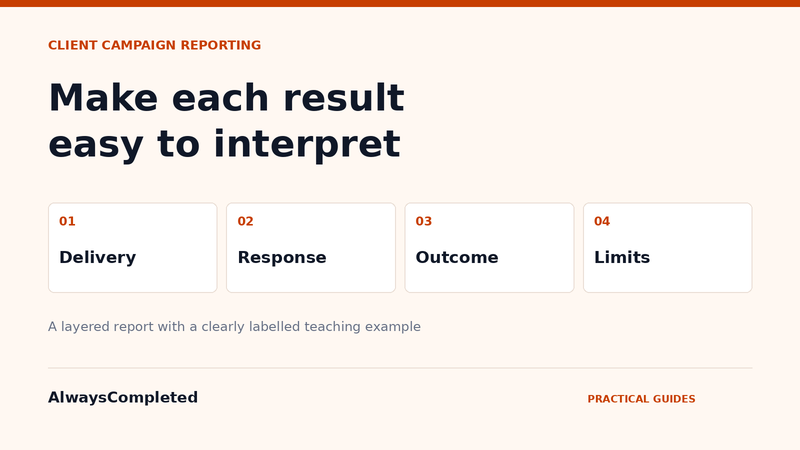
A useful social media campaign report answers one decision: what should the client continue, change, investigate or stop? To answer it honestly, separate three layers: the work delivered, the activity recorded by each platform, and the business outcomes you can actually verify.
An order marked complete does not establish sales. A platform click is not a website session. A submitted form is not automatically a qualified opportunity. Putting these measures in separate sections makes the report easier to read and prevents one number from standing in for another.
Download the editable three-layer reporting table, the fully annotated educational report, and its example data. The example is entirely hypothetical; it is not an AlwaysCompleted campaign, client result or benchmark.
Write the campaign question at the top
Start with the decision the report will support. “Did the pilot generate enough qualified enquiries to justify another test?” is more useful than “How did social media perform?” The first question identifies both the outcome and the next decision.
Record the agreed objective, intended audience, offer, destination, campaign dates and reporting cut-off. Name the person who will decide what happens next. If the campaign was contracted to deliver a defined quantity rather than a business outcome, state that distinction at the start.
AgencyAnalytics recommends selecting report metrics around the client's goals and interpreting them in context. This template applies that principle by keeping fulfillment, platform observations and business evidence visible as separate layers. See its social media reporting guide.
Write a short opening assessment after the data is assembled. Use three sentences: what is known, what remains uncertain and the proposed next step. Avoid a green “success” label when the main business question cannot yet be answered.
Layer 1: report contracted delivery separately
List what was agreed, what was supplied or completed, and the evidence of acceptance. For creative work, that might be an approved file and version. For published content, it might be the live URL and publication time. For a service order, retain the order identifier, metric, quantity, recorded status and applicable conditions.
Keep different units on separate rows. Six edited videos and eight scheduled posts are two commitments, even if some posts use those videos. Do not combine them into “14 assets delivered” unless that total has an agreed meaning.
AlwaysCompleted's reseller guide recommends preserving the agreed service, destination, metric, quantity, price and conditions, with the order ID linked to the client's reference. It also notes that timing, refill and cancellation conditions depend on the selected service. Use the actual agreed record when judging fulfillment.
A delivery row needs a clear reference basis. Here, “baseline” means the contracted plan, not a previous month's result. Show the shortfall explicitly: eight posts agreed, six published, two awaiting approval. Explain the status and owner; do not silently lower the plan to six after the period ends.
If a service dashboard and a public counter disagree, preserve both observations with their times. Check the contracted metric, destination, counting method and order status before diagnosing the difference. Neither a later counter movement nor an analytics total automatically proves that a contract was fulfilled or breached.
Layer 2: add platform observations with matching scope
Select the few measures that help explain the campaign question. Give each row its exact field name, unit, account or campaign filter, date window and source. An export's “clicks” field may have a different meaning from another report's “outbound clicks”; confirm the definition before treating them as equivalent.
Separate paid and organic activity where the source allows it. If only a combined total is available, label it combined. Do not estimate an organic remainder by subtracting two reports with different definitions or scope.
Use comparable date ranges, but also check whether the content and campaigns covered are comparable. A campaign-level comparison differs from a post-level comparison at equal age. A post published yesterday has had less time to accumulate activity than one published two weeks ago.
Keep each platform's audience estimates in its own row. Adding audience counts across platforms does not identify a deduplicated set of people unless you have a method that actually performs that deduplication. Similarly, a comment count does not describe the meaning of the comments. If feedback matters, summarize the observed themes with a clear sample and avoid inventing a positive response.
Layer 3: connect available business outcomes
Choose the system that can support each outcome. Website analytics can report measured visits or events. A backend submission log can confirm accepted forms. A CRM can record qualification. An order system can confirm purchases and refunds. These are different records, with different scope and timing.
Google defines an Analytics session as a period of interaction with a site or app. It is not a count of ad clicks or a count of people. Use the session definition in Google's documentation when labeling a GA4 row.
For each business measure, state the attribution rule and evidence available. “Accepted submissions with the recorded campaign identifier” is narrower than “all leads caused by this campaign.” A campaign identifier can help associate a record with a route; it does not by itself establish incremental impact.
Do not add a platform's attributed conversions to the website's conversion count as though they are separate people. They may describe overlapping activity under different attribution rules. Keep the original figures, record the settings and explain why they are being compared.
If costs are included, identify the currency and scope: media spend, supplier charges, creative work and agency fees should remain distinguishable. A cost-per-result calculation needs a named numerator and denominator. Without verified revenue and appropriate cost records, do not turn engagement or form counts into an ROI percentage.
Use a table that keeps the evidence attached
The downloadable CSV uses the same core fields for all three layers:
| Field | What the client should see |
|---|---|
| Layer and measure | Delivery, platform observation or business outcome; exact unit |
| Reference basis | Contracted plan, comparable previous period or another explicit reference |
| Baseline and current | Two values using the stated definition; blank where unknown |
| Difference | Absolute change, relative change or percentage points as appropriate |
| Source and scope | Record, dates, filters, time zone and retrieval date |
| Limitation | Missing records, overlapping campaigns, maturity or measurement issue |
| Decision and owner | What the row changes and who will act |
Do not use zero to fill a missing export. Use a status such as “not received,” “not measured,” “not applicable” or “not yet mature,” and leave the numeric cell blank. Those statuses have different meanings and lead to different actions.
For a count, calculate current − baseline. Relative change is (current − baseline) ÷ baseline × 100 when the baseline is nonzero. For rates, report a change in percentage points alongside any useful relative change. Never average unrelated platform rates to manufacture a campaign-wide rate.
A fully worked educational report
All names, activity and numbers below are hypothetical. A fictional B2B pilot asks whether its enquiries justify another test. The current period is November 2–15, 2026; the comparison period is October 19–November 1. Both contain 14 days and use UTC. The report is prepared on November 16.
The illustrative platform export covers the same paid campaign scope in both periods. Website records cover measured sessions assigned to that campaign and accepted forms associated with those sessions. No account, export or client was actually inspected to produce this example.
| Layer and measure | Baseline or plan | Current | Difference | Source and main limitation |
|---|---|---|---|---|
| Delivery: approved video edits | Plan: 6 | Accepted: 6 | 0 remaining | Fictional acceptance log; not audience evidence |
| Delivery: published posts | Plan: 8 | Published: 6 | 2 below plan | Fictional URL log; two await approval |
| Platform: impressions | 12,000 | 15,000 | +3,000; +25% | Fictional fixed-scope export; not unique people |
| Platform: outbound click events | 180 | 210 | +30; about +16.7% | Fictional export; not sessions |
| Business: measured campaign sessions | 120 | 150 | +30; +25% | Fictional website report; measured cohort only |
| Business: accepted forms in that cohort | 6 | 9 | +3; +50% | Fictional backend reconciliation; excludes tests and duplicates |
| Business: accepted forms per session | 5% | 6% | +1 percentage point | Defined ratio; not a default platform metric |
| Business: qualified enquiries | 2 | Unknown | Not calculable | Current CRM review incomplete and follow-up immature |
| Business: revenue | Unknown | Unknown | Not calculable | Revenue records unavailable |
The report can say the recorded accepted-form count rose. It cannot say sales increased, that all enquiries are qualified, or that the campaign alone caused the change. In the example, the landing-page introduction also changed on November 2. That is a competing explanation worth recording.
The accepted-form ratio is 6 ÷ 120 = 5% in the earlier period and 9 ÷ 150 = 6% in the current period. Its change is one percentage point. The 50% increase concerns the count of accepted forms, not the rate and not revenue.
Why 210 clicks and 150 sessions are not a missing-people calculation
The difference is 60 in arithmetic terms, but the units are not interchangeable. It does not establish that 60 people disappeared, that 60 clicks were invalid or that delivery failed.
Google's clicks-versus-sessions troubleshooting guide explains, in a Google Ads context, that repeated clicks and incomplete measurement can produce differences. Use that as a reason to investigate definitions and collection; it does not establish the cause of a discrepancy on another platform.
For this example, retain both figures and mark the cross-system reconciliation unresolved. A useful investigation checks the actual click field, destination, reporting dates, campaign filters and website measurement. It does not force the session total to equal the click total.
What the client-facing assessment should say
“Six of eight planned posts were published, and all six video edits were accepted. Recorded campaign sessions increased from 120 to 150; accepted forms increased from six to nine. We cannot yet assess qualified-enquiry performance because the current CRM review is incomplete and newer enquiries have not had the agreed seven-day follow-up period.”
“Complete the two approval decisions and reconcile the current enquiries before approving a larger campaign. Review qualification on November 23, when the final November 15 cohort has had seven days of follow-up. Keep the present figures as the November 16 snapshot; append the later review rather than overwriting the original report.”
These are example decisions and dates, not a recommendation to launch or spend on a real account. The full downloadable report includes the calculation notes, missing-data log and responsible roles.
Turn the report into a next-step decision
Close with a short action list linked to the evidence. Each action needs an owner, due date and observable completion condition.
If work is incomplete, resolve the delivery status. If the business result is missing, assign the evidence request. If the measurement is uncertain, repair or verify it before relying on a new comparison. If the result is promising but several things changed, design a narrower next test rather than announcing a proven cause.
A renewal decision can reasonably be “not yet.” Explain what information will change it. In the example, the missing qualification review matters more than another page of impression charts. If that review finds poor fit, the next change could concern the offer or audience; if it finds good fit, the team can discuss another bounded test with its own agreed scope.
Before sharing a real report, confirm that its figures can be reproduced, its exclusions are visible and its statements match the available evidence. Keep client-sensitive records in the agreed reporting channel. Public case studies require their own permission and context.
Use the blank reporting table when agreeing the next campaign, so its measurement requirements are settled before launch. When comparing advertising and promotion options, specify delivery and business evaluation separately. The report should make the next decision clearer, including when the right decision is to collect missing evidence first.
