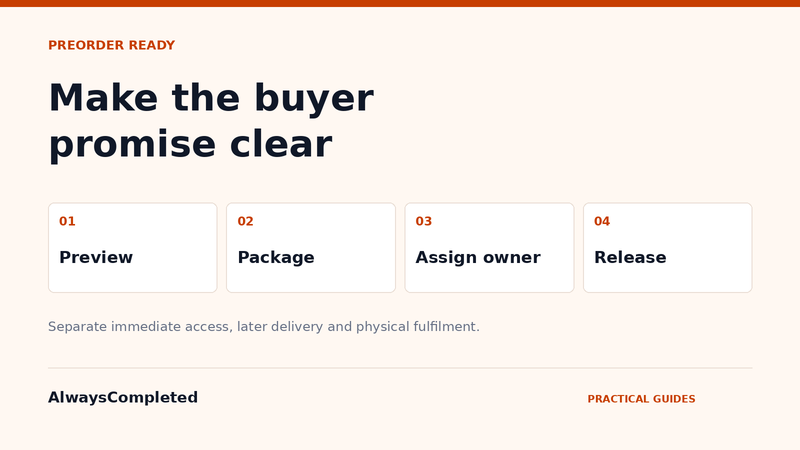
Bandcamp Preorder Readiness: Preview Tracks, Packages and Release Controls
A Bandcamp preorder is a promise about access and delivery. Before promoting it, be able to explain what the buyer receives immediately, what arrives later and who will complete the release action. If a physical item is involved, its fulfilment promise needs its own clear record.
A future date and attractive artwork do not finish that work. The campaign destination must match an offer the team can explain and maintain throughout the preorder period.
This guide includes three fictional acceptance sheets: a digital album, an album with vinyl and a one-track album configuration. Public Bandcamp documentation was reviewed on 26 November 2026. No purchase, account setup or fulfilment test was performed for the examples.
Download the preorder acceptance sheet, three DEMO offers and release-day handoff
Decide whether a preorder fits the release
Begin with the reason a listener would choose the offer now. Perhaps existing fans want to reserve a physical edition, or the artist has an approved preview and a clearly scheduled full release. Write that proposition plainly, without projecting demand you have not measured.
A preorder also creates work: maintaining the offer, answering customer questions, managing any production changes and completing the final release. Assign owners for those tasks before commissioning a campaign around the page.
If the recording or package is still too uncertain to describe accurately, the immediate task is to resolve the offer. You can prepare creative while holding the purchase invitation. That decision is more useful than publishing a vague “coming soon” claim beside an unclear checkout.
Confirm the release object and immediate tracks
Bandcamp's preorder guide uses an album object with selected tracks available immediately. Standalone tracks do not have the same preorder workflow, although an album can contain a single track. The guide also requires an explicit final release action: select release pre-order now and then Update.
Record the exact object and track list in your acceptance sheet. For each track, identify the approved audio version and whether it belongs in the immediate offer or the later full release. The reviewer should compare the intended plan with the actual public page, rather than assuming all uploaded audio is exposed in the same way.
The preview should support the message used in promotion. If the invitation highlights a particular song, check that the listener can encounter the promised preview or understands that it becomes available later. Avoid using an excerpt from an unapproved mix simply because it is already in a shared folder.
| Offer question | Evidence to collect | Decision before promotion |
|---|---|---|
| What can a visitor hear now? | Actual page observation and approved preview plan | Is the invitation accurate? |
| What does a preorder buyer receive now? | Saved offer and available delivery evidence | Are immediate benefits clearly described? |
| What arrives at full release? | Final track list and release plan | Is the later promise specific and achievable? |
| What physical item is included? | Package description and fulfilment owner | Are product and delivery statements approved? |
| Who completes the release? | Named operator, backup and checklist | Is the final action owned? |
Give physical fulfilment its own acceptance decision
Bandcamp documents linking a music package, such as vinyl, to the corresponding album so the digital preorder is associated with that purchase. It distinguishes this from non-music merchandise. Check the correct album relationship in the actual package setup; do not infer it from matching artwork.
Then review the physical promise separately. The digital album becoming available does not demonstrate that a record has been manufactured, packed or dispatched. Record the package version, fulfilment contact and approved wording for expected dispatch. If the date is an estimate, keep the wording consistent with that status.
In the fictional vinyl example, the team has a planned digital release but no confirmed dispatch statement. The acceptance decision is to hold the physical-purchase campaign until the responsible person approves that statement. The worksheet does not fill the gap with a plausible manufacturing deadline.
Check the invitation from a buyer's perspective. Does “preorder the album” lead to a digital purchase, a physical package or a choice? If different options have different delivery promises, the page and creative should make that distinction understandable.
Treat codes as a separate early-access route
Bandcamp's code guidance says redeemed preorder codes provide access to the entire album, not just the preview tracks. A reviewer code therefore needs a different approval from a public preview link.
Before sharing codes, identify who may receive early access and who approves it. Do not put active codes into a general press document or public acceptance sheet. The operational record can reference a controlled inventory without exposing the redeemable values.
The Bandcamp code tracker covers issuance and redemption records. Use it alongside this offer checklist: the tracker manages who received a code, while the acceptance sheet explains what access that code grants during the preorder.
For promotional materials, distinguish public page, private review access and purchased access. A link that is appropriate for a trusted reviewer is not automatically the right destination for an advertisement.
Assign the final release action and backup
Put a named operator and backup in the release plan. Include the approved release moment and time zone, the exact album and the checks that must pass before activation. Do not let an announcement calendar stand in for an operational handoff.
The operator should know where the approved final files and metadata are recorded. If a last-minute correction arrives, identify who decides whether to proceed, revise the offer or change the announcement. A release action should not depend on somebody interpreting an ambiguous message in a group chat.
Record the observed state after the action as well as the action itself. Confirm the intended full-release content and public purchase route. If the team expects a particular buyer notification, retain the relevant platform confirmation or authorized observation rather than claiming every email reached its recipient.
A future date in a worksheet is a plan; the saved platform state and resulting offer are evidence. Keep those categories separate in the release log.
Use the three example offers to expose missing decisions
The download demonstrates different acceptance questions:
- Digital album: the track list and preview decision are approved, but the final operator must still complete the release handoff.
- Album plus vinyl: digital access and physical dispatch are reviewed independently; unresolved fulfilment wording keeps the physical offer on hold.
- One-track album: the team confirms the album configuration and explains why a visitor sees one recording, without implying extra tracks are included.
Each example contains test-evidence fields and explicit unknowns. None is labelled as a successful purchase or a working live page. Replace the examples with observations from your own offer before treating the sheet as approval.
Match promotion to the accepted offer
Write a concise destination brief containing the public URL, primary buyer action, immediate benefit, later delivery and owner for changes. Give creative reviewers the same record. This prevents a caption, landing page and package description from drifting into three different promises.
The AlwaysCompleted music release page describes preparation and Send Promo scope, while the advertising page explains destination and channel checks. Neither establishes that a specific Bandcamp preorder campaign is included. Confirm that the selected current listing accepts the intended URL and ask technical support about any uncertain deliverable.
Approve promotion when the offer is understandable and its outstanding questions have owners. If the buyer promise changes later, update the acceptance record and the affected creative together. That keeps a preorder campaign coherent from the first invitation through the actual release and any physical fulfilment that follows.
