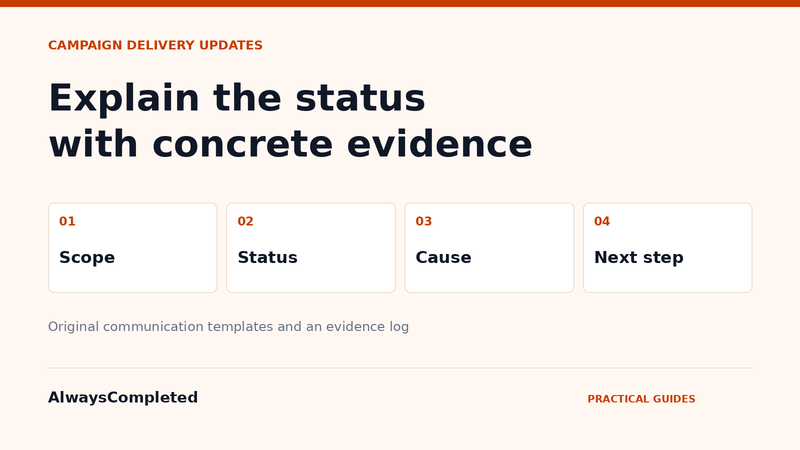
How to Explain Delayed or Partial Campaign Delivery
A useful campaign-delay update tells the client what you can verify, what remains unresolved and when you will communicate again. It should let them make a practical decision without turning an estimate into a promise. You can commit to an update you control even when you cannot confirm a delivery date.
This guide includes four original English message templates: an expected start, a delay, partial delivery and an inaccessible target. Use the editable template pack, plain-text messages, pre-send checklist and internal fact record. All sample quantities, dates and situations below are fictional. Preparing a draft does not contact a client or technical support.
Start with the decision the client needs to make
“We are checking” can be accurate and still leave the client unable to plan. A release manager may need to decide whether to change an announcement. An agency contact may need a factual line for an internal meeting. A client with an incorrect destination may need to confirm one URL before anything else can happen.
Ask yourself what the next useful decision is. Then build the update around the minimum information needed for that decision. A timing question needs the agreed estimate and current evidence. A quantity question needs the exact unit and source. An access question needs the observed problem and the detail that will resolve it.
Avoid an operational diary. The client does not need a sequence of internal handoffs or speculative explanations. Describe the relevant work as a review with technical support when that is accurate. Keep internal procurement references out of routine client copy, while preserving a complete internal record. Do not invent an outage, platform restriction or reason for a delay because it sounds plausible.
Create a fact record before drafting
Open the approved brief and the current order record. Record the client reference, exact deliverable, target, quantity, relevant condition and last checked time with its timezone. Keep the accepted version of the offer; a changing catalogue description should not silently replace what the client approved.
The AlwaysCompleted reseller guide recommends retaining the agreed service, destination, metric, quantity, price and conditions, together with dated revisions. Use that record as the starting point for the conversation. A previous quote does not authorize an additional order or a replacement campaign.
Separate three kinds of information:
| Type | Fictional example | Appropriate client wording |
|---|---|---|
| Confirmed observation | The record shows In progress at 14:00 UTC | “Delivery was recorded as in progress at our latest check.” |
| Estimate or expectation | The saved description gave an estimated start window | “The stated start window was an estimate; a revised time is not confirmed.” |
| Unresolved question | The public counter differs from the reported quantity | “We are checking the difference between the reported quantity and the target observation.” |
An observation needs a source and a time. An estimate needs its qualification. An unresolved question should remain a question until evidence resolves it. This separation makes a short message easier to write because you are no longer trying to make one sentence perform all three jobs.
The order acceptance log provides a fuller record for repeated checks. Preserve earlier observations when a new one arrives. If a previous update was wrong, correct the specific claim and explain what the newer evidence establishes.
Distinguish a delivery deadline from an update time
“I will update you tomorrow at 15:00 UTC” is a communication commitment. “It will be finished tomorrow” is a delivery claim. Only use the second statement when the available evidence and applicable agreement justify it.
Choose an update time that a named person can meet. Set it before sending the message and include the timezone. If you work across regions, use a full date as well as a weekday. “Tomorrow morning” creates unnecessary ambiguity when the sender and client are in different places.
For example, a fictional order has not started at a 26 November checkpoint. No revised start time is confirmed. The owner can say, “I will send the next update by 27 November at 12:00 UTC, including any new confirmation or the question still awaiting an answer.” That promise can be kept even if the delivery question remains open.
At the checkpoint, send a substantive update. Identify what was checked, whether the status changed and what remains unknown. Repeatedly moving the same promised completion date without evidence makes the record less reliable. A continuing unknown should be stated plainly.
Template 1: explain the expected start
Use this when the client asks about an order that is within its documented expected-start context and there is no confirmed failure or missed guarantee. Check the actual stage before choosing the wording. Do not say work has begun solely because the order was submitted.
Subject: Start update for [campaign/reference]
Hi [name],
I checked [deliverable and target] at [date, time, timezone]. The current record shows [verified status or observation]. The agreed start information is [accurate estimate or expressly confirmed condition]. We do not yet have a confirmed [start/completion] time beyond that information.
[Owner] will check again and update you by [date, time, timezone]. [One relevant action, or “No action is needed from you at this point.”]
Thank you, [name]
Replace the bracketed start information with the actual wording applicable to the order. If the record only establishes submission, say submission. If a confirmed problem has already been identified, use the delay template instead of presenting it as ordinary waiting.
Template 2: explain a delay without inventing a cause
Use this when the latest record differs materially from the expected progress or an agreed milestone has been missed. Recognize the planning impact. Give the cause only if it is established and relevant; otherwise describe the observed delay.
Subject: Delivery update for [campaign/reference]
Hi [name],
[Deliverable] has not reached [expected stage] as of [date, time, timezone]. I understand this affects [known planning need]. The verified position is [brief observation]. A revised [start/completion] time is not yet confirmed.
[Accurate action already taken or action you will take, with its owner and time.] I will update you by [date, time, timezone], even if the timing question is still unresolved. [Include a specific available option only after its conditions have been checked.]
Thank you, [name]
“Technical support is reviewing the timing” belongs in the message only when that review has actually been requested or confirmed. Before a request, use “I will ask technical support to review the timing by…” and make the commitment achievable. Do not change a planned action into a completed action to make the message sound more reassuring.
The ordering FAQ describes timing as service-dependent and generally estimated unless expressly guaranteed. It directs material delays to technical support with the order ID. A duplicate order is not a substitute for investigating the original issue.
Template 3: explain partial delivery with a clear unit
A partial-delivery update should identify what was ordered, what the record reports and what remains unresolved. Keep units consistent. Do not describe reported activity as unique people, sales, retained followers or another outcome that the order does not establish.
Consider a fictional order for 1,000 units of a defined activity. The order record reports 650 delivered and 350 remaining. Separately, the target counter has increased by 620 since the saved baseline. These observations differ by 30, but the difference does not establish its cause. Reporting delay, concurrent activity and incompatible measurement scope must be checked, not assumed.
| Fictional record | Value | Meaning |
|---|---|---|
| Ordered quantity | 1,000 units | Agreed quantity for the specified activity |
| Reported delivered | 650 units | Quantity reported by the order record |
| Reported remaining | 350 units | Remaining quantity reported in that record |
| Observed target change | +620 units | Difference between compatible target observations |
| Difference requiring review | 30 units | Reported quantity minus observed change; cause unconfirmed |
Do not quietly replace 650 with 620 or treat either value as independent proof of attribution. Keep the separate sources in the internal record, then communicate the distinction if it matters to the client’s decision.
Subject: Partial-delivery update for [campaign/reference]
Hi [name],
The order for [quantity and exact unit] is recorded as partially fulfilled at [date, time, timezone]. The record reports [delivered quantity] delivered and [remaining quantity] remaining. [If relevant, state the separately observed target value and its limitation.]
We have not confirmed [specific unresolved outcome or calculation]. [Owner] is [verified next action]. I will update you by [date, time, timezone] with the confirmed outcome or the remaining question. [Include any remedy only if its availability and status have been verified.]
Thank you, [name]
The FAQ explains that a Partial label is not evidence that the original deposit has returned to a payment method. Avoid financial promises based on the status label alone. Refer questions about the actual handling to the applicable terms and confirmed order outcome.
Template 4: ask for one missing access detail
Use this when the agreed target cannot be verified or accessed in the required way. State what you observed without blaming the client. Ask for the smallest detail that can resolve the uncertainty. A broad request to “check everything” tends to create a long exchange without establishing the destination.
Subject: One detail needed for [campaign/reference]
Hi [name],
At [date, time, timezone], [approved target] showed [specific observed issue]. I cannot yet confirm [the required access or exact destination]. Please confirm [one specific URL, item or access detail].
[Owner] will review your reply and confirm the next step by [agreed response checkpoint]. Please coordinate any change to the active target with us so the existing record can be checked. We have not confirmed a new delivery time while this detail remains unresolved.
Thank you, [name]
For an apparently incorrect URL, ask the client to confirm the exact intended item. Do not silently substitute a profile for a post or a different recording with a similar title. For an access issue, record what was actually visible: a login requirement, unavailable content or an unconfirmed destination. An observation from one context does not establish a platform-wide outage.
Keep passwords and unrelated personal information out of the request. The purpose is to identify the target and its required availability. If changing an active destination would affect the review, coordinate that change before treating the replacement as approved.
Offer only options that apply to this record
Cancellation, refill and other follow-up options have conditions. The FAQ makes clear that availability depends on the service and stage, and a submitted request is not a completed result. Check the specific record before including an option in client copy.
For example, “A cancellation request is available for this order; would you like us to submit it?” describes a verified request route. It does not promise approval. “The order is cancelled” requires confirmation of that outcome. Keep the distinction visible in your internal status and client update.
If the client asks for a new purchase, different target or revised scope, record the changed instruction and obtain the authorization needed for that work. Do not infer it from frustration about the existing delay. Keep the investigation and any newly approved work distinguishable so quantities, costs and responsibility remain clear.
Where the answer depends on contractual rights or a disputed calculation, refer to the applicable agreement and appropriate review. These templates are communication aids; they do not create a second set of cancellation or refund policies.
Run the pre-send check and keep the conversation useful
Read the draft once as the person who must act on it. Can they identify the campaign, understand the present position and find the next update time? Remove a sentence if it only repeats reassurance without adding a fact, question or action.
- Match the recipient and campaign reference to the correct record.
- Check the exact target, quantity, unit and observation timestamp.
- Keep reported values distinct from independent observations.
- Retain qualifications on estimates and unresolved causes.
- Verify every statement that an action has already occurred.
- Include only applicable options, with request and outcome kept separate.
- Assign one owner and a realistic, timezone-specific update checkpoint.
- Remove all placeholders and unnecessary internal details before sending.
The downloadable checklist leaves every result unreviewed. Mark a check passed only after examining the real record. A completed template is a draft until a person has checked the recipient, facts and commitments.
After sending, retain the exact message and time in the campaign record. At the next checkpoint, add the new evidence, state what changed and close only the questions actually resolved. The client should be able to follow the sequence without interpreting an uncertain date as a guarantee or a partial result as a completed campaign.
