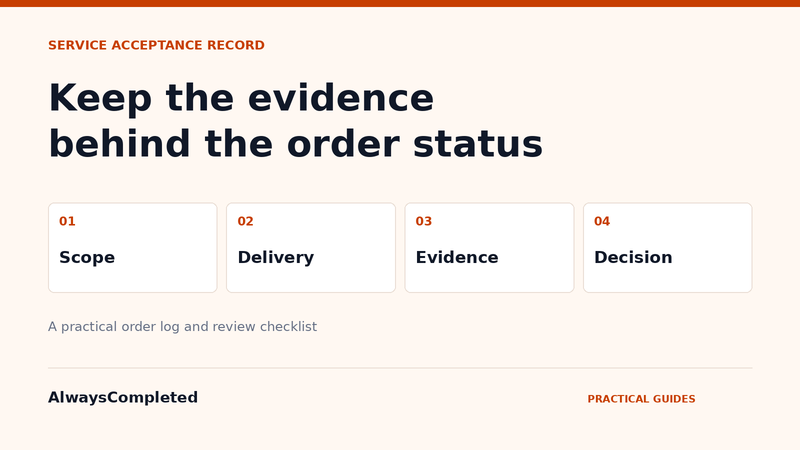
SMM Service Acceptance Checklist: Keep a Reliable Order Log
Accept a promotion order by comparing the saved service conditions with dated delivery evidence. Keep the ordered quantity, the dashboard status and your own observations in separate fields. A screenshot of a changed counter is useful evidence of the counter at that moment; it is not a complete record of what was purchased or what caused the change.
A reliable log should let a second person reconstruct the review without asking you to remember the original listing. It should also preserve an unresolved difference instead of forcing every order into a successful or failed category before the evidence is sufficient.
Use the original blank order register, append-only observation log, two fictional order records and worked observation history. The review checklist and support-note template explains the fields and contains a reusable message draft. No real orders were placed or examined to create these examples.
Save the service ID and the description version
Start the record before submitting an order. Copy the service ID, service name, exact metric, unit, accepted target type and the conditions that affect delivery. Save a dated description snapshot or an internal reference to it. A link to the current catalogue is useful, but a changing page does not preserve the version you reviewed.
Keep the source as well as your summary. If a listing says a timing is estimated, your summary should retain that qualification. If a condition is absent, write “not stated in saved description” instead of filling the gap from another service with a similar name.
AlwaysCompleted's reseller guide calls for retaining the service, destination, metric, quantity, quote and agreed conditions. It also distinguishes a previous client quote from authorization to repeat the order. The register below turns that recordkeeping principle into a review workflow; it does not change any service terms.
For an agency, preserve the relationship between three references: your client brief, the selected service and the submitted order. One client package can contain several services, and a single service order does not establish completion of every part of that package. Keep your creative work, reporting work and ordered platform activity identifiable.
Record the actual unit
“Quantity 500” is incomplete. Record 500 of what, on which target, under which measurement definition. A follower count, a video view, a website visit and a delivered file are different units. Do not compare them merely because each appears as a number.
If the description and the available report use different definitions, identify the difference before accepting the comparison. You may need clarification about the supplied evidence. A field named “delivery” does not by itself establish whether the value is a requested quantity, a provider report or an independent observation.
Record the accepted link, quantity and timestamps
Open the exact destination and confirm that it identifies the intended item. Preserve the submitted URL separately from the final URL observed after any redirect. Record the target's stable identifier where the service exposes one, so a later name or display change does not make the record ambiguous.
Take a baseline before submission when a relevant counter is visible. Note the source, time, timezone, account or access context and displayed precision. “1.2K” is a rounded display, not an exact observation of 1,200. Do not subtract it from a later precise number and report an exact delivery difference.
Use timestamps with an explicit offset, such as 2026-11-23T10:00:00+00:00. If the dashboard displays a different timezone, retain that original value and document any conversion. A start observed on one calendar date in one timezone can appear on another date elsewhere.
The ordering FAQ asks users to check the exact destination, maintain required access and avoid overlapping orders for the same metric and target unless the service permits them. These conditions help preserve a reviewable record. Log any relevant concurrent activity instead of treating the target as an isolated experiment.
After submission, add the actual order ID and the confirmation time. Record what was submitted, even if it differs from the approved brief. Preserve corrections as dated revisions with their reason and approval; do not silently replace the original value.
Keep ordered and observed delivery in separate columns
The order register holds the agreement and latest review state. The observation log holds the history. Add a row for each check rather than overwriting the first screenshot reference with the newest one.
| Field group | What belongs there | What to keep separate |
|---|---|---|
| Agreement | Service ID, description version, metric, unit, quantity and accepted destination | A later catalogue description |
| Submission | Actual order ID, submitted URL, submission time and client reference | An unsubmitted draft or planned order |
| Dashboard observation | Exact status and any available quantity fields at the capture time | Your interpretation of the status |
| Target observation | Counter or other relevant evidence, source, precision and timestamp | An assumed quantity caused by the order |
| Conditions | Saved timing, access and follow-up requirements | Unstated promises borrowed from another listing |
| Review | Check result, unresolved question, owner and next review time | Marketing effectiveness or future reliability |
Suppose an exact counter rises from 1,200 to 1,700. The observed net change is 500. That arithmetic is correct when the same counter and target are compared, but the result still describes a net change. Other activity, removals, reporting delays or measurement definitions can affect its relationship to the order.
If the provider separately reports 500 units, retain that as a provider-reported value with its source. Agreement between two values is useful; it does not transform both into an independently attributed count. Write the conclusion at the level the evidence supports.
The example CSV contains a net-change column for readable, exact counters. It leaves that field blank where subtraction is not meaningful. The files contain no automatic connection, live fetch or hidden inference; users enter and review the values themselves.
Read the status without making it the whole conclusion
AlwaysCompleted's FAQ describes Pending as queued, Processing as preparation, In progress as delivery begun, Completed as recorded completion, and Partial as partial fulfilment. Canceled or Cancelled indicates that the order or an identified remainder will not continue. Copy the actual status you see; the guide qualifies these descriptions for places where those labels are used. Source: order-status definitions.
Keep your review state in another field. Suggested internal values are Not reviewed, Review in progress, Recorded checks matched, Open question and Follow-up required. These are original log labels, not additional AlwaysCompleted dashboard statuses.
A Completed label and conflicting evidence can coexist in the record. Preserve both and identify the exact question requiring support. Equally, an early counter check that differs from a still-active order is not a final shortfall finding. Record the stage, timing and limitations before drawing the conclusion.
“Recorded checks matched” should state its boundary: which conditions were checked, which evidence was used and what remains unverified. It is an operational conclusion about the recorded review, not a certification that every marketing outcome has been achieved.
Check the stated conditions against the evidence
Work through a short acceptance review using the description version saved for that order. Assign each check Pass, Needs review, Not checked or Not applicable. A missing source should remain Not checked, rather than being recorded as a pass because nobody has reported a problem.
- Identity: the order ID, service ID and target correspond to the submitted record.
- Scope: the metric and units match the agreed service and the available evidence.
- Quantity: ordered, provider-reported and observed values remain separately labelled.
- Timing: capture times can be compared with the actual stated timing and current order stage.
- Access: relevant changes to the target's visibility, URL or other required settings are recorded.
- Conditions: the saved follow-up terms are identified without assuming unsupported coverage.
- Evidence: source references are available to the people reviewing the issue.
- Decision: the conclusion, limitation, owner and next action are explicit.
Do not make a service-specific contractual judgment from a generic checklist. The log organizes evidence for the applicable conditions. It is not a substitute for checking the purchased description and receiving clarification on an unresolved claim.
Two fictional records with different conclusions
The service IDs, order IDs, targets, counts, terms and observations below are invented teaching data. They are not catalogue entries, completed customer orders or evidence of future service reliability. Example URLs use example.com and do not identify a real platform target.
| Record | Saved fictional request | Dashboard and target observation | Bounded review conclusion |
|---|---|---|---|
| DEMO-A | 500 units of the same defined public video counter; exact baseline 1,200 | Dashboard Completed; provider-reported 500; target 1,700 at the review time | Recorded quantity checks match at this checkpoint; causal attribution and marketing effect are not established |
| DEMO-B | 300 units of another defined video counter; exact baseline 600 | Dashboard Partial; provider-reported 200; remaining 100; target 790 | Provider reports partial fulfilment; target net change is 190; source difference remains open |
DEMO-A: a matching checkpoint does not end the history
The fictional order is submitted on 22 November at 09:00 UTC. At the 23 November review, the same exact counter reads 1,700. The record preserves the 500 net increase, the separately reported 500 units and the Completed status. The reviewer marks the recorded quantity checks matched at that time.
At a planned 25 November follow-up, the counter reads 1,680. The observation log adds a new row: a net increase of 480 from baseline and a decrease of 20 from the previous capture. The earlier row remains unchanged. The latest review becomes Follow-up required because the meaning and relevant coverage of the change need clarification.
The reviewer does not label the change an automatically approved refill, a failed guarantee or a loss of 20 unique people. The fictional description refers to selected-service follow-up conditions without supplying enough detail to decide eligibility. That unresolved condition stays visible and the record identifies a question for support.
This illustrates why an acceptance date should be a checkpoint rather than a claim that the observed state will remain unchanged. A subsequent observation can justify reopening a review without rewriting the evidence available at the original decision.
DEMO-B: keep the partial report and the counter difference visible
The fictional provider report says 200 delivered and 100 remaining against the 300-unit request. The target's net change is 790 minus 600, or 190. The record keeps 200 as provider-reported delivery and 190 as the observed target change. It does not silently adjust either value to make the row reconcile.
The difference of 10 is a measurement question. It could require checking scope, reporting times or intervening target changes; those are possible explanations, not findings. The support note asks which evidence and conditions explain the discrepancy and how the remaining portion is handled.
The log does not declare a refund, a cancellation or an approved follow-up from the status alone. It records the support reference, the question sent and the next owner. Any response is appended with its time and evidence, including an unresolved answer if that is what the record supports.
Schedule repeat checks around a reason
Choose follow-up times that serve a defined question: has the stated processing window elapsed, has an investigation produced a response, or is a permitted follow-up condition ready to assess? Save the reason beside the planned time. There is no universal interval in this template that proves a service is reliable.
Keep the observed metric and method comparable across checks. If a counter becomes hidden or rounded, mark the comparison unavailable. If the target changes, record the change and its effect on what can be concluded. Avoid inventing a continuous series by interpolating missing observations.
For repeat orders, compare records only after checking their scope, description versions, targets, timing and evidence quality. Two superficially similar service names can describe different conditions. Even a clean set of historical records does not guarantee the next order's timing or outcome.
The log's purpose is operational learning: identify recurring questions, improve the information preserved at submission and recognize which checks cannot currently be performed. A campaign's value to the business requires a separate assessment of relevant audience and outcomes.
Write a support question that can be investigated
A useful support note contains the order ID, exact service and target, saved condition, relevant timestamps, separate reported and observed values, and a precise question. Include concise evidence references. Avoid exposing unrelated client conversations, account credentials or private records that are unnecessary for the review.
For DEMO-B, the template might read:
Fictional example only. Order DEMO-B, service EXAMPLE-S02, target https://example.com/video-b. The saved request is 300 units. At 2026-11-23T12:00:00+00:00, the dashboard shows Partial, with 200 provider-reported units and 100 remaining. Our exact target counter changed from 600 to 790 between the attached captures. Please clarify the measurement scope and the handling of the remaining portion under the saved service conditions. Evidence references: B-description-v1, B-dashboard-01, B-target-00 and B-target-01.
This note states the difference without pretending to have established its cause. The downloadable draft adds fields for the response, next owner and review time. Preparing the template does not submit a ticket or authorize a duplicate order.
Questions to settle before closing the record
What evidence should I keep?
Keep the description version, submitted details, order ID, source-specific observations and dated review decisions. Retain enough context to interpret screenshots: target, metric, precision, period and capture time. Keep the evidence in an appropriate internal location and share only what the reviewer needs.
Does an accepted order prove future reliability?
No. It describes the checks completed for that order at the recorded time. Repeat observations can improve your understanding of the process, but they do not establish a guarantee, a future result or the marketing effectiveness of the activity.
How should I record a partial or disputed delivery?
Keep the dashboard's exact status, ordered quantity and available reported fields. Add your observations separately, state the unresolved question and preserve support references. Do not replace an unknown explanation with a guessed cause or a remedy that has not been confirmed.
Start with one order record and one baseline observation. The existing SMM panel guide covers broader selection and planning; this log gives the actual delivery review a stable record. Complete the review before using its result in a client update or a decision about another order.
