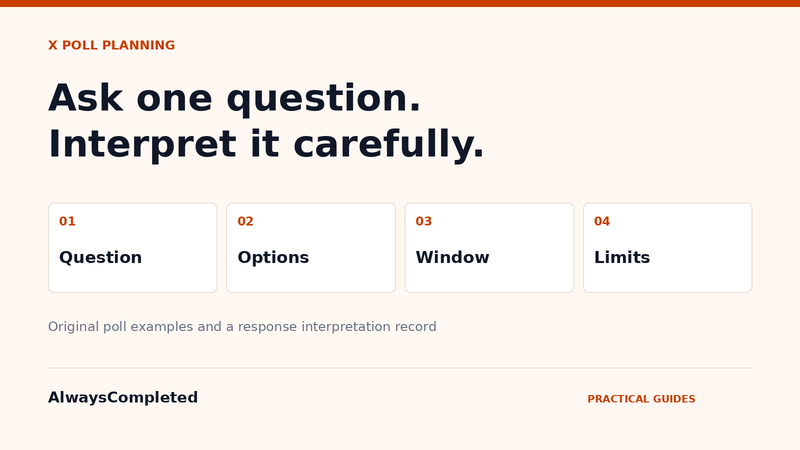
X Poll Design: Ask a Useful Question and Report the Limits
Use an X poll to inform a small editorial choice: which explanation to prepare next, which format to try or which of several stated times suits the people who choose to respond. Write the decision first, then a neutral question and distinct options. Before publishing, decide how you will describe the result without turning voluntary votes into a claim about the whole market.
A poll can make a content decision more concrete, but its meaning depends on the wording, options, exposure and response window. “Our audience wants this” is often much broader than the evidence. A more defensible conclusion names the actual poll and explains the limited next action it supports.
The downloads include an original design and reporting worksheet plus six complete weak-to-improved question pairs. Every example is DEMO. No poll was published and no votes, percentages, respondent identities or campaign results were collected. Numerical result fields are deliberately empty.
Choose a decision small enough for the evidence
Start with a reversible content decision the team can act on. Choosing the next tutorial topic is more suitable than treating a quick poll as proof of product-market demand or willingness to pay. The question should help prioritise work already within the team's ability to deliver.
Write the action rule in advance. For example, the team may consider the most selected of four tutorial topics for its next draft, while also checking whether it has the expertise and evidence to explain that topic well. This is a planning input, not a commitment to obey a vote regardless of feasibility.
State what the poll will not establish. A preference for a short video does not prove that the same people will watch it, complete it or buy a service. A preferred start time does not equal a confirmed booking. Keep those later behaviours separate from the choice people make in the poll.
Buffer describes polls as a way to gather quick ideas about themes and formats. Use that limited editorial role rather than describing the result as a representative customer survey. The workflow here adds a written decision boundary and reporting record to make that distinction practical. Buffer's X guide
Ask one neutral, answerable question
Replace a broad prompt such as “What content do you love?” with a question tied to the next task. “Which of these topics should our next desk-setup tutorial cover?” makes the available decision clear. The answer can change the topic without pretending to describe every person's general content preferences.
Remove wording that pushes respondents towards the answer the brand prefers. “Do you want our amazing new guide?” combines a judgement with the question. Ask which question the next guide should answer, or whether a specifically described resource would be useful, without praising it in the prompt.
Avoid asking two things in one option. “Cheaper and faster” does not tell you which attribute mattered. “Video tips” can overlap with both “video” and “tips.” Keep each response attached to a single clear meaning, with comparable wording across the options.
Pew Research Center's questionnaire guidance emphasises clear, specific questions and response categories that do not overlap. It also explains that wording, the options offered and their order can affect responses. Those principles help improve a small platform poll, but they do not make its participants a random sample. Pew: writing survey questions
Fit the choices to current X limits
X's current Polls Help allows up to four choices, with up to twenty-five characters per option. The duration can be set from five minutes to seven days and defaults to one day. Check the draft in the actual composer before publication, especially after shortening wording to fit. X: Polls limits
Short labels should remain understandable. “Dims” may save characters while leaving the reader unsure whether you mean product dimensions or dimming a lamp. Use ordinary words when they fit, and revise the question itself when an option needs too much explanation to make sense.
Decide whether “None of these” is necessary. It is useful when respondents may reasonably reject every offered time or topic. In a narrow prioritisation question asking specifically which of four planned resources should come first, the limited set can be explicit in the wording. Do not force an apparent positive preference when the actual question requires room for no suitable option.
X also says photos cannot be included in a poll. If the decision depends on visual context, do not write as though images will automatically sit inside the poll. Provide a clear, accessible context in the available publishing route and verify what the voter can actually see, or choose a self-contained text question. X's poll creation note
Use the six rewrites as design exercises
The first DEMO replaces mixed content formats with four desk-setup topics: cable routing, lamp placement, screen position and storage layout. These are different subjects for the next tutorial. The question no longer mixes “video,” “Reels” and “tips” as if they were comparable alternatives.
The second asks for one primary format for a song breakdown: text-only post, short video, live audio Q&A or annotated image. The task is format selection, so the options stay at the same level. It does not infer that choosing live audio proves a willingness to attend a scheduled event.
The time-choice example identifies a specific fictional date and the UTC time zone. It offers three actual start times plus “None of these.” A choice such as “weekends” would not be comparable with “17:00,” and “evening” would mean different things to people in different places.
The remaining pairs cover a pricing explainer, a product comparison and a companion resource for a release-planning guide. Each includes the weak wording, why it fails, a complete improved question, four counted options and a bounded next decision. No example has a manufactured winning result.
Record exposure and timing
Save the publishing account, exact question, ordered options, start time, end time and time zone. Record where the poll was shared and any known activity that could change who encountered it. A poll seen mainly by one existing community does not describe everyone who might eventually buy a product.
Choose the response window around the decision and the intended context, not a supposed universal best duration. A short window may exclude people who are unavailable at that time. A longer window can include a different mix of exposure and events. Neither choice removes voluntary participation or guarantees a useful number of responses.
Do not infer individual preferences from public replies. X says neither the creator nor other participants can see who voted or how each person voted. A person commenting under the poll may not have voted, and an account following the publisher does not establish the identity or characteristics of a voter. X: private voting
Keep a copy of the final draft before publication. X's Edit Post Help excludes polls from editable post types, so do not depend on correcting a confusing live question through ordinary post editing. If a substantive problem is discovered, document it and decide whether the result is still usable for the narrow question. X: Edit Post exclusions
Separate independent preference from commissioned activity
If the purpose is to learn what voluntary participants prefer, keep commissioned votes and technical tests out of that evidence. A service deliverable or a coordinated test does not become an independent audience preference just because it appears in the same aggregate total.
Record any known contamination. If independent responses cannot be distinguished from commissioned or test activity, do not invent a corrected total by subtracting a guessed number. The private voting model also prevents the creator from validating individual votes through a list of named respondents. Mark the research interpretation as unsupported and choose another appropriate way to learn.
The AlwaysCompleted X service guide already distinguishes poll-vote service scope from independent response evidence. This article concerns question design and honest reporting. Ordering votes cannot validate the preference claim the worksheet is intended to investigate.
Keep the decision proportional even when no commissioned activity is known. The participants selected themselves from the people who encountered the poll. That supports a description of this poll's responses, with its limits, rather than a percentage estimate for all customers, followers or people in a market.
Report the wording and the result together
Wait for the actual end if you intend to report a final result. Record the observation time and whether the display was final or still changing. X shows the current total and time remaining during voting and identifies the winning choice after the poll ends. X: viewing poll results
Copy the values the platform actually provides. Preserve total votes, option labels and displayed percentages or counts without inventing unavailable precision. If only a rounded percentage and a total are available for an option, do not present a reconstructed exact vote count as an observed figure.
A useful report says which question was asked, when and where it was published, what was observed and what the team will do next. Include any ambiguity, limited exposure or known test activity that changes the interpretation. A screenshot can support that record, but it does not replace the wording and context.
Do not silently change the question when comparing two polls. A new set of options, different wording or a different audience route can change what the numbers mean. Pew's guidance on trend questions stresses preserving question wording and context when measuring change. Question wording and comparability
Choose the next content action
Use the result alongside editorial judgement. If an option is clearly preferred within the observed responses and the topic is feasible, prepare a draft and review its usefulness. If responses are sparse, close or difficult to interpret, the next action may be a better question or a small content experiment, not a confident declaration of demand.
Keep a later publication's performance separate from the poll. A selected topic can receive few useful responses when published, and a lower-ranked topic can still be valuable to a different audience. The poll chose a starting point; it did not guarantee the outcome of the content.
The social media campaign report template can hold the wider reporting context. Preserve the poll's exact reference and the decision it informed, then record actual follow-up observations under their own dates and definitions. That makes the learning traceable without overstating certainty.
