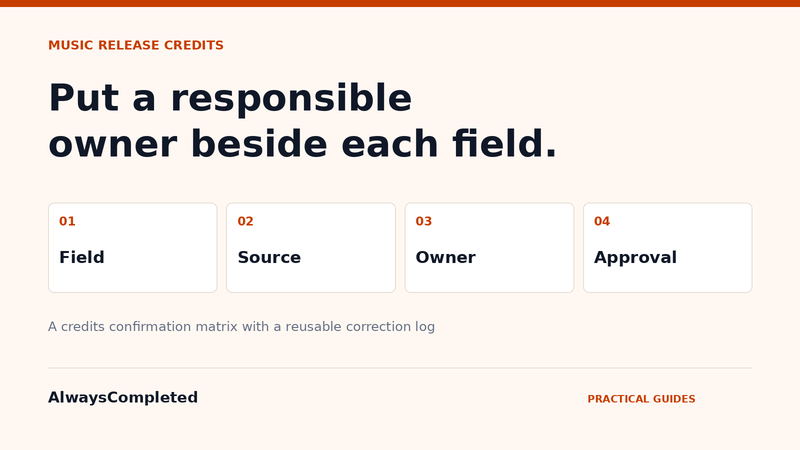
Music Credits Matrix: Who Confirms Each Field Before Delivery?
A music release credits checklist works best when every field has an owner, an approved value and a destination. A shared document saying “credits confirmed” is difficult to audit if nobody knows whether the confirmation covered the artist name, a featured performance, the producer credit or the songwriting entry.
Build the record at field level. Ask the appropriate contributor to confirm the information, map it to the distributor's current form, compare the saved entry with the approval, and check the public result after release. Keep submitted information separate from what a particular service displays. A missing credit on one screen does not establish that the distributor never received it.
The downloadable matrix contains a blank working structure and a three-track DEMO release with a shared act, a guest performer and a production contributor. A separate discrepancy log distinguishes a wrong entered value from a field that is not visible in the current interface. No release was submitted or private distributor account tested for this guide. Public documentation was checked on 26 November 2026.
1. Define the release and track boundaries
Begin with the exact release and its track list. Give each track a stable working reference so that a change in its displayed title does not disconnect it from the credit record. Record the version when two recordings share a title. Do not copy the credits for an original recording into a live take or remix without checking the people involved.
Separate release-level entries from track-level entries. A guest on one song should not accidentally become a guest on the whole project because someone copied the first track's line into every row. A person may also contribute in several ways; those are separate facts to confirm rather than a reason to choose whichever role looks most prominent.
For the fictional three-track EP Rooms After Rain, the shared act is North Window. Track T01 is “Hall Light,” T02 is “Open Window” and T03 is “Last Tram.” Guest performer Mara Bell appears only on T02. Producer Jules Reed works on all three recordings. The example is an editorial model with fictional names, not a release catalogue or a claim that any credit has been accepted.
The working reference T02 links the guest's approval to the exact song and recording version. If the team later changes the running order, T02 should continue to identify that recording in the internal matrix. The public track number can be updated separately after the new sequence is approved.
2. Assign an owner to the fact, not just the upload
The delivery coordinator is responsible for entering and checking information. That does not automatically make them the authority on every contributor's name or role. Ask each contributor, or the person authorised to confirm their information, to review the specific fields that concern them.
Use a compact ownership structure:
| Field decision | Person who confirms the fact | Person who checks the entry |
|---|---|---|
| Shared act name and release identity | Artist's designated decision owner | Delivery coordinator |
| Guest's display name and track scope | Guest or authorised representative | Delivery coordinator |
| Production contribution and spelling | Relevant contributor | Delivery coordinator |
| Songwriting information requested by the distributor | The responsible writer/administrator | Delivery coordinator |
| Mapping into the distributor's available fields | Coordinator, using current documentation | A second reviewer where available |
One person can occupy several positions on a small project. Keep the decisions separate anyway: confirming your name and confirming that the saved form contains that name are different checks. If the person responsible is unknown, mark the field pending and assign someone to resolve the ownership.
Request approval in a form that identifies the row and version. “Please confirm row T02-F01: Mara Bell, guest performer on Open Window, intended Featuring entry” is easier to answer accurately than “Can you check the metadata?” Retain the actual reply and the version reviewed. A changed field needs a new confirmation when the change affects the original approval.
3. Map roles using the distributor's current rules
Your source matrix describes the contribution; the destination mapping describes how the chosen distributor represents it. Keep both. A role label in one distributor's form is not evidence that every distributor uses the same categories or displays them identically.
For CD Baby specifically, its current artist-credit guidance distinguishes Primary, Featuring and contributor roles. A shared act is entered under its shared name rather than adding its individual members as additional Primary artists. A guest on one track receives the track-level Featuring role. Instrumental and production contributions should use their relevant contributor fields rather than being promoted to Primary merely to make them visible.
Apply that distinction to the DEMO: North Window remains the act; Mara Bell is mapped to the T02 guest entry; Jules Reed is mapped to the production contribution on each applicable track. A band member's guitar performance can be represented as a separate performance contribution without making the person an additional primary act. Confirm the available specific role before typing it into the live form.
CD Baby's entry instructions describe different routes for singles and albums, with additional album-track roles entered in Track Information. Songwriting entries are handled in the Songwriter Information section, separately from the performance/production role controls. These are documentary references, not a verified walkthrough of your account.
Do not improvise a second field to compensate for an unclear label. CD Baby's role guidance explains that its songwriter entry is used to generate composer credit on stores. If the current form or a required contribution remains unclear, record the exact question for distributor support before submission. Do not assume a dedicated composer control exists because a different platform has one.
4. Record approved, entered and submitted values separately
Use at least three value columns. Approved source value is what the responsible person confirmed. Saved distributor value is what you can read back after saving. Submitted value/evidence records the state actually sent. These may agree, but agreement is a result to check rather than a reason to merge the columns.
Copy exact spelling from the approved record. Recheck spacing, punctuation, accents and the selected track. A visually similar name is still a discrepancy if it differs from the approved form. Keep role words out of the name field unless the distributor explicitly requires a combined field; do not append “producer” merely to force a visible label.
Give the review a narrow target. Ask the second reviewer to compare the matrix against the saved entries, track by track. They should confirm that the correct value is attached to the correct field and scope, not just read the displayed release title and declare the package ready.
If the form has no suitable field, write “not available in observed form” and record what was inspected. That observation is different from “not required,” “not supported anywhere” or “already delivered.” Ask the distributor which route applies and keep the response with the affected row. Avoid inventing a substitute role that changes the meaning of the contribution.
5. Keep songwriting facts and approvals within their proper scope
The matrix helps collect and verify requested information; it does not decide authorship, ownership percentages, payment entitlement or a private agreement. If those facts are disputed, flag the specific field and the responsible decision owner. A spreadsheet cannot resolve a disagreement by giving one person's preferred value a green status.
CD Baby's naming guidance asks for legal or registered names for songwriter credits, in contrast to the stage names commonly used for artists. Use the distributor's current instructions and the writer's confirmed information. Do not infer a legal name from a public biography or paste private identity documents into a general campaign folder.
The public press-credit list can reference approved display information while the controlled delivery record holds the fields needed for submission. Give contributors the relevant rows to review. A photographer or social editor usually does not need the entire underlying administration file to prepare a release announcement.
In the downloadable example, songwriter-related entries use clearly fictional teaching names. They illustrate ownership and mapping questions without supplying real registrations, identifiers or splits. Actual registration evidence, submission values and storefront observations remain NOT_RUN or unfilled.
6. Distinguish a delivery error from a display question
After release, inspect the exact recording on the chosen service and write what you actually observed. Include the destination URL, date, app or web context, and the place where you looked for credits. If you cannot open the relevant view, record that limitation instead of treating the absence of a screenshot as proof of missing data.
Use the discrepancy log to separate three situations:
| Situation | Evidence to compare | Next useful question |
|---|---|---|
| Saved value differs from approved value | Approval, saved form and submission record | Which correction process applies to this field and release state? |
| Requested role is absent from the observed form | Current form context and distributor guidance | Is another supported entry route available? |
| Submitted credit is not visible on one destination | Submission evidence and exact public view | Was it delivered, and does this service expose it in that view? |
These paths should not lead automatically to the same action. A typo requires a factual correction request. A display question may require clarification before any data change. Repeatedly entering alternate roles to chase visibility can turn an unresolved observation into an inaccurate credit.
CD Baby's add-credit guide warns that roles should be entered before distribution. Its separate post-delivery changes table lists field- and plan-specific exceptions, including limited featured-artist changes, while several producer and songwriter changes are unavailable. Check that current table and obtain support confirmation for the exact case; neither “everything can be fixed later” nor “nothing can ever change” is a reliable rule.
7. Walk through the three DEMO discrepancies
In the first fictional scenario, the approved guest name for T02 is “Mara Bell,” but the assumed saved entry reads “Mara Bells.” The problem is a value mismatch. The next step is to compare the actual saved and submitted states, then use the applicable correction route. Until that evidence exists, the example cannot claim that a real correction was submitted or accepted.
In the second scenario, a coordinator cannot locate a suitable role in the form they inspected. The approved contribution still exists in the source record. The next step is to document the form context and ask a specific mapping question. Marking the row “delivered” would be inaccurate; deleting the contribution would discard useful source information.
The log also provides a third, separate display scenario: a producer credit is assumed present in a submission record but not visible in one checked storefront view. The question concerns delivery/display evidence. It is not proof that the producer was omitted everywhere. All three scenarios are teaching assumptions with real evidence fields deliberately blank.
8. Approve the complete package and preserve the record
Before delivery, check every essential row for a confirmed source value, a valid destination mapping, a verified saved entry and a named owner for anything unresolved. Record the version approved for submission. If a contributor's change arrives afterward, add it to a discrepancy record so the team can determine what has actually been sent and what remains possible.
Use the music release asset handoff template for the broader package of audio, artwork and records. If the same music is also uploaded to Audiomack, the Audiomack metadata checklist covers that destination's separate saved-upload checks. Completing one destination does not verify the other.
When preparing an AlwaysCompleted music release service, supply the approved information requested by the exact listing and clarify gaps with technical support. The credits matrix is your coordination tool; it does not turn a promotion or submission listing into distributor metadata administration. Keep the contributor approvals, distributor delivery and service-order deliverables as distinct records.
