Bandcamp Track and Album Codes: A Small-Campaign Redemption Log
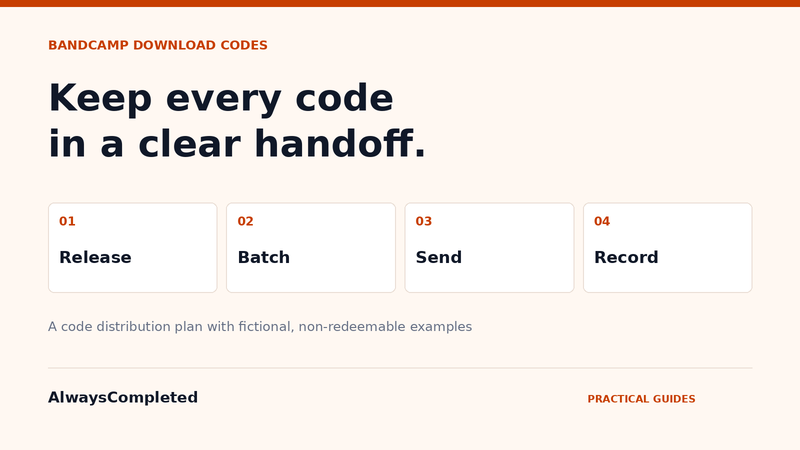
A useful Bandcamp download codes tracker answers three separate questions: which codes exist, which have been sent, and which have been redeemed at a recorded check. Keeping those states separate prevents duplicate assignments and gives a small artist team a record it can reconcile. It does not turn code redemption into a listening or fan-retention metric.
Bandcamp now calls these track/album codes. Its current tutorial describes unique codes that provide digital access to a track or album. This guide uses the familiar “download codes” search term alongside that current name.
The downloads contain eight deliberately invalid example codes, a blank inventory and a workbook with working counts. They are original teaching materials. No codes were generated, sent or redeemed for this article, and no private Bandcamp account was inspected. Public documentation was checked on 26 November 2026.
Download the inventory and instructions
- Download the editable code inventory workbook
- Download the eight-row INVALID DEMO inventory CSV
- Download the blank inventory CSV
- Download the inventory guide and reconciliation checklist
The CSV files contain data and headings. The XLSX workbook supplies the formulas, filters, status choices and separate DEMO and Blank sheets. The Blank sheet has 100 prepared rows; its initial zeros mean no records have been entered. The eight-row demonstration is a teaching sample, not a statement about the size of a batch that Bandcamp lets you generate.
1. Choose the release and the people who actually need access
Write a short purpose before exporting anything: “Provide the authorized album to reviewers who agreed to receive it,” or “Fulfil a promised download for listeners who requested one.” Name the release, the person responsible for the inventory and the place where the original export will be kept.
Check that you control the material and can grant the access you are offering. If another team member owns the Bandcamp account, have that person confirm the release and route. Do not substitute a similarly named release or a link copied from an older campaign.
Decide what an issued code means operationally. In this template, it means the code was actually sent through the agreed route. Reserving a row for a recipient is useful, but the issued date stays blank until delivery is attempted. A recipient reference by itself is not evidence of sending.
Use a small internal reference such as R001 in the shared working copy. Keep the mapping to a real contact only where the team needs it, with suitable access. Anonymous-looking references can still be linked to people through that mapping; they are not a promise of complete anonymity. The public example contains no real contact information.
2. Give different uses different batch names
Bandcamp’s track/album code tutorial describes naming a batch when generating codes and exporting an inventory as CSV. The batch name is for your records. Use it to preserve the reason a set exists rather than assuming every exported code belongs to one undifferentiated campaign.
A practical convention might be release_ref_press_2026-11 and release_ref_listener_2026-11. These are proposed record names, not required Bandcamp syntax. Make the names stable once work begins. If the purpose changes, document it instead of silently relabelling the original batch.
Save the untouched export separately from the working inventory. Enter or import the code as text so that punctuation and leading characters remain intact. Before proceeding, compare the number of imported records and a few complete code values with the source. A visually similar value is not enough when a character determines access.
The worksheet’s eight INVALID DEMO values cannot be redeemed. Replace them only in a private working copy, or start with the Blank sheet. Never publish a screenshot or downloadable copy containing unused live codes as a campaign example.
3. Assign each unique code once
Bandcamp’s single-code FAQ says track/album codes are unique and single-use. A discount code has a different purpose. Do not send one access code to several people and describe it as a shared campaign link.
Use one inventory row for one code. Before assignment, search that code across the current register and any older register for the same release. The workbook highlights repeated code values within each sheet, but it cannot inspect files you have not imported. Its warning is a useful check, not a complete access-control system.
Assign one person to coordinate sending during a small campaign. If several people help, agree who locks or reserves a row and who records the issued date. Two editors can otherwise pick the same apparently unused code before either saves a change.
After sending, record the date and destination used. If the message fails, keep the history and investigate the delivery problem; do not immediately give the same code to somebody else. A failed email report does not establish whether the original recipient could have obtained the code through another route.
4. Provide a clear redemption route
The official tutorial specifies the artist account’s /yum redemption route and explains how to obtain redemption reports. Copy the route from the correct account rather than treating the placeholder in this workbook as a working address.
A short original message can be enough:
DEMO wording: Here is the album access code you requested for [release]. Open [verified artist redemption page] and enter [your assigned code]. Please keep the code for your own use. If the release or route looks wrong, reply before trying another code.
Replace every bracketed field before use. Keep the code and route together, identify the release and give the recipient a practical way to ask for help. Do not promise a review, post or endorsement in return for access.
Verify the plain redemption page before distribution. Bandcamp also documents code-bearing links that can redeem on click; opening a production link as a casual QA step can therefore change the state you are trying to track. Use a deliberately allocated test code only when the owner intends a real redemption, and record that consumption. This article performed no such test.
Check that the message does not quietly add a newsletter subscription promise. A code is an access mechanism. It is not permission to add the recipient to a separate mailing list. If building a subscriber relationship is the next task, use the distinct artist email signup-page workflow.
5. Reconcile the register against a dated report
Choose a review date when planning the handoff. At that review, save the relevant report and identify the release and batch it covers. Join the report to the working inventory by the exact code, not by row number: exports can be sorted differently.
Use these statuses consistently:
| Status | Meaning in this register | What it does not establish |
|---|---|---|
| REDEEMED | The code is shown as redeemed in the report checked | Listening duration, a review or a retained fan |
| NOT_REDEEMED | The code is shown as not redeemed at the recorded check | Why the recipient has not redeemed it |
| UNKNOWN | No reliable current status is available | Confirmed non-use |
Record the check date with a known status. An issued date does not replace it. If only part of a report is available, keep the unmatched rows unknown until you can resolve them. Do not infer “not redeemed” merely because a code is absent from an incomplete file.
Resolve exceptions before summarizing. An unfamiliar redeemed code may belong to another batch. An apparently redeemed but unissued code may have been used for an earlier test or distributed outside the current process. Preserve the observation and investigate the history. Changing the dates to make the totals look tidy would hide the useful finding.
For later reviews, keep dated copies or a separate change note. Overwriting a status without retaining the previous observation makes it harder to explain when the record changed. A lightweight file naming convention is sufficient for a small team if everyone follows it.
6. Read the worked example without inflating the result
The DEMO sheet contains eight INVALID DEMO records. Six have an issued date and two do not. Its recorded status counts are two redeemed, four known not redeemed and two unknown. Those three status categories account for all eight records.
Among the six issued records, two are known not redeemed at the fictional check. The other two known-not-redeemed records are the unissued inventory. That distinction matters: an unissued code is available inventory, not a listener who ignored an invitation.
Do not calculate unused codes as eight minus two redeemed. That would label the two unknown records as confirmed unused. Similarly, six issued minus two redeemed describes four issued records without confirmed redemption, but only two of those are actually recorded as not redeemed. The other two need a status check.
The workbook shows these categories separately. Issued counts use populated issue dates, and the guide explains how to preserve date types when importing CSV. The formulas were checked in the workbook calculation engine, including the last prepared row. The sheets were visually inspected; a native Excel application and a real Bandcamp account were not used.
A useful DEMO review is: “Reconcile the two unknown statuses, retain two unissued codes, and investigate any mismatch before considering a follow-up.” It is not “The campaign retained two fans.” There is no real campaign result in the example.
Decide the next action from the actual problem
A route error calls for a corrected instruction. A duplicate assignment calls for a controlled replacement and an explanation to the affected recipient. An unknown report calls for better reconciliation. None of these problems is solved by sending more codes to more people.
A reminder may be appropriate when someone requested access and the original message genuinely needs clarification. Keep it proportionate and relevant. A lack of redemption does not create an obligation to respond, and an agreed review invitation is not a guarantee of coverage.
If all records reconcile, close the small campaign with its dated inventory, unresolved questions and responsible owner. You can use separate, consented evidence to understand feedback or repeat listening later. Keep that evidence distinct from this access log so its meaning stays clear.
The music platform promotion guide describes catalogue actions, including a separate Bandcamp follower category. Those listings do not define native code fulfilment. For audio preparation, feedback or submission scope, consult music release services and verify the exact deliverable. Start here by downloading the tracker, checking your own redemption route and assigning only authorized codes to the intended recipients.
