A 30-Day Telegram Content Plan for a Music or Brand Channel
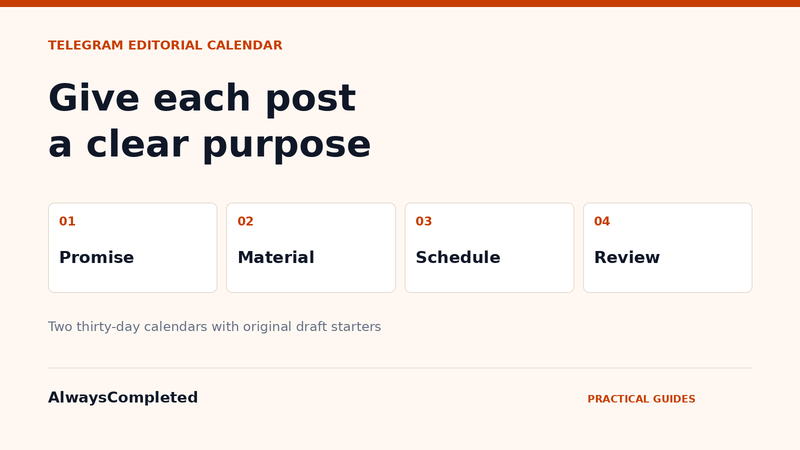
A useful Telegram content plan gives subscribers a reason to return and gives the editor a realistic production schedule. Start with the channel’s promise, choose a pace you can sustain, then give every planned post a purpose, source material, owner and next action. A 30-day plan does not require 30 public posts.
The two calendars in this guide each contain 12 example publications and 18 days without a scheduled public post. Twelve is an editorial starting point for this workbook, not a proven optimum or a growth guarantee. You can reduce the plan without breaking it.
Download the music-release calendar, the agency and small-brand calendar, and the 24 original post drafts with production notes. Each CSV has all 30 days, including free days, plus purpose, thesis, format, material, owner, CTA and results fields. No post has been scheduled or published.
Write the channel’s promise in one sentence
Describe what the subscriber receives beyond announcements. A music channel could promise “short listening notes, the decisions behind each release and the occasional performance you can hear here.” A planning agency could promise “practical briefs, small campaign checks and clear explanations of reports.”
Use a promise you can support with your own work. A channel about the recording process needs authorized recordings or notes. A channel about marketing decisions needs truthful examples and clear limits. Neither needs invented client successes to be useful.
Add a simple boundary. If every service update, personal thought and unrelated trend can become a post, the promise will not help you choose. Ask of each idea: would someone who subscribed for this promise understand why it belongs here?
Your pinned introduction can carry that promise, a small navigation list and the current important destination. Telegram supports pinned messages with a banner that helps readers jump back to them. It also supports hashtags that collect tagged channel posts in search. Source: Telegram’s channel guide.
Choose a rhythm before filling the calendar
The workbook uses publication days 1, 3, 5, 8, 10, 12, 15, 18, 21, 24, 27 and 30. Enter your real start date and publishing time only after checking your production capacity and the relevant time zone.
A free day is a real option to publish nothing. You might use it to prepare a recording, check a link, answer an existing conversation or simply do other work. Do not turn every blank day into an extra reminder merely because a scheduling tool makes it easy.
If twelve posts are too many, keep six: the introduction, two useful explanations, one key announcement, one follow-up and one recap. If you already have evidence that a different pace serves your audience, adapt the calendar to that evidence. The template is meant to make choices visible, not impose a frequency rule.
Assign an owner even if the same person writes, approves and publishes. This prevents a small team from assuming that somebody else has checked the release link or the facts in a draft.
Give the month five editorial jobs
The calendars combine useful material, process, dialogue, a clear offer or release, and a recap. These are planning categories, not Telegram metrics.
Useful material helps the reader do or understand something. Process shows a genuine decision or method. Dialogue asks one question the team is prepared to respond to. Release or offer makes a concrete next step available. Recap helps a newer subscriber find the material already worth reading.
Do not make every job a sales request. A listening exercise can end by inviting attention to a sound. A brief checklist can end by asking the reader to choose the missing decision. A release post can provide a verified listening destination. The action should match the material.
The twelve publication slots across thirty days
Both versions use the same day pattern, but they contain different theses, drafts and assets. The music version uses Windows at Dawn, a fictional teaching release. Day 15 is its planned release point, contingent on verified availability. The agency version represents a fictional small planning team, not an actual client case.
| Day | Music-release version | Agency or small-brand version |
|---|---|---|
| 1 | Introduce the channel’s listening-and-process promise | Explain the channel’s practical planning promise |
| 3 | Offer a simple “follow one sound” listening exercise | Share a five-line brief checklist |
| 5 | Show the original click that became a rhythmic detail | Explain how a deliverable differs from a desired outcome |
| 8 | Tell the small observation behind the song’s setting | Rewrite an unclear fictional task into a concrete brief |
| 10 | Ask where subscribers prefer a first listen | Ask which planning task needs a clearer example |
| 12 | Share a cleared preview with a specific listening cue | Share a compact campaign-readiness worksheet |
| 15 | Publish the release invitation after checking availability | Describe a real available service scope, if approved |
| 18 | Explain one arrangement decision in the released song | Explain one reporting distinction with teaching figures |
| 21 | Answer a genuine question, or label an artist-selected topic | Answer a genuine question, or label an editor-selected topic |
| 24 | Invite a listener’s interpretation without demanding one | Show an original before-and-after draft, labeled as an example |
| 27 | Share an authorized alternate performance | Publish a useful handoff checklist |
| 30 | Link the month’s useful posts and ask what to explore next | Summarize the month’s tools and choose the next question |
The remaining 18 days are deliberately marked “Free day” in each file. There are no fabricated results waiting in the result column. Dates, actual URLs, measurements and review decisions stay blank until the work happens.
Prepare the first three music posts
The example copy below is original teaching copy for the fictional release. Replace invented story details with truthful material and confirm permission to publish all audio, visuals and performances.
Day 1 — the promise. “This month, we will explore one song from three directions: a detail to listen for, a decision from the recording and the finished performance. Use the pinned index to find each note as it appears. Release information will stay in the pinned index when it is confirmed.”
This introduction explains the channel without pretending the song is already available. Prepare the index as a real message and add links as posts exist, rather than filling it with destinations that do not work yet.
Day 3 — something useful before the release. “Try following one small sound through a song you know. Notice when it enters, when it disappears and what the gap changes. You do not need to name the instrument. The exercise is simply to hear one layer all the way through.”
The post gives a complete activity inside the channel. It can be plain text; a second production is not necessary just to make the calendar look varied.
Day 5 — a real production detail. “In this teaching release, a dry click became part of the pulse. The clip moves from the source sound to the same detail inside the arrangement. Listen for where it returns, rather than for a dramatic before-and-after improvement.”
To publish your own version, supply the actual source recording and matching excerpt. If your track does not use that method, choose a different genuine decision. The draft is not evidence that the example track or recording exists.
Prepare the first three agency posts
Day 1 — the promise. “This channel turns small campaign problems into usable briefs and checks. Expect one concrete task at a time: clarify the offer, prepare the material or read a report. The pinned index will collect the tools so you can find them again.”
This can be adapted to a small brand by changing the task. A desk-accessory brand might promise straightforward setup demonstrations and product-care answers instead of campaign planning.
Day 3 — the brief. “Before asking someone to make a post, write five lines: who it is for, what they need to understand, what you can show, what they should do next and who approves it. If one line is missing, resolve that decision before the design starts.”
The calendar names a one-page brief as the required material. It does not require a paid consultation to make the post useful.
Day 5 — a distinction that prevents confusion. “A deliverable is work somebody can supply, such as three approved video edits. An outcome is what you hope that work helps achieve, such as qualified enquiries. Put both in the brief, but do not describe the outcome as guaranteed just because the files were delivered.”
This draft demonstrates a method without claiming a client result. The full download includes another nine complete draft starters for each version, with evidence and publication conditions.
Use Telegram’s features to help the reader
Pin an index that stays current
Keep a short starting message with the channel promise, links to a few useful posts and the current confirmed release or offer. Replace obsolete dates when circumstances change. A pinned message does not need to repeat every detail from the month.
Use consistent topic labels if they help navigation. For example, one tag can collect listening notes and another process posts. An agency could separate briefs from reporting examples. Do not add a long tag block that makes the message harder to read.
Schedule content with dependencies in mind
Telegram documents scheduled posts and additional sending options from the Send control. Before scheduling, preview the actual message and verify the intended destination, assets, time and channel. Source: Telegram’s scheduled-message overview.
An evergreen listening exercise can be prepared in advance. A claim that a release is live depends on a real availability check. If the release date moves, review all dependent posts: the invitation, follow-up, pinned message and recap. Changing one calendar cell does not establish that scheduled messages elsewhere changed too.
Keep “draft,” “ready,” “scheduled” and “published” as different states. Only enter the actual post URL after publication. A locally approved file is not a published channel message.
Choose silent delivery for the right reason
Telegram’s May 7, 2026 update documents silent scheduled messages: hold Send, choose Schedule Message and use the bell control. The channel guide explains that a silent message can still produce a notification without sound. Sources: Telegram’s silent scheduling update and channel guide.
Use this option thoughtfully for a non-urgent recap or a message whose planned time could disturb readers. Silent delivery does not make an unnecessary post useful. For a time-sensitive announcement, decide explicitly what is appropriate rather than inheriting the previous post’s setting.
Make dialogue possible before requesting it
Telegram supports comments through a linked discussion group, while channel reactions and polls provide other feedback options. If you invite a reply, ensure the intended route exists and somebody can moderate or answer it. Sources: Telegram’s channel guide and Channels FAQ.
The day-21 question post has an honest fallback. If nobody asked the proposed question, introduce it as something the artist or editor wants to explain. Do not invent a subscriber’s message to make the channel appear busy.
Review posts at comparable ages
Choose an observation window before comparing posts, such as a planned check 48 hours after each publication. That number is a workbook choice, not an industry standard. Record the actual check time and leave missing data unavailable rather than zero.
Telegram says channel view counters are approximate, include forwarded copies and can count a later repeat view again. Treat them as reported views, not a list of unique subscribers who read or understood the post. Source: Telegram’s view-counter explanation.
A useful review combines the post’s purpose with the observations you can support. A poll can inform the next topic among people who responded, but it does not represent every subscriber. A link click is different from a completed listening or purchase action. A process post may produce a worthwhile question even when an announcement has more reported views.
For example, if a fictional month produces several specific questions about one arrangement decision, the next plan might include a clearer demonstration. That is an editorial response to the questions, not proof that the format caused audience growth. No such responses have been collected for these templates.
At day 30, keep the topics that served the channel promise, revise unclear material and remove tasks the team could not support. Prepare the next first three posts before adding more frequency.
If the calendar supports a release campaign, compare the broader work required with the actual scope of music release services. Once the channel contains useful material and working navigation, the Telegram promotion guide can help you inspect available service conditions. Additional delivery does not replace a clear editorial promise or guarantee that subscribers will return.
