Spotify or SoundCloud First? Choose a Release Workflow for Your Goal
Use a private SoundCloud workflow when the immediate job is to improve unfinished music with a small group. For a finished single or EP, start the distributor process early and give Spotify and SoundCloud distinct roles in the same campaign. “First” should describe the next necessary action, not a permanent ranking of the platforms.
SoundCloud supports direct uploads; getting a music release onto Spotify normally means working through a distributor. SoundCloud also offers distribution to other services, but that is a separate submission process from publishing a track on SoundCloud itself. These distinctions are documented in Spotify's delivery guide and SoundCloud's distribution overview.
This guide compares three practical situations: a work in progress, a finished single and a multi-track campaign. The examples and decision tools are original planning exercises, not accounts of real artist results.
Start with the decision your music needs
Write one sentence before choosing a platform: “The next listener needs to help us decide ___” or “The next listener should be able to hear ___.” If the missing answer concerns the arrangement or mix, a public release date may be premature. If the recording is approved, the unresolved work is delivery, presentation and listener access.
| Stage | Immediate goal | SoundCloud role | Spotify role | Evidence needed before the next step |
|---|---|---|---|---|
| Work in progress | Resolve a specific creative question | Private listening link and bounded feedback session | No scheduled release required for this feedback exercise | Decisions on the recording, permissions and final version |
| Finished single | Make an approved recording available and explain why to listen | Planned public track, profile context and community conversation | Delivered single, correct artist profile and eligible pre-release preparation | Approved delivery, verified destinations and a coherent launch message |
| EP campaign | Give several tracks a clear listening sequence | Public playlist or selected track route with useful context | Delivered multi-track release and an eligible focus-track pitch | Track order, recording identities, timing and channel-specific review plan |
Do not choose based only on where you already have an account. A musician with an established SoundCloud audience may start communication there while the distributor processes Spotify delivery. An artist whose listeners mainly use Spotify may lead the public campaign with that destination and use SoundCloud for a different audience or listening context.
The useful question is which channel serves the present task with the fewest unresolved dependencies. You can postpone a channel if there is no clear role for it.
Separate direct upload, distribution and public availability
A file can exist in your SoundCloud account without being a distributed release. A distributor submission can exist without appearing on a public Spotify page. A public link can exist without being the version or artist profile you intended.
SoundCloud's current distribution walkthrough describes a separate flow: complete track and release details, choose partners, map artist profiles, review and submit. It currently introduces that workflow for Artist Pro subscribers. Verify your actual plan and current terms before choosing the service; direct upload access alone does not establish distribution eligibility.
For Spotify, the Upcoming section reflects unreleased music delivered by the label or distributor. That is a useful checkpoint between “we submitted the release” and “the public can play it.” Check the recording, artwork, date and artist mapping there when available. Ask the distributor to resolve missing or incorrect delivery information.
Assign one person to own delivery status. A screenshot of a submitted form is evidence of submission, not evidence that every selected store has accepted and published the release.
Scenario 1: collect feedback on a work in progress
Suppose a fictional producer is comparing two endings for an unfinished track, Night Ferry. A public Spotify release would not answer that question more clearly than a focused listening session. The immediate task is to learn which ending supports the arrangement and why.
- Define the version and question. Label the working files A and B, with a date. Ask listeners to compare the final transition, rather than inviting an unrestricted judgment of the whole project.
- Choose the intended reviewers. For example, ask four trusted collaborators who can explain what they heard. Four is an illustrative group size, not a research standard or a representative audience sample.
- Share the complete private link. SoundCloud explains that a private track's secret link includes a token and that anyone with that complete link can listen. Treat it as shareable access, not a promise that only named recipients can hear it. See the private-sharing guide.
- Request usable observations. “At which moment did the ending feel complete?” produces a more actionable response than “Would this go viral?” Ask for a timestamp, observation and suggested change.
- Close the loop. Record what you changed, what you deliberately kept and which questions remain. Set a decision date so the feedback exercise does not become endless revision.
Imagine the four reviewers return twelve notes. You group them into three arrangement questions, accept two changes and keep the original third section after listening again. The useful output is a documented creative decision. Twelve notes do not mean twelve fans, and agreement among collaborators does not predict public demand.
If the link was forwarded beyond the intended group, SoundCloud documents a way to reset a private link. A reset invalidates the old link and is irreversible; communicate the replacement to people who still need access. Do not use that action casually in the middle of a review round.
Scenario 2: coordinate a finished single
Once the recording is approved, distribution becomes an early dependency. The choice is no longer “upload now or wait forever.” You can prepare SoundCloud presentation and campaign material while the distributor processes the finished release.
Use a calendar with different kinds of deadlines
Do not turn a store's shortest stated processing time into your entire campaign schedule. CD Baby currently recommends signing up at least three weeks ahead for a promoted or date-specific release, ideally four to six weeks. That guidance covers its own workflow and allows for inspection, partner processing and promotion; it is not a universal promise for other distributors. See CD Baby's timing guidance.
SoundCloud's distribution walkthrough recommends setting the release date 30–45 days ahead. Use the current guidance of the distributor you actually select, account for corrections, and confirm the planned release time. These recommendations are planning buffers, not guaranteed delivery dates.
For an illustrative six-week single plan, use these checkpoints:
- Six weeks before: approve audio and credits, choose the distributor, confirm artist identity and submit complete materials.
- Four weeks before: resolve review questions and confirm delivery progress. Prepare the SoundCloud track and campaign destinations without assuming public availability.
- Two weeks before: aim to have an eligible unreleased Spotify song visible and its pitch submitted; finish listening links and launch assets.
- One week before: recheck status, exact release timing, link behavior and remaining blockers. Avoid discovering a wrong artist profile on launch morning.
- Release day: verify each public destination and edition before using “out now” messages.
- After release: review each platform's evidence over a stated period and decide the next useful action.
Spotify's New Releases guide advises pitching the focus track at least two weeks ahead. Its pitching help page separately ties an unreleased song pitch at least seven days before release to followers' Release Radar. Seven days is not a universal editorial-selection cutoff, and neither timing rule guarantees an editorial placement. Plan for the earlier checkpoint and check that the track is actually available to pitch.
For a first release, do not assume you must wait until launch to seek artist access. Spotify documents a pre-release access route using the artist link or URI supplied by the distributor and the upcoming release's UPC or EAN. Start early; access and delivery are separate tasks.
Give each channel a reason to exist
For the fictional finished Night Ferry single, Spotify might be the principal destination in a fan's preferred listening service. SoundCloud might carry the same approved recording with a short production note and a conversation around a particular musical moment. That is a proposed division of work, not a claim that either audience will respond.
If your public SoundCloud version intentionally appears earlier, document the reason and label the later Spotify availability accurately. Do not casually describe a publicly available recording as exclusive or assume every platform's unreleased-content rules treat it identically. Check the applicable delivery and pitching rules before promising an opportunity.
Scenario 3: build an EP campaign around a coherent sequence
A fictional four-track EP, Harbor Lights, contains one previously released single and three new recordings. The campaign needs a listening order, an entry track and a reason to explore further. It does not need four unrelated launches on the same day.
Create one track ledger: order, title, version, main and featured artists, recording identifier, prior release status, audio file, artwork relationship and intended destination. Confirm with the distributor how the existing single should be included. Do not change recording identities merely to make the campaign spreadsheet look uniform.
On Spotify, choose an eligible unreleased focus track for the pitch. Spotify permits only one song pitch at a time and says a song already live is no longer eligible for song pitching. That makes the previously released single a different campaign asset from an unreleased EP track; consult the current pitch rules.
On SoundCloud, plan the public playlist or track route so a new visitor understands where to start and what belongs to the EP. Prepare contextual copy for the whole project, then explain individual tracks where useful. Verify that the intended tracks are actually accessible through the shared destination; a playlist label is not evidence of playback access.
An EP review should ask whether listeners reached the intended recording and whether the sequence needs clearer presentation. Do not infer that everybody who played the opening track completed the EP.
Keep one content record and separate platform checks
Maintain a shared source record for final audio, credits, artwork, dates and approved descriptions. Alongside it, keep a status column for each platform. This preserves a common identity while exposing unfinished delivery tasks.
For example, an artist-name correction may be complete on the SoundCloud track but still pending in Spotify delivery. SoundCloud explicitly says edits to tracks on SoundCloud do not update releases sent to other services. Record the separate distributor request and verify the external result before closing the issue.
Include the release time and timezone in your record. Spotify explains that the date in Upcoming reflects the earliest availability date across countries, so it can differ from a date you expect in your own timezone. Investigate that difference with the distributor instead of changing dates based only on a screenshot.
Measure the task each platform was assigned
For the demo, review whether the targeted creative question was resolved. For the single, record delivery status, destination checks and platform-specific listening evidence. For the EP, examine the intended entry track and the available track-level data without inventing a completion funnel.
Spotify counts a song stream after at least 30 seconds, according to its stream-counting guide. SoundCloud's Insights guide distinguishes plays, likes, comments, reposts and downloads. Preserve those metric names, periods and sources rather than relabeling every interaction as a listener.
If a hypothetical report shows 300 Spotify streams and 180 SoundCloud plays, you have two platform totals. You have not established 480 unique people, an audience overlap, a revenue forecast or a winning platform. Likewise, a link click is evidence about a route; it does not prove a subsequent stream.
Decide the next action from the unresolved task: fix a broken destination, clarify the EP entry point, finish a feedback decision or continue a useful conversation. A larger count alone does not tell you which action is needed.
Download the decision tree and release map
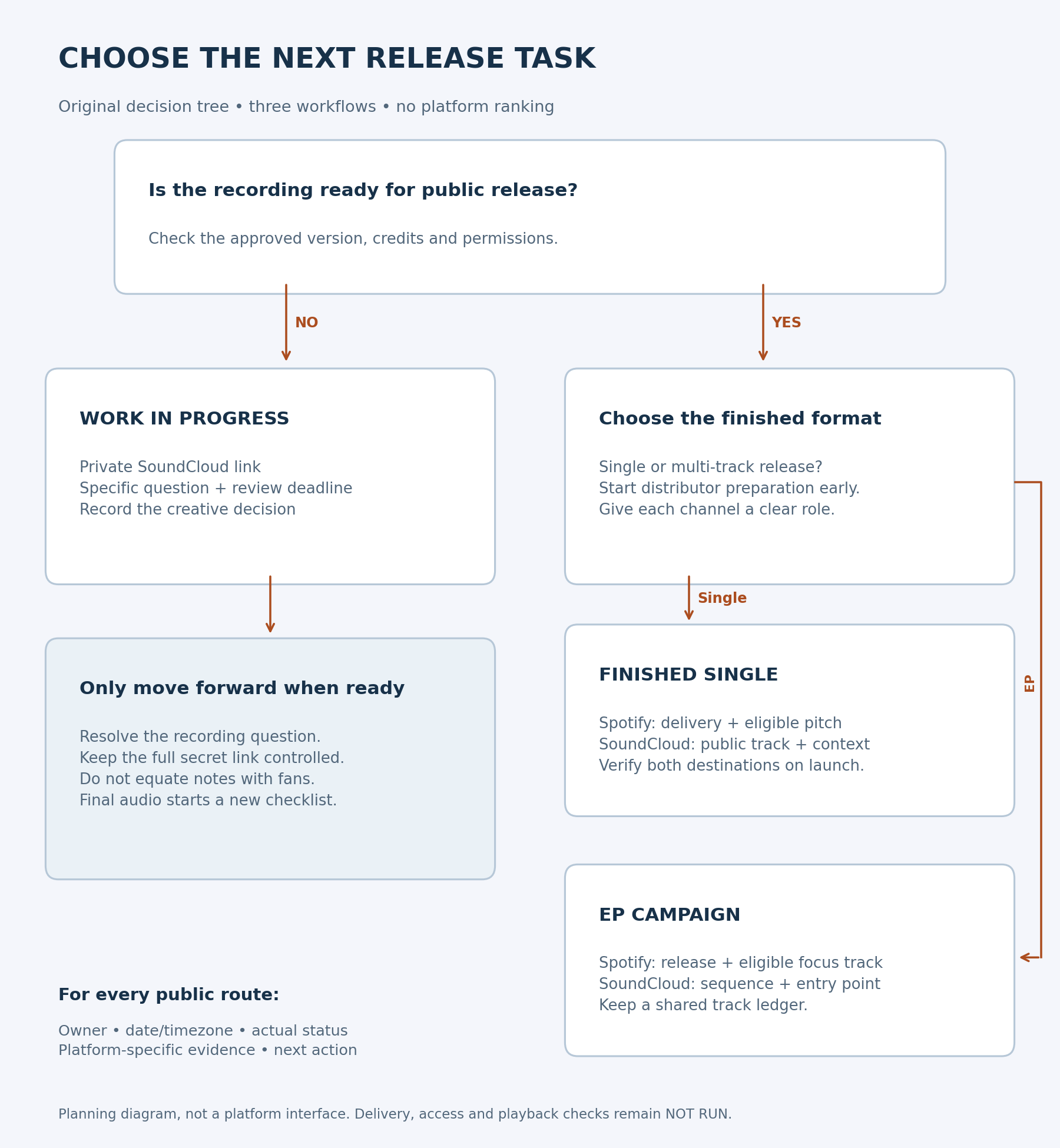
The original decision tree summarizes the three routes. The editable three-scenario release map includes channel roles, prerequisites, checkpoints and blank actual-status fields. The working worksheet adds the recording ledger and a release-day verification record. No real account, release delivery or device test is represented.
If you need outside help, describe the stage, platform, recording and unresolved task before reviewing music release services. Confirm the exact deliverable and required destination. A service listing does not establish distributor acceptance, official playlist access or listener demand.
