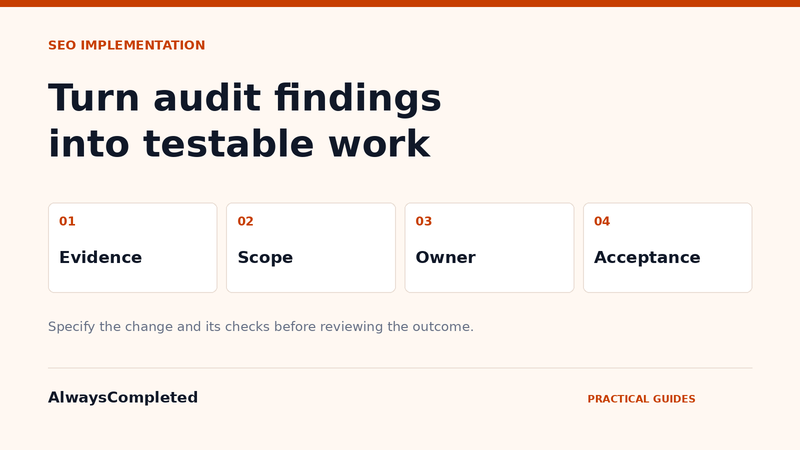
Turn an SEO Audit into an Implementation Brief
An SEO audit becomes useful implementation work when each accepted finding names a reproducible problem, the affected pages, the proposed change and a check that can establish whether the change was completed. A severity label or tool score alone does not give a developer enough information to make a responsible edit.
Turn the audit into a small set of decisions before turning it into a large task list. Some findings share one cause. Some need more evidence. Some describe deliberate site behaviour. A clear brief preserves those distinctions and lets the website owner approve concrete work without accepting a promise of search growth that the evidence cannot support.
The original downloads include six fictional audit findings, two fully worked implementation tasks and a reusable blank brief. All example URLs, observations and before/after snippets are DEMO. They illustrate a handoff, not an audit of AlwaysCompleted or a completed client project. Google documentation and the current AlwaysCompleted service scope were checked on 26 November 2026.
- Download the six-finding DEMO backlog
- Download two worked tasks with before/after evidence
- Download the blank implementation brief
Ask what the finding actually proves
Start with the observation, not the recommendation. Ask the auditor to show the exact URL, the time of the check, the tool or method and the relevant output. A screenshot of a red dashboard total may establish that the tool reported something. It does not establish which pages need a change or what the correct change is.
Google's guidance on hiring an SEO recommends evaluating the proposed work and its reasoning. Its guidance on third-party SEO tools and advice also distinguishes external assessments from Google's own internal ranking data. Use a tool finding as evidence to investigate, with its limitations attached.
For a canonical finding, preserve the actual declared URL and the page where it was observed. For a broken link, preserve the source page, visible anchor text, target and response chain. For a content concern, preserve the relevant page version and the user question it fails to answer. Each requires different evidence and a different person to resolve it.
If the evidence cannot be reproduced, assign an investigation task before an implementation task. That is a legitimate outcome. It is cheaper to clarify one ambiguous finding than to deploy a broad change and then discover the original diagnosis was wrong.
Group pages by cause without hiding exceptions
A hundred affected URLs may come from one template or from several unrelated editorial mistakes. Group them by the mechanism you can support with evidence, then retain the exact members of each group.
A template-level task needs representative pages and exceptions. For example, a category template may generate the same incorrect canonical on several pages, while one manually configured page behaves correctly. The brief should tell the developer which template is implicated and which working pages must remain unaffected.
Do not replace the affected-URL list with a count. Counts are useful for scope, but a developer needs the actual pages or a precise, reproducible selection rule. Record whether the list is exhaustive or a sample. A crawler's export, Search Console example list and a manually checked set can have different coverage.
In the DEMO backlog, two canonical examples share one configuration cause and become one task. An incorrect internal link is a separate editorial task. An intentional noindex page is documented as no change. A temporary server-error observation remains an investigation. This keeps the queue focused on actions that the evidence supports.
Specify the intended behaviour before the edit
Write the target state in terms of the visitor's page and the site's intended organisation. “Fix canonical” is incomplete if nobody has decided which URL should represent the content. “Fix links” is incomplete if the replacement target has not been approved.
For duplicate or very similar pages, Google's canonical guidance describes signals that express a preferred URL and advises against conflicting signals. The brief should therefore identify the preferred page and the evidence supporting that choice. It should not prescribe a self-canonical for every URL without understanding the relationship between the pages.
Record dependencies before implementation. The correct destination may need to be restored, a content owner may need to confirm whether two pages are equivalents, or the CMS may generate a field from a shared setting. A task cannot be accepted if its essential dependency is still a guess.
Define the boundary of the change as well. A targeted canonical correction does not automatically authorise a slug migration, a redirect overhaul or deletion of older content. If the investigation shows that a broader change is necessary, revise the brief with the new evidence and impact.
Worked task: resolve a conflicting canonical
The fictional site studio.example has a useful release-planning guide at /guides/release-plan. Its source HTML declares /services, while the sitemap and internal navigation use the guide URL. The content owner confirms that the guide is a distinct article and should retain its existing address.
The task is to correct the article's canonical configuration at the responsible source, then verify the affected page and a small set of template siblings. It does not rename the guide. The DEMO before/after evidence in the download shows the exact canonical element, final URL and intended sitemap membership.
Acceptance is concrete: the guide loads at the agreed address; the rendered document contains one intended canonical; the sitemap and relevant internal links use the same preferred guide URL; and unrelated sibling pages retain their correct behaviour. Save the actual before and after observations with timestamps when performing this on a real site.
Google's eventual canonical selection remains a later observation. Passing the implementation checks demonstrates that the site now expresses the agreed preference consistently. It does not guarantee when Google will recrawl the page or which version it will select.
Worked task: repair a wrong internal destination
The second fictional finding is on /guides/release-plan. The anchor “release checklist” points to /tools/release-checklsit, a misspelt path that returns a missing-page response. The approved tool is already available at /tools/release-checklist.
The task identifies the source paragraph and the exact element to change. The author verifies that the correct destination really provides the promised checklist before updating the link. A redirect is not assumed to be necessary for a typo used only in this source; the implementation decision follows the actual scope of the defective URL.
Google's link guidance recommends crawlable anchor elements with usable destinations and meaningful text. The brief applies that guidance to one specific defect. Its acceptance check verifies the link's actual href, the final destination and the visible tool. A visually underlined phrase with the old target would fail.
The download also includes a small regression check: another unrelated link in the same paragraph must retain its destination. This helps prevent a broad search-and-replace from changing more than the accepted task.
Make priority a reasoned decision
Prioritise by the importance of the affected page, the confidence in the diagnosis, the consequence of leaving it unresolved and the effort or dependencies involved. Avoid assigning an expected traffic percentage to every task simply to make the backlog look numerical.
An accidental noindex on a key service page may deserve prompt attention because it conflicts with a clear indexing intention. A title that could be more specific may need an editorial decision. A canonical on a deliberate alternate page may need no change. A short queue that records these reasons is more useful than a large queue with identical high-priority labels.
Keep implementation and investigation priorities separate where helpful. A serious but uncertain observation can receive urgent investigation without prematurely approving a technical change. The outcome may be a fix, a monitoring decision or evidence that the system is working as intended.
Give every task an owner, reviewer and evidence requirement
The implementation owner changes the system. The reviewer checks the agreed outcome. One person can perform both roles in a small project, but the record should still distinguish the action from the evidence that accepts it.
Specify the environment and release boundary. A staging correction is not a production correction until the actual public result is checked after release. A saved CMS field is not sufficient evidence if the rendered page still contains an older value from another template or cache.
For each task, keep the original evidence, the approved change, the implementation reference and the post-change observations. Record exceptions rather than silently excluding them from the completion total. If the issue appears on several URLs, explain which were retested and why that set is sufficient for the stated scope.
A rollback or pause decision should be practical. For the DEMO link task, the previous content revision can be restored if the approved tool is withdrawn. For a shared-template change, the team may need to restore a known configuration while investigating an unintended effect. Name the responsible person and the evidence that would trigger that decision.
Accept the work, then observe the search outcome
Close an implementation task when its specified checks pass. Record the actual completion date and evidence. Then monitor later search observations separately, using a consistent URL group and noting other changes that could affect the result.
The existing SEO progress-report template covers that later measurement. Keeping it separate allows an honest statement such as “the incorrect link was repaired and verified” even before there is enough search data to assess any wider effect.
When comparing AlwaysCompleted website SEO services, bring the concrete brief and confirm which work the selected description includes. A catalogue label does not automatically include CMS access, development, a full technical audit or every repair in your backlog. Ask technical support to clarify the deliverable, evidence and implementation responsibility before treating a package as acceptance of the entire task list.
