Musician Press Photo Brief: Plan the Shoot Before Building the EPK
A musician press photo brief should tell the photographer what the pictures need to communicate, where they will be used and how the team will decide that the delivery is complete. Write it before booking the session. That gives the photographer room to plan useful compositions instead of trying to rescue a favourite portrait after a website, journalist and poster designer request three different shapes.
Begin with a small number of real placements. Choose the story, translate those placements into a shot list, agree the use and delivery terms, and review the finished files against the brief. The aim is a coherent set that people can use, with accurate captions and credits attached.
This guide includes a one-page photographer brief, an editable version, an eight-placement shot matrix, caption records and original crop sketches. The fictional duo and image concepts are DEMO planning material. No photo session, photographer approval or platform upload was performed for this article. Documentation was checked on 26 November 2026.
1. Decide what this chapter of the music should look like
Write a two-sentence creative direction. The first identifies the current music; the second describes the visual feeling you want to explore. “A close, conversational acoustic record; warm indoor light and an uncluttered room” gives a photographer something to interpret. “Make us look professional and get more attention” gives them no useful choice to make.
Choose two or three visual references and annotate each one. You might like the distance between the subject and the camera, the softness of the light, or the room left beside a person. Explain that element instead of requesting a copy of another artist's photograph. Keep reference material in the planning conversation; it is not a source of images to put in your finished press kit.
Then identify one boundary. Perhaps the release is about a home recording process, so the pictures should not imply an arena show. Perhaps a former band member appears in an old set, so those images cannot represent the current lineup. A short boundary protects factual accuracy while leaving plenty of creative freedom.
For the DEMO duo North Window, the direction is “two musicians writing intimate songs together, photographed in a simple rehearsal room.” The proposed palette is muted blue, warm wood and natural fabric. The brief asks for a shared working moment plus direct portraits. These are original teaching choices, not a formula for acoustic artists or a claim about audience response.
2. List the actual placements before choosing the shots
Ask the people who will use the pictures what they need. An EPK image, a venue poster, a press article and an artist profile can impose different crops. Record the intended recipient, the composition needed and the current specification source. If no recipient has supplied dimensions, keep the field open until someone obtains them.
CD Baby's musician photo-shoot guidance recommends planning around use, including horizontal and vertical compositions, different distances and room for cropping. It also recommends agreeing the process, delivery and intended image uses before the shoot. Apply that planning principle to your specific recipients rather than treating one export as suitable everywhere.
| Placement | What the photographer needs to know | What the team must confirm |
|---|---|---|
| Press article | A usable horizontal group portrait with room around faces | Publication's requested file and credit treatment |
| EPK download | A clear current-lineup image, plus an alternative | Who approves the selected set and captions |
| Venue poster | Space on the requested side for event information | Designer's actual layout and crop |
| Artist profile | A recognisable face or group within the destination's crop | Current platform rules and preview |
| Website introduction | Composition that survives the site's narrow layout | Desktop and phone crop in the actual page |
This table describes decisions, not universal specifications. Put the real recipient's requirement in the downloadable matrix. Where a request conflicts with the available photograph, change the shot or obtain a different brief; do not hide the conflict behind a large export.
For an existing EPK, review its image positions before the session. The separate EPK template for curators and journalists explains how the finished materials fit the recipient's task. Here, the work is producing the usable photographs that will go into it.
3. Choose a photographer by the work and process you need
Review a small selection of complete sessions, if the photographer makes them available, alongside their portfolio highlights. Look for the kind of work your brief requires: a group in a constrained room, portraits that still read at a small size, or consistent images across several compositions. A beautiful outdoor portrait does not by itself show how a photographer will handle your rehearsal space.
Ask how the session will run. Who scouts the location? Who directs people who are uncomfortable in front of a camera? Who selects the initial images? How many edited pictures are included, how are additional edits handled, and when will the final files arrive? Record the answers in the brief so the team is planning around the same deliverable.
Give the photographer a realistic priority order. If the session is short, the current-lineup portrait and the one essential campaign crop come before experimental setups. Agree a fallback location or reduced shot list for conditions that prevent the original plan. A fallback is useful only if the people involved know when to use it.
For a self-directed shoot, keep the same brief. The person taking the photographs still needs a story, an intended use, enough time to review the first frames and a clear way to decide which files are ready. Budget changes the production arrangement; it does not remove the need to choose and check the output.
4. Plan the crop while there is still room to move
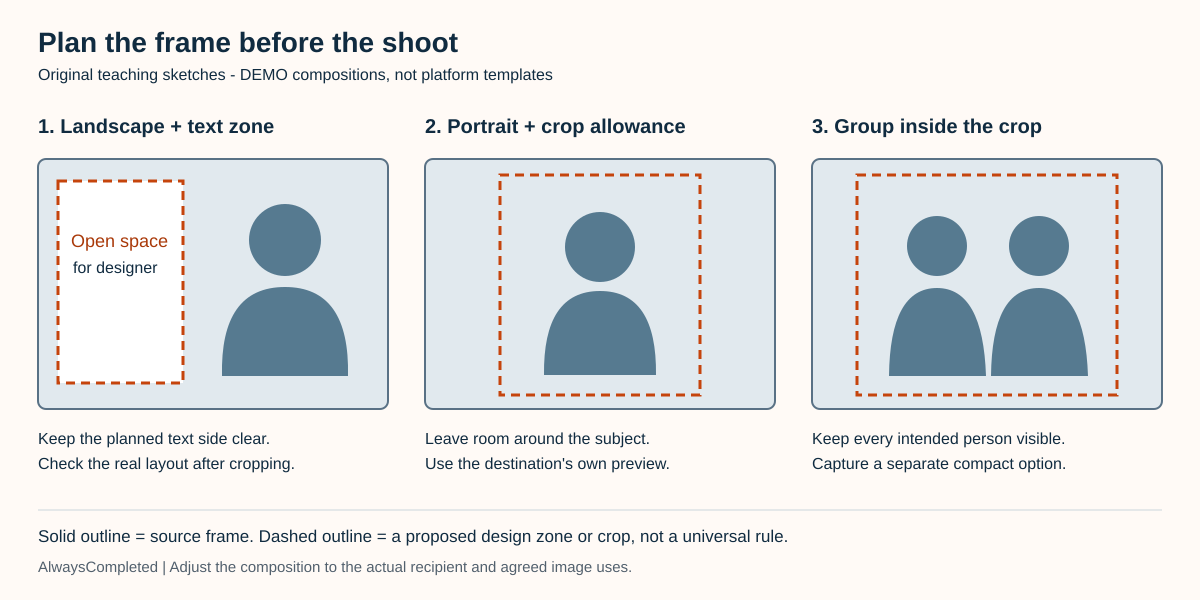
Think about three spaces in the frame: the subject, the area a crop may remove and any area that a designer needs for text. Negative space means useful open space, not an accidental gap that disappears as soon as the image becomes narrower. Tell the photographer which side needs it and why.
For a group, check the people at both edges. A wide photograph can look balanced while making a square crop impossible without cutting someone out. Capture a tighter grouping as a separate option if a compact placement is important. For an individual, leave enough space around the head and shoulders for the actual destination's preview.
The original crop sheet uses simple shapes to show three planning situations: a landscape composition with a text zone, a compact portrait with crop allowance, and a group that must fit inside the proposed crop. It is a conversation aid, not a platform template or an image-safe-area guarantee. Show the photographer the destination preview when that is available.
Apple Music illustrates why a platform-specific check matters. Its current artist image guidelines prefer 2400 × 2400 pixels or larger, set an 800 × 800 minimum, accept JPG or PNG and say not to upscale. Apple also provides a crop tool and asks that eyebrows and lips remain within its guides. Those are Apple artist-image requirements, not general press-photo requirements.
Keep a text-free master where the intended use calls for a photograph. If a poster designer adds a date or title, treat that as a separate derivative. Do not return a flattened poster to a journalist who requested an editable-layout-friendly press image.
5. Agree the image uses, exports and approval process
List the uses you actually expect: editorial press, the artist website, streaming profiles, social posts, paid promotion, print or artwork. Ask the photographer to confirm which uses, crops and edits are covered and how the credit should appear. Record any limits and the evidence of the agreement. This is an operational brief, not a substitute for resolving an unclear permission with the responsible parties.
Distinguish the files you want to receive from the files a recipient ultimately needs. The photographer may deliver an agreed high-resolution set; the publicist may create a smaller download for a particular publication. Name the person responsible for those derivatives. Do not assume that raw camera files, unlimited retouching or every future use are included because they were never discussed.
Set two deadlines when they are useful: a selection/contact-sheet date and a final edited-delivery date. Work backward from the earliest real campaign deadline. Add time for a factual correction such as a wrong lineup caption or an export that does not match the agreed crop.
Write the approval in terms of identifiable files. “Approved the four selected images listed in brief v02 for the uses recorded there” is stronger than an unqualified “all good.” The filename, reviewer, date and scope should stay together. Leave a permission status pending until the relevant confirmation exists.
6. Review the contact sheet against the shot matrix
Review for the jobs in the brief before selecting only on personal preference. For each essential placement, identify a candidate and explain why it works. A contact sheet is a convenient selection view; inspect the corresponding full file before approving technical quality.
Use a short acceptance sequence:
- Confirm that the correct people and current lineup appear.
- Inspect focus, visible defects and the intended expression in the full file.
- Try the proposed crop without stretching or adding invented detail.
- Check that any required open space survives that crop.
- Compare the export with the actual recipient's requirements.
- Confirm the caption, credit, use permission and selected filename together.
Mark each placement accepted, needs revision or not supplied. These are team worksheet statuses, not a photographer's official terms. An accepted EPK image does not automatically satisfy a poster request with a different composition.
In the DEMO, North Window's first favourite is a wide room photograph with each musician near an edge. It works as a landscape story image but fails the proposed compact profile crop. The corrective action is to select the separate close-group frame, not to label the wide frame “approved for all uses.” No actual image performance is implied.
7. Attach captions and credits before handing over the set
A usable caption identifies the subject accurately. For a group, record names in the relevant visible order and check that order against the final crop. Include a location or date only when known and appropriate to publish. Keep private location details out of the press caption unless there is a reason and approval to include them.
Keep the photographer credit separate from the caption, even if a publication later combines them. Record the exact credit line, selected file, allowed use reference, crop restrictions and contact for questions. A recipient should not have to infer permission from a filename or reconstruct the photographer's name from a chat thread.
The downloadable caption record includes a fictional example with a deliberate PENDING permission field. It shows how to prepare accurate information without pretending that an agreement has been obtained. Replace the demonstration names and conditions before sharing a real package.
Then use the music release asset handoff template to place the approved set in the wider release package. Keep superseded selections out of the recipient's current folder, retain the selection record internally and identify one owner for subsequent replacements.
8. Check the destination before promoting it
Open the image in the actual EPK or website layout on a phone and desktop. Confirm that the crop preserves the subject, the download opens the intended file and the visible credit is correct. For a platform profile, distinguish submission from approval and public display. Apple's upload instructions describe an image review process; an uploaded file is not proof that listeners can already see it.
The broader Apple Music artist page checklist covers page identity, access and the final listener view. Assign that check to the person who has the relevant account. This article's documentary review does not establish a result in your account.
If a release also needs work from AlwaysCompleted's music release services, compare the exact listing with the material you now have. Photography, distribution, editorial acceptance and a service order are separate deliverables. Ask technical support about any unclear asset requirement before ordering; the press-photo brief does not establish that photography or image licensing is included.
