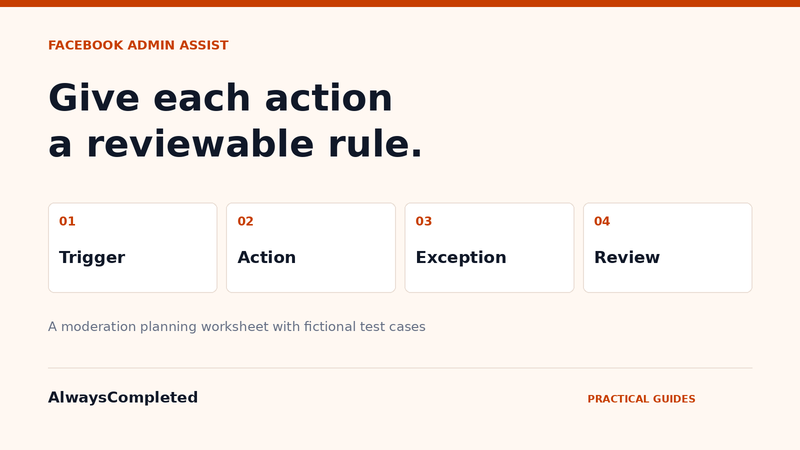
Facebook Group Admin Assist: A Moderation Rule Worksheet
Before relying on a Facebook Group moderation rule, write down the condition it detects, the action it is meant to trigger and the useful posts it could catch by mistake. Test that logic on representative examples, compare it with a human review decision, and assign someone to handle exceptions. A rule that is easy to express is not necessarily a good substitute for judgement.
This guide provides twelve original fictional posts, four combinations of conditions and an editable change-and-retest record. The examples are a local reasoning exercise. They were not submitted to Facebook, and their calculated flags are not observed Admin Assist results. Actual account controls, automation behaviour and overrides remain NOT_RUN.
The immediate goal is a defensible moderation decision. It is not to decline as much content as possible, maximise an automated approval rate or remove people because one earlier action exists in their history. Keep the reason for each rule visible so that another moderator can understand when it needs reconsideration.
Separate the group rule from the detectable condition
Suppose a fictional maker group allows useful project discussions and contextual links, while directing unrelated selling elsewhere. “Posts should contribute to the group” expresses a purpose, but it is not a simple observable condition. A link, short length or previous moderation event is only a possible signal.
Write the policy in ordinary language first. Then identify which parts can actually be observed in the account. You may be able to inspect whether a post includes a link, its length or available moderation history. Those fields do not directly tell you whether the link answers another member's question or whether a previous decision was mistaken.
Keep a human target judgement for each teaching example. Does this particular post need additional review under the stated group policy? Decide that from its content and context before looking at a rule's output. Otherwise, the rule can appear successful simply because you redefine “undesirable” as whatever it flags.
Avoid a universal label such as “bad member.” A relevant short question and an unrelated sales pitch can both be brief. A member with a previous moderation event can submit a useful corrected explanation. Review the post and the available history in its actual scope rather than treating one characteristic as a permanent identity.
Verify which Admin Assist controls are available
Meta's October 2026 announcement describes more flexible Admin Assist rules in Forum, combining conditions such as post length, link use and previous moderation actions. The announcement states that Forum is available in the US. It does not establish that every Facebook Group account worldwide has identical menus, operators or actions. Meta: Forum admin tools
Inspect the real interface before translating a worksheet rule into settings. Record the available conditions, exact comparison options, supported combination behaviour and possible actions. If a needed control is absent, retain the worksheet for manual review. Do not describe the local example as an active platform rule.
The same announcement discusses Admin AI suggestions in the pending-post queue. Those suggestions and Admin Assist automation are different features. A tag suggesting that a post might conflict with a rule is not itself the final decision your team records. Keep the actual suggestion, any automated action and the human judgement in separate fields.
Meta's older March 2022 announcement also described Admin Assist handling member requests using criteria such as completed membership questions. That is historical context, not a current worldwide interface specification or a reason to mix admission rules with post review. Meta: group-admin tools announced in 2022
Define a small, reproducible set of conditions
The downloadable exercise uses three explicitly defined signals. L means the fictional post contains the DEMO_LINK marker. S means the post is shorter than twenty whitespace-separated words. H is a supplied fictional prior-moderation-history flag. These definitions make the paper calculation repeatable; they do not claim that Facebook counts words or exposes history in exactly this way.
The marker stands for a link in an invented post. It is not a real destination or a link-detection algorithm. The history flag is a teaching input, not a scrape of someone's account. In a real workflow, record the history field that is actually available and the relevant period; an unavailable value must not silently become “no history.”
The four candidate combinations below mean all listed conditions must be true. They are alternative hypotheses to compare individually, not instructions to activate four overlapping rules at once. Confirm the actual platform operators before implementing any equivalent.
| Candidate | Paper condition | Question it tests |
|---|---|---|
| R1 | L and S | Would reviewing short link posts catch the problem without too much useful material? |
| R2 | L and H | Does linking combined with relevant history identify a useful review subset? |
| R3 | S and H | Does shortness combined with history help, or punish concise corrections? |
| R4 | L and S and H | Does requiring all three become too narrow to catch obvious mismatches? |
For this exercise, a true result means “candidate for human review.” It is not a platform decline, deletion, suspension or finding that the author broke a rule. That cautious action lets you inspect false positives before considering any more consequential behaviour in an authorised account.
Compare the conditions with twelve complete posts
The fixture includes contextual repair links, short questions, corrected posts and unrelated sales offers. Every row contains full fictional text, the supplied history flag, the calculated word count and the human target judgement. You can inspect the reason for a mismatch rather than receiving a mysterious final score.
A short post that links to an assembly diagram requested in a previous discussion is useful under the fictional policy. R1 still flags it because it contains a link and is short. This is a false positive for the stated review target. The appropriate response is to examine context, not declare contextual links inappropriate to make the rule look better.
A longer unrelated sales pitch can escape a short-link condition. Adding more words does not make its purpose relevant. This is a missed target in the fixture. It demonstrates why the absence of a flag should not be interpreted as proof that a post follows every group rule.
The history examples are equally deliberate. A useful corrected explanation may carry the supplied H flag; a concise acknowledgement may do so too. If the candidate rule catches those posts, record their actual text and why human review differs. Do not erase the history, but do not let it substitute for reading the new post.
Record false positives and missed cases without inventing success rates
The attached matrix reports the exact DEMO IDs each combination flags. It also lists false positives and missed targets against the exercise's stated judgements. Those are deterministic results from a twelve-post fixture, not estimates of your group's real moderation accuracy.
Small selected examples can reveal a logical defect, but they cannot establish how often that defect occurs in a live group. Do not advertise a percentage improvement, fewer moderator hours or a reduced spam rate from this exercise. Actual operational results would require an authorised observation period and a clear, consistent review standard.
Preserve the original post and rule version when investigating a mismatch. “Rule caught a useful repair answer” is more actionable when the record shows the exact conditions, output and reviewer explanation. If the source changed later, keep a minimal description of what was evaluated at the time rather than rewriting history around the revised post.
Borderline cases deserve a separate note. A promotional link may be allowed in a designated thread but inappropriate elsewhere. That context might be unavailable to a simple condition. Mark the missing context and the person who can resolve it instead of forcing a confident classification into an incomplete row.
Assign a human review and override route
Write down who may reconsider a decision and which actions they can actually take. A worksheet can request human review, but the real interface may offer a different set of controls. Record the available route rather than promising that every automated action has an identical one-click reversal.
Give the reviewer a short packet: exact post reference, group rule, automated condition and action if any, relevant context, proposed correction and reason. Avoid copying unrelated profile details into the log. The purpose is to resolve a specific moderation decision, not to build a permanent judgement about a member.
When communicating a correction, explain the rule rather than blaming “the algorithm.” For example: “Our short-link filter caught a diagram that answered an existing repair question. We have reviewed that context and are adjusting how those cases are checked.” This is sample wording for a hypothetical situation, not a message sent by this article's author.
If a rule repeatedly needs the same exception, revisit its design. A human override should not become an invisible routine that hides an unsuitable condition. You may decide to retain the signal for manual prioritisation, narrow the available criterion, change the action or stop using that rule. Record which choice was actually approved.
Change one rule version and retest the same cases
Create a version record before editing a live rule: purpose, conditions, exact operator, action, owner and effective date. State the expected improvement and the risk introduced by the change. A narrower rule may reduce false positives while missing more unsuitable posts; that trade-off needs to be visible.
Run the same twelve fictional cases against the revised paper logic so that the comparison has a stable reference. Add new cases when an actual ambiguity is discovered, but preserve the original set. Otherwise, a result may change because the sample changed rather than because the rule improved.
In an authorised account test, capture the actual observed action separately from the calculated prediction. If the UI uses different word-counting, link handling or history semantics, record the difference. A local calculation cannot certify the behaviour of an account feature you have not tested.
Leave a rule pending when essential information is missing. “Cannot reproduce the intended condition with current controls” is a useful outcome. It is safer and more accurate than marking a spreadsheet rule implemented merely because the team likes its wording.
Keep the moderation workflow tied to the real group
Review the rule when the group's purpose changes. A community opening a designated resource thread may need a different link policy from one that prohibits promotion everywhere. Explain the current policy in the group and train reviewers on the same version used in the worksheet.
The existing Telegram onboarding and moderation playbook addresses a broader process on another platform. Its rules do not prove Facebook controls. Here, the deliverable is a tested explanation of one condition-and-action decision with a clear human review route.
The AlwaysCompleted Facebook guide distinguishes group-related order scopes and actual approval requirements. Ask technical support about the selected listing where necessary. A service for group activity does not configure Admin Assist, override your group rules or establish the quality of moderation.
