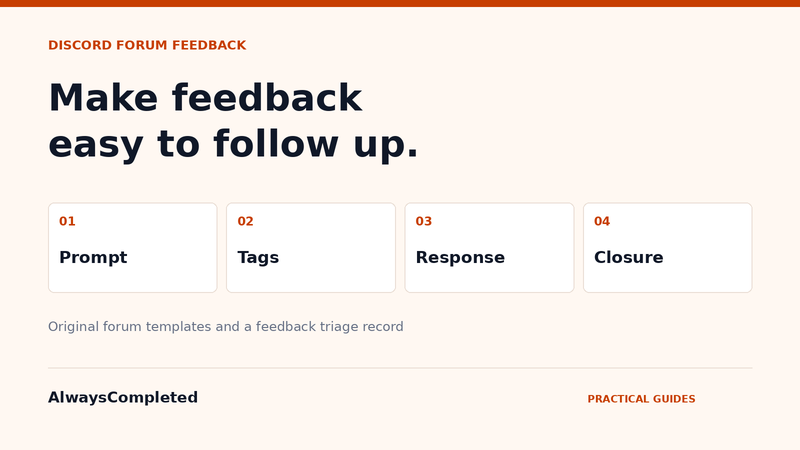
Discord Forum Channels for Useful Music or Product Feedback
A useful Discord feedback forum gives each question a clear home, enough context for a meaningful reply and a visible decision from the person responsible. Start with one post per question, a small set of topic tags and a manual response routine. The goal is to make feedback usable after the conversation has moved on.
Forum structure cannot decide which suggestion to implement or which arrangement sounds better. It can help contributors explain what they observed and help the project owner respond without losing the thread. That distinction keeps the forum from becoming an unreviewed wish list.
This guide includes an original post template, two complete fictional posts, a tag matrix and a decision log. The examples are DEMO material for a Harbor Room music project and a fictional Patch Desk product. No server was configured, no contributor contacted and no feedback received. Actual permission checks, posting and pilot observations are NOT_RUN. Documentation was checked on 26 November 2026.
- Download the post template and two complete examples
- Download the tag matrix, response log and pilot checklist
1. Choose feedback that benefits from a persistent discussion
Use a forum when a question needs context, several replies or a decision that people should be able to find later. A question about a particular demo arrangement or a proposed product behavior fits that pattern. A casual greeting or a quick coordination message can stay in an ordinary conversation channel.
Discord's Forum Channels FAQ describes separate posts, post guidelines and tags, and currently requires Community to create and use Forum Channels. Check the offered controls and intended access before redesigning the server. A written plan does not establish that a specific account can configure it.
Keep sensitive support requests outside a public feedback queue. A contributor should not need to publish credentials, private customer information or an unreleased file they lack permission to share in order to receive an answer. Explain the appropriate private route in the guidelines instead of relying on moderators to remove details after posting.
Distinguish a continuing forum from a one-off listening session. A private SoundCloud feedback session can focus a small group on a specific track revision. The forum described here maintains a queue of distinct questions over time, with searchable decisions and named owners.
2. Ask for the context needed to answer one question
The template has five substantive fields: goal, context, specific observation, requested response and an optional relevant link. Give the post a descriptive title too. “Feedback please” makes a contributor do the work of discovering the question. “Does the chorus entrance feel abrupt after the quieter verse?” tells them where to begin.
Ask for a version reference whenever the object can change. A track draft, product build or document revision gives replies a stable subject. Without that reference, a later reader may compare the feedback with a different version and misunderstand both the observation and the decision.
Keep observation and interpretation separate. “The bass enters at the same moment as the second vocal layer” describes something a listener can check. “The chorus is bad” supplies a judgment without a location or reason. A contributor can disagree with the interpretation while still helping you investigate the same moment.
The requested response should make the boundary explicit. “Tell me where the transition becomes unclear” is different from “rewrite the arrangement.” “Explain which step needs a warning” is different from “design our entire onboarding.” A bounded question respects the volunteer's time and makes the eventual answer easier to use.
3. Show two complete posts rather than only a blank form
DEMO music post: “Is the first chorus entrance clear in Lantern Room, draft B?” The goal is a quieter verse followed by a deliberate lift. The context identifies a fictional draft and says mixing is not being reviewed. The observation names the simultaneous bass and vocal-layer entrance. The question asks what the listener notices first and where the transition becomes unclear, if anywhere.
That wording leaves room for “nothing is unclear.” It does not push people toward agreeing with the author's preferred criticism. The optional file field is a placeholder for an authorized share; the example contains no invented audio link or claim that anyone listened.
DEMO product post: “Should replacing a saved routing preset require confirmation?” The goal is to let a person save changes without accidentally replacing a useful configuration. The context describes a fictional prototype. The observation is that Save would overwrite the selected preset in the proposed flow. The requested response asks which point needs an explicit choice and why.
The product example invites a specific design decision. It does not pretend to be a bug report from a real user. If a real post reports a failure, request the reproducible steps and relevant version through an appropriate support route. Do not require someone to invent a feature proposal before their problem can be acknowledged.
Discord's own game-community guidance uses a feedback forum with status labels and a separate structured bug-report example. The principle is useful beyond games: collect the context that supports the next decision, while keeping distinct kinds of requests understandable.
4. Keep topic and status tags small and understandable
Use topic tags to route the question and status tags to show what the team is doing. In the DEMO, Arrangement and Feature Question identify subjects. Received, Reviewing and Answered describe the manual review state. These are an original editorial scheme, not a built-in automated Discord workflow.
| Tag group | DEMO labels | Responsibility |
|---|---|---|
| Topic | Arrangement; Feature Question | Contributor proposes; reviewer corrects if needed |
| Status | Received; Reviewing; Answered | Assigned project owner keeps the current state accurate |
Choose one current status in your operating procedure. The worksheet does not claim Discord enforces that rule automatically. If a post has both Reviewing and Answered, the owner should resolve the ambiguity and leave a short explanation where helpful. A tag is useful only if readers can trust its meaning.
Discord documents tag filtering and the option to require a tag before posting in its Forum FAQ. Requiring a tag can support organization, but your selected labels still need plain definitions. Avoid creating a long taxonomy before you know what questions people actually submit.
Do not encode sensitive details into public tags. A neutral subject label is enough to route work. If a post belongs elsewhere, explain the destination and preserve a useful public answer when appropriate, without copying private details into the forum.
5. Assign an owner before promising a response routine
Give every accepted post one accountable owner. Other people may contribute, but someone must decide whether more information is needed, whether a proposal is being evaluated and what response closes the loop. “The team will look at it” is difficult to act on when the team is busy.
Publish a response routine you can sustain. For example, the fictional pilot proposes a review on two named days each week, with a backup reviewer during absence. That is a planning choice, not a service promise or a recommendation that every community needs the same schedule. Fill the real days and owners before presenting it to members.
Received means the question has entered the queue and has an owner. Reviewing means that owner is actively considering it or gathering a stated piece of context. Answered means the owner has posted a substantive response or a clear decision. It does not mean every suggestion was implemented, every contributor agreed or the issue can never be revisited.
Ask for missing information once, clearly. Name the detail that blocks the decision and explain why it matters. Do not repeatedly send the contributor back to a template when their existing post already contains the necessary information in a different order.
6. Close the loop with a decision and a useful next step
A good response identifies the question, explains the decision and states what happens next. For the music DEMO, the scripted owner response proposes comparing a version with the second layer delayed while keeping the rest of the draft unchanged. It is a proposed experiment, not evidence that a new arrangement was produced or preferred.
For the product DEMO, the scripted response proposes an explicit Save as new choice alongside Replace selected. It explains the concern about accidental replacement and says the interaction still needs a prototype review. No usability test or improvement claim is invented.
When the answer is “not now,” give the reason and the condition that would justify reconsideration. A clear scope decision is more useful than leaving a post indefinitely Reviewing to avoid disappointing someone. Link a real follow-up only when it exists and is accessible to the intended readers.
Keep editorial status separate from Discord's post lifecycle. The FAQ explains that inactivity can move posts to Older Posts and that a closed post can be reopened unless locked. Neither moving out of the active list nor closing a post proves that the question was answered. Use the decision log for that evidence.
7. Pilot one forum and inspect the whole contributor route
Begin with one forum, the short template and a small group of willing contributors. Do not open several overlapping feedback areas before the team can respond consistently in one. A pilot should reveal unnecessary steps, unclear wording and ownership gaps before you invite a wider audience.
Test the actual route with the intended ordinary role: find the forum, read the guidelines, create a harmless post, choose a topic, receive a response and locate that response later. Record permissions and actual observations separately from expected behavior. Administrator access alone does not establish the contributor's experience.
Use the onboarding route map to help a newcomer find the right place. The forum should have a purpose understandable from its entry point. A person should not need to know the internal project structure to discover where their question belongs.
At the pilot review, inspect a few complete post histories. Could a reviewer identify the question without asking again? Was the owner visible? Did the status match the response? Which field did contributors repeatedly misunderstand? Remove a field that adds work without helping a decision; clarify a field whose information is repeatedly missing.
Record the pilot honestly. The supplied log includes worked fictional transitions and blank actual rows, not participation metrics or a claimed reduction in response time. A useful first result is a concrete change to the template or routine, supported by actual observations when the pilot is eventually run.
AlwaysCompleted's Discord services describe separate catalogue activities, including members, reactions, community messages and boosts. An order does not supply the editorial judgment, volunteer feedback or accountable project response described here. Use technical support for listing-specific questions, and establish the forum's human workflow before treating promotion as the next step.
