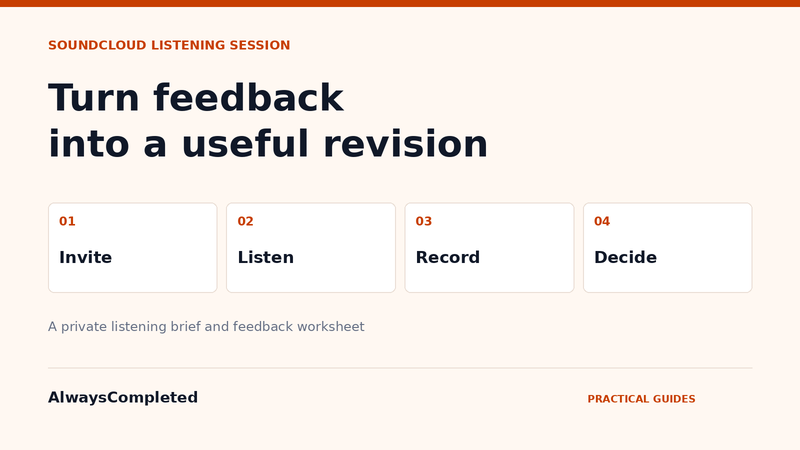
Run a Private SoundCloud Listening Session and Turn Feedback into a Revision Plan
A useful private listening session starts with one decision, a clearly identified track version and a small group who agree to give specific feedback. Ask listeners to describe what they heard and where, then turn the observations into a revision log. Do not treat every preference as a technical fault or every repeated comment as a vote that must change the song.
SoundCloud supports private sharing through a complete secret link and comments attached to moments in a track. Those features can support the process, but the questions, version record and editorial decisions are yours to organise. A secret link can be forwarded; it is not a guarantee that only the original invitees will hear the recording. Source: private links. Source: timestamped comments.
Use the original invitation template, feedback sheet and revision log. A complete fictional example appears below. No listening session was held, no participant was contacted and no audio was changed for this article. Platform instructions were checked on 25 November 2026.
1. Choose the question before choosing the listeners
Write the decision you still need to make. “Does the first chorus communicate the vocal clearly?” gives listeners a different task from “Does this arrangement keep your attention?” Avoid trying to settle composition, performance, mix, mastering, artwork and release strategy in one short session.
Choose a stage of the recording where the answer can still affect the work. If the arrangement is locked and a release is already scheduled, tell participants which changes remain possible. Otherwise, you may collect useful observations that arrive too late to act on, or invite a complete rewrite when only a final export check was intended.
| Decision area | Useful neutral question | What to avoid |
|---|---|---|
| Vocal clarity | Which words or phrases become difficult to follow, and at what time? | “The vocal is too quiet, right?” |
| Arrangement | Where did your attention change, and what was happening then? | “Should I cut the intro?” before a first listen |
| Technical playback | Did you hear a repeatable click, dropout or unexpected change? Note time and device. | Calling every unfamiliar sound a production error |
| Creative identity | Which moment felt most distinctive, and why? | Asking for a score that supposedly predicts commercial success |
Set one primary question and, if needed, one secondary check. Let listeners give an unexpected observation too. The goal is a useful response to the recording, not a form designed to confirm the artist’s preferred answer.
Define success for the session as a decision or a focused follow-up test: keep the arrangement, investigate a click, compare two vocal balances, or collect another perspective. A small voluntary listening group does not provide a representative market forecast, even when everyone likes the track.
2. Invite a small, relevant group voluntarily
Choose people whose perspective matches the question. A genre listener can describe how a transition feels; an experienced producer may help investigate a technical observation. Neither role makes every opinion decisive. Record the perspective so you can interpret the feedback without treating all comments as interchangeable expertise.
For a manageable first round, you might invite four to six people and request one focused listen plus a short note. That is a planning choice, not a statistically validated sample size. Include people who can disagree respectfully, and avoid asking only collaborators who already know every intended detail.
SoundCloud’s Get Heard material encourages connecting with people in your scene and replying meaningfully to comments. Apply that as a relationship-based invitation, not a mass request for matching praise or public engagement. The session’s value comes from independent observations, not a manufactured comment count. Source: community connection.
Ask permission before sending an unreleased recording, state the time commitment and make declining easy. If the arrangement is a paid professional review, agree its scope separately. Payment for time or expertise should not be a condition that the review is positive or posted publicly.
A short invitation you can adapt
“Hi [name], I’m reviewing [track title, version] before the next production decision. Would you be willing to spend about ten minutes on a private listen by [date and timezone]? I’m mainly checking [question]. If you are interested, I’ll send the private link and a short feedback sheet. Honest observations are welcome; there is no request to like, repost or leave a public endorsement. Please don’t forward the unreleased link. It is completely fine if the timing does not work.”
The template also includes the follow-up instructions to send after the person agrees. Do not paste a secret token into a public document or group whose membership you have not considered. Keep the listener roster and contact details separate from any aggregate summary you may share.
3. Prepare the private link and a fixed version
Use your own track or one you are authorised to share for review. Check that its privacy is set as intended. SoundCloud says private tracks do not appear on the public profile or in its search. On the web, use Share below the waveform to copy the complete secret link; the mobile share control is available from the track’s menu. Source: private-track visibility. Source: copying the secret link.
Send the full generated URL, including its token. A normal public-style track address may not grant access to a private recording. Test the intended route with an authorised participant or appropriate test context before relying on it for the group, and record any access problem separately from music feedback.
Keep the recording stable throughout a round. Give it a version such as Rooms After Rain — review v03, note its duration and record the file identifier in the sheet. If the audio changes while people are listening, identical timestamps may refer to different moments, and conflicting comments may simply describe different files.
Specify a feedback window and a preferred response method. Participants can use timestamped SoundCloud comments or the supplied sheet, depending on the agreed workflow and available controls. Do not require someone to post their feedback in a place they are uncomfortable using; a direct note with mm:ss and the version can serve the same editorial purpose.
If you need to revoke a secret link later, SoundCloud documents a reset through Share. It invalidates previous private links and is not reversible, so coordinate with anyone who still needs access before doing it. Resetting a link also does not recall a recording or note someone already saved. Source: secret-link reset.
4. Collect observations before discussion
For an asynchronous session, ask people to send their first observations independently before you circulate a group summary. For a live session, allow quiet note-taking before discussion. This makes it easier to distinguish separately noticed patterns from several people agreeing with the first confident speaker.
- Confirm the track version and listening setup: device, headphones/speakers and any relevant environment note.
- Listen once without pausing for an overall impression.
- On a second pass, note the exact moments relevant to the agreed question.
- Describe the audible event or experience before suggesting a fix.
- Include one element worth preserving and any uncertainty about the observation.
On SoundCloud’s web interface, a listener can click below the waveform to comment at that point and use replies to discuss it. The mobile instructions use the comment icon at the relevant second; mobile comments are listed in the comments section rather than displayed directly on the waveform. Including the timestamp in your separate record helps preserve the context across interfaces. Source: web comments and replies. Source: mobile comments.
A useful note sounds like: “At 00:47, when the pad enters, I lose the last word of the phrase on my earbuds.” It identifies a moment, an experience and a listening condition. “Boost the vocal 3 dB everywhere” jumps directly to a solution that may not match the cause or the intended balance.
For a possible technical defect, ask whether the listener can reproduce it at the same timestamp. If it occurs only once, record that too. The engineer can then distinguish a candidate file defect from a playback interruption, a device-specific issue or an intentional sound. Do not label the cause as confirmed before checking it.
Keep the request light enough that participants can complete it. Three precise notes are often more actionable than a long checklist filled with guesses. Allow “I didn’t notice a problem” and “I’m not sure” as valid responses; a compulsory criticism box can generate changes nobody actually believes are needed.
5. Separate technical questions, creative choices and strengths
Group comments by the underlying moment or issue, not by identical wording. Two listeners may describe vocal masking differently. Keep their original observations and attach a shared issue ID, rather than replacing both comments with a stronger statement that neither person made.
Classify the issue provisionally. A repeatable click is a candidate technical problem to verify. A request for a faster build is usually an arrangement preference. A clear hook is a strength to preserve. A listener struggling to access the link is an access issue, not a verdict on the music.
Repeated independent observations deserve attention, but they are not a universal voting threshold. Several people on similar devices may share the same listening condition. One precise report of a reproducible defect can be more useful than several vague opinions. Consider relevance, repeatability, artistic intent and the cost of testing the proposed change.
When feedback conflicts, restate the choice. “Two people disagree about the intro” is less useful than “One listener wanted the chorus earlier; another valued the gradual build. The intended listening context favours a patient opening.” You can keep the main arrangement, create an alternative later, or run a narrower comparison. You do not need to average incompatible creative preferences.
6. Turn the fictional session into a revision log
The following invented example concerns a 3:42 track called Rooms After Rain, review v03. Four fictional listeners, L01–L04, supply six observations. They are teaching records, not testimonials, real participants or evidence about any released recording.
| Note | Listener / setup | Time | Observation | Initial category |
|---|---|---|---|---|
| F01 | L01 / Earbuds | 00:47 | Last word becomes hard to follow as the pad enters | Possible clarity issue |
| F02 | L02 / Nearfield speakers | 00:48 | End of the vocal phrase feels masked | Possible clarity issue |
| F03 | L03 / Headphones | 01:28 | I wanted the chorus sooner | Arrangement preference |
| F04 | L04 / Headphones | 01:28 | The gradual build makes the chorus satisfying | Conflicting preference |
| F05 | L02 / Nearfield speakers | 02:16 | A small click was audible on a second listen | Candidate technical defect |
| F06 | L04 / Headphones | 00:12 | The opening synth motif is memorable | Strength to preserve |
The artist does not simply turn six notes into six edits. F01 and F02 become one clarity question. F03 and F04 describe a creative trade-off. F05 gets a verification task. F06 protects an element that could be lost during broad revision.
| Decision | Linked notes | Action | Owner | Verification / reason | Example status |
|---|---|---|---|---|---|
| R01 | F01, F02 | Compare two focused pad/vocal alternatives | Engineer + artist | Check phrase intelligibility without losing the intended atmosphere | Test queued |
| R02 | F03, F04 | Keep the main build for this version | Artist | Record the creative reason; revisit only with a specific alternative brief | Decision recorded |
| R03 | F05 | Check source and export at 02:16 before editing | Engineer | Reproduce on suitable playback; determine whether it is in the file | Verification queued |
| R04 | F06 | Preserve the opening synth motif | Artist | Check that other revisions do not obscure it | Preservation check queued |
This log distinguishes an intended edit from a completed fix. R03 remains a verification task until the click is reproduced and its cause understood. R01 remains a comparison until someone listens to the alternatives. R02 can record a creative decision without pretending that the disagreement has been scientifically resolved.
For each real change, assign an owner, target version and review date. Write an acceptance question rather than an arbitrary technical prescription: “Can the phrase be followed on the intended test setups while keeping the atmosphere?” is a clearer check than “Make the vocal better.” Capture the result and whether the change was kept, revised or rejected.
The downloadable feedback sheet provides ten blank observations. The revision log provides six blank decisions with space for linked note IDs, reasoning, owner, proposed change, verification method, target version and result. The example deliberately uses fewer decisions than observations because related notes belong together.
7. Update the audio without losing the review context
Close the first feedback round before changing the recording, and save the original notes with their version. If the arrangement or timing changes, keep both old and new timestamps where needed. A comment attached to the old second 01:28 does not necessarily describe the new second 01:28.
SoundCloud currently offers Replace file to Artist and Artist Pro subscribers for tracks not already monetizing through SoundCloud for Artists. The help page says replacement preserves statistics and comments. It also says a shorter replacement can remove comments from the shortened waveform while leaving them in the track’s comment section. Preserve the external revision log regardless. Source: replacement eligibility and comments.
The Artist subscription currently includes three track replacements per month, so check its allowance before planning repeated revisions. Confirm the actual account and track controls; do not assume every participant or collaborator can replace the file. Source: Artist replacement allowance.
For an already monetizing track, the replacement help directs the creator toward a new upload. Treat that as a separate release decision with consequences for links and existing work, not an instruction to replace a live campaign destination immediately. Coordinate any necessary change and retain a mapping to the old version before updating shared materials.
After a revision, ask a focused follow-up question about the changed part. Keep the playback comparison sensible and avoid making a louder version the obvious favourite merely through level difference. Review preserved strengths as well as the intended fix. A narrow second round is more useful than reopening every decision without a new question.
8. Close the loop with participants and the release team
Thank people for their time and summarise what you decided without requiring them to agree. A short response might say: “Two notes helped us investigate the chorus clarity. We are checking the reported click. We kept the longer build because it serves the main version.” Ask permission separately before using any comment publicly as a quote.
Mark the version ready for its next stage only when the required checks are complete. Save the approved file, remaining limitations and responsible owner. A listening session can improve the decision process without establishing that the release will attract a particular audience or meet a commercial target.
For the broader release plan, use the SoundCloud promotion guide. If you later compare SoundCloud services, evaluate their exact scope separately from this feedback exercise. Ordered praise, matching public comments or activity counts are not substitutes for voluntary listening or a qualified review of the recording.
