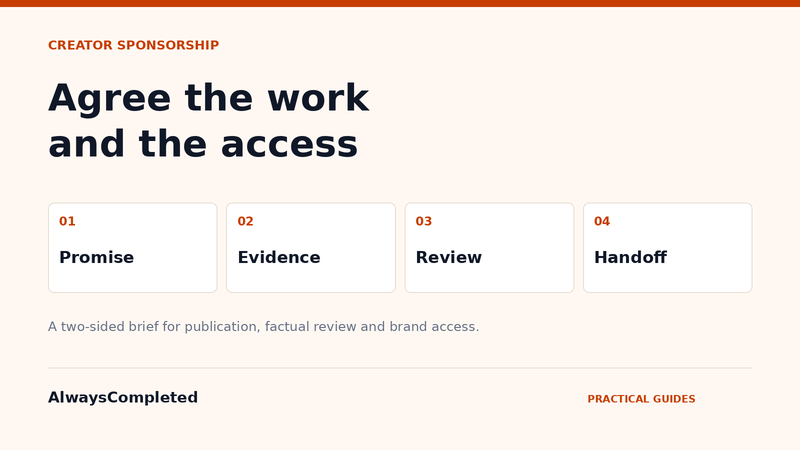
YouTube Creator Sponsorship Brief: Deliverables, Brand Access and Review
A useful YouTube sponsorship brief identifies what the creator will publish, which claims the brand can support and what access is requested beyond publication. Agree on those items before production begins. A friendly agreement to “feature the app” leaves the mention, review process and later advertising use undefined.
The two-sided brief below uses a fictional learning app to show how a creator and brand can make the work reviewable. It includes an acceptance table, factual review checkpoints and a separate brand-access record. All permissions in the DEMO remain pending. No creator deal, account or campaign was operated, and no rate or reach result is invented.
Agree on the viewer promise
Start with the reason the sponsorship belongs in the creator's video. What question does the viewer already have, and what can the sponsored segment usefully demonstrate? This keeps the brief focused on the audience's task rather than a list of product slogans.
For the fictional learning app, the viewer promise is modest: show how a learner creates a short practice plan and records a note after completing it. The brief does not claim that the app improves grades, saves a measured amount of time or produces a particular learning outcome.
Ask the brand to separate verified functionality from desired messaging. A feature request or roadmap item should not appear as a live product capability. The creator needs a current version, approved demonstration access and someone who can verify the relevant facts.
Preserve the creator's ability to explain the experience in their own voice. A factual review can correct a wrong feature name or unsupported statement without turning every sentence into a mandatory brand script. Record which elements are required and which remain the creator's editorial choice.
Define the publication deliverable precisely
Identify the channel, video type, planned mention placement and required assets. If the agreement includes a demonstration within a longer video, specify where it belongs in the viewing experience rather than assuming that any mention somewhere in the upload fulfils the brief.
Record the destination link, disclosure responsibilities and any required description or pinned-comment placement. Keep the link wording accurate. A link labelled “free worksheet” should not unexpectedly lead to a paid subscription page.
List version and review milestones: outline, demonstration plan, draft cut, factual review and approved publication candidate. Assign a response owner and turnaround expectation for each step. These are project terms to agree, not universal platform requirements.
Include the consequences of a late material change. If the app interface changes after filming, the parties need to decide whether the footage remains accurate, needs an explanatory update or must be rerecorded. A clear change record prevents the creator from absorbing an undefined revision request.
Separate publication from brand partner access
YouTube's brand partner access can enable a brand and authorized parties acting for it to see video performance information and use the supported creator-partnership advertising route. The documentation describes creator- and brand-initiated paths, with some creator options dependent on YPP status. It also advises parties to arrange usage agreements independently. Sharing brand partner access.
Therefore, keep three questions separate: what is published, what technical access is requested and what use the parties have agreed. A published sponsorship does not prove that the creator has accepted every possible advertising or reuse request.
The brief should name the requesting brand account and the intended operator. State why access is needed, which video it concerns and who verifies the grant. Use pending until the correct native state has actually been observed.
Do not place usable codes or sensitive account information in a public brief. Reference the approved private handoff. The example contains only invented placeholders, so it cannot be mistaken for a live access instruction.
Check the collaboration route without assuming eligibility
YouTube's Creator Partnerships tab is available to eligible creators in supported countries or regions. It can support discovery and management of brand enquiries, but its presence and options must be checked for the actual creator. Creator Partnerships availability.
A production brief can still be useful before the parties know which supported route is available. Mark that question as an owner task instead of inventing an interface screenshot or treating an unavailable tab as a reason to misstate the relationship.
Keep the agreement and production records accessible to both parties through their chosen working process. A platform message thread may hold important decisions, but the final version should still identify the agreed deliverables and remaining questions clearly.
The relevant brand account and channel should be verified before an access request is accepted. Similar names, an agency's involvement or a forwarded message do not replace that check.
Make factual review concrete
Give each claim an evidence owner. In the DEMO, “create a practice plan” is tied to a current app workflow. “Record a note” is tied to another visible action. A proposed “learn twice as fast” line has no support and is removed from the brief rather than softened into an equally unverified promise.
Ask the reviewer to identify the exact timestamp or script line that needs correction. “The app changed” is too broad. “At the demonstration's second step, the button is now called Save plan” gives the creator a defined task.
Review the full context after the correction. A technically accurate sentence can still imply an unsupported result when paired with a before/after image or an exaggerated headline. Keep the visual and spoken promise together in the evidence table.
Avoid requiring the creator to claim an experience they have not had. If the agreed work is a demonstration, describe it as a demonstration. A supplied app screen does not establish a personal endorsement, a long-term result or an independent test.
Accept the work against agreed evidence
Use an acceptance table with one row for each deliverable. It should name the version, requirement, responsible reviewer, evidence and state. An approved draft cut and a published video are different milestones.
For publication, retain the final URL and confirm the agreed mention, link and disclosure. If advertising access is part of the arrangement, verify that separately. Do not mark the entire project complete while a required permission or reporting handoff remains pending.
Reporting scope should be agreed before the creator is asked to supply data. Identify the metric, period, source and sharing method that the parties are authorized to use. A public counter is not a substitute for a private report, and a private report is not automatically available through every collaboration arrangement.
No brief can guarantee the audience's response. Acceptance should first establish whether the promised work was delivered. Campaign evaluation can then examine the actual evidence without rewriting a publication commitment as a guaranteed performance result.
Close the handoff and preserve the approved use
The final package should contain the agreed version, publication reference, relevant claim evidence, access state and unresolved items. Name who owns later changes to the destination or creative, especially if the brand plans a separate promotion phase.
For a campaign spanning Instagram as well, use the collaboration mechanisms guide to choose that platform's publishing arrangement separately. Do not copy an Instagram permission assumption into a YouTube handoff.
If the published video will receive an additional AlwaysCompleted order, compare its agreed URL and limitations with the current YouTube service description. Confirm the exact delivery unit and accepted object in View. A catalogue order does not imply sponsorship brokerage, access to a creator marketplace or permission to reuse the creator's work. Ask technical support about the service's own scope when needed.
The result of a good brief is a clear production decision: the creator knows what to make, the brand knows what evidence to supply and both know which approvals remain open.
