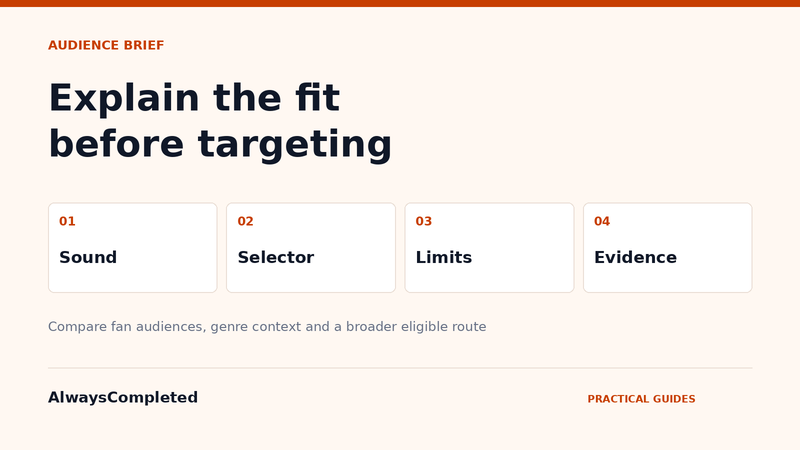
Spotify Fan Targeting vs Genre Targeting: Build a Music Audience Brief
Fan targeting and genre context answer different questions in a Spotify advertising brief. One starts with a listener audience associated with artists; the other starts with the listening context around the ad. Choose between them by explaining why the recording fits the proposed experience, then checking which controls are available for the actual campaign.
Do not turn a broad genre label into a claim that you know someone's identity, intentions or private characteristics. The worksheet uses musical observations and explicit unknowns. Its three audience proposals are fictional DEMO hypotheses, with no real account forecasts or campaign results.
Download the audience rationale worksheet and three candidate definitions
Separate the person from the listening context
Spotify's fan-base help describes audiences derived from listening signals, including fans of the promoted artist or other artists. Its targeting-options help separately describes contextual controls for In-Stream placements, such as music genre and podcast episode topics. These are not interchangeable labels.
For planning, write two different statements. An audience statement might say, “We want to investigate an available fan-base selector connected to similar music.” A context statement might say, “We want the ad to sit near a musical setting that suits this recording.” Neither statement establishes the exact people who will respond.
The distinction changes the creative question too. Someone hearing an ad after a suitable genre track may still be unfamiliar with your artist. The message needs to identify the promoted release clearly instead of assuming a shared fan relationship.
Explain the musical fit without copying a famous name
Listen to the approved recording and name observable features: vocal style, rhythm, instrumentation, energy and the occasion the music suits. Then explain why those features support the proposed audience or context. “Sparse electronic rhythm and close vocal” gives the reviewer more to assess than “sounds like a big artist.”
If another artist is used as an internal reference, identify the relevant musical connection honestly. A reference can help the team discuss a candidate selector; it does not give permission to use that artist's identity in the advertisement.
Spotify's fan-base guidance says artist/event promotion creative should mention and feature the artist or event being promoted, rather than other artists selected for targeting. Keep the external creative about the approved project. Do not turn “target listeners associated with X” into “X recommends us” or an implied collaboration.
Also write a reason to reject the hypothesis. Perhaps the selected artist is musically distant, the desired selector is absent or the brief depends on a demographic inference you cannot substantiate. A useful rationale can end in “do not use this option.”
Verify placement, market and restrictions
Record the actual selector label from the campaign setup. A phrase in a strategy document is not proof that a matching control exists. Keep the market, age range, format and placement with that observation so another person can understand the configuration.
The targeting help lists restrictions for under-18 delivery in the United States, United Kingdom and European Union, including unavailable fan-base and certain other audience options. Verify the applicable account and market rules. Do not try to recreate a restricted audience through a different label.
Keep the source date visible. This guide reviewed public documents on 26 November 2026, without entering a real account. The worksheet therefore leaves actual selectors and forecast values for an authorized operator to complete.
If a required control is unavailable, decide whether another legitimate route still answers the brief. Changing to a broader eligible audience can be a reasonable new proposal, but it should be approved as a different configuration, with its own reporting question.
Build three candidate definitions
The DEMO recording is fictional Northglass's Open Corridor. The assumed sound is a restrained electronic rhythm, an intimate vocal and a gradual chorus expansion. The worksheet turns those assumptions into three different proposals.
| Candidate | Musical rationale | Evidence needed before selection |
|---|---|---|
| Similar-artist fan audience | Investigate listeners associated with genuinely comparable music | Actual available selector, honest musical reference and applicable restrictions |
| Contextual genre | Investigate an eligible context that matches the recording's listening feel | Available In-Stream context and an explanation of why the ad belongs there |
| Broader eligible audience | Keep the introduction accessible without a narrow music selector | Approved market/age/placement, understandable creative and a defined review question |
These are candidates, not ranked recommendations. The broader option is not automatically wasteful, and the narrower option is not automatically more relevant or efficient. The choice depends on the actual controls, creative and decision the campaign is meant to support.
The asset includes an exclusion or rejection field for every candidate. This makes it possible to explain why an option was set aside, rather than keeping it in the plan because someone already spent time naming it.
Read the forecast as a planning input
Have the authorized operator record the forecast exactly as shown, including the settings and observation time. Leave the value blank when no account check has occurred. Do not substitute a made-up audience size or an estimated cost from another campaign.
A forecast can help identify a delivery constraint, but it does not prove how many people will become listeners. It also does not resolve a weak musical rationale. A candidate can be technically deliverable while offering little reason to expect the creative will make sense in that context.
When comparing proposals, change one meaningful element at a time in the planning record. Preserve the previous settings so the team can see whether a different forecast followed from market, age, placement, fan-base choice or another adjustment. Do not present a bundle of changes as evidence about a single selector.
The worksheet does not authorize a live experiment. It organizes the proposal, spending boundary and reporting question that a real campaign owner would need to approve.
Plan the delivery review before launch
Choose the evidence that can answer the question. Spotify's delivery-insights guide distinguishes music genre, podcast topics and streaming context. A music-genre breakdown reflects the preceding listening context; it is not a complete profile of every person's music taste.
Use the report to inspect what was actually delivered within its scope. Keep report date, filters and definitions with the observation. A selected audience and a resulting breakdown are different records: the former is the configuration, the latter is the available delivery evidence.
For a later audience-response review, use the appropriate report for that campaign system. Avoid calling every ad impression a listener or every attributed listener a newly acquired lifelong fan. The Spotify audience goal scorecard helps define the decision before those numbers are collected.
Finish a proposal someone can approve
Write the chosen candidate, actual selector, musical reason, restrictions checked, remaining unknowns and next review. Name who approves creative, targeting and spending. If the evidence is incomplete, “clarify” is a useful decision; it avoids inventing precision at the point where money would be committed.
The AlwaysCompleted Spotify promotion guide describes catalogue objects and deliverables. Native fan-base or genre controls are not automatically included in a promotion package. If those exact controls matter to your requirement, ask technical support to confirm the channel and scope in the selected listing before ordering.
The finished rationale should explain why the candidate fits this recording and what evidence could change the decision. It should not promise access to “the exact fans” or claim that a narrow setting guarantees lower costs or better results.
