Spotify Ads Manager or Spotify for Artists? Choose the Right Campaign System
Choose the Spotify campaign system before commissioning creative or comparing a promotion quote. An audio advertisement, a sponsored release recommendation and an unspecified external promotion package can all be described casually as “Spotify ads.” They require different evidence about the destination, account, work and report.
Start with one sentence: We want an authorized operator to use [named system] to introduce [exact music object] through [format], with [defined report] available afterward. If a bracket cannot be filled, keep it as an open question. A confident guess makes the eventual quote harder to evaluate.
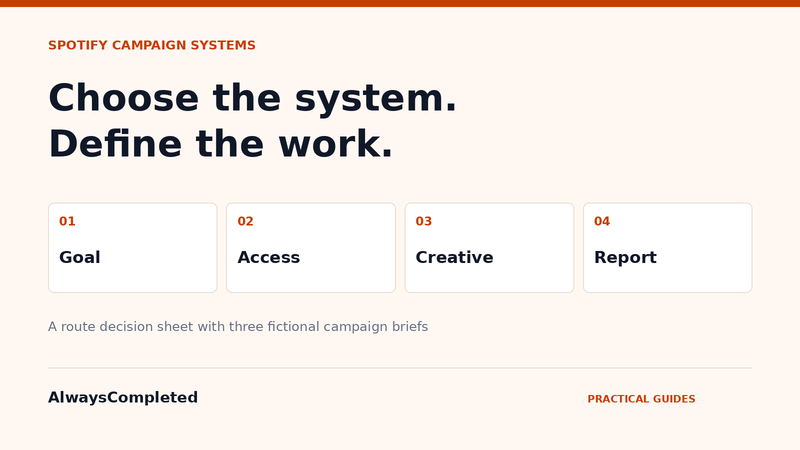
This guide provides a route decision sheet with six criteria and three fictional briefs. It helps you identify a system to investigate; it does not establish eligibility or forecast audience response. Public documentation was checked on 26 November 2026. No advertising account was opened or campaign activated for the examples.
Download the six-criterion route sheet, three DEMO briefs and blank decision record
Identify the system behind the proposed work
Spotify's audio specifications describe audio advertising through Ads Manager and Direct IO. Its display-campaign help places Marquee and Showcase in the Campaigns area of Spotify for Artists. These are different production and account routes.
The useful question is not whether one route has the more impressive name. Ask what the listener will encounter. Will they hear a produced message with music and a call to action? Will they see a release recommendation? Or has the proposal not named the actual channel yet?
Write the answer in ordinary language beside the product name. That prevents a vague phrase such as “promote the artist” from concealing a disagreement about what is being bought. Also identify who is operating the system. A freelancer using an authorized account, the artist's own team and a catalogue service with an unspecified network are different arrangements.
| Question in the brief | Evidence to request | Decision it supports |
|---|---|---|
| What will the listener encounter? | Named system, format and a description of the actual placement | Which production route to investigate |
| Which music object is promoted? | Exact release, track, artist or playlist URL and the selected destination field | Whether the route accepts this object |
| Who can operate and approve it? | Account owner, authorized operator and approval contact | Whether work can start in the right account |
| What must be produced? | Required creative, versions, rights and acceptance checklist | What belongs in the creative quote |
| What spending is authorized? | Current proposed media commitment and separately identified work fees | What the client is agreeing to pay for |
| What will be reviewed? | Named report, definitions, access route and review date | Whether the evidence can answer the campaign question |
The table is an original procurement method. It is not a list of controls guaranteed to exist in every Spotify account. Ask for proof from the setup that would actually be used.
Match the destination to the intended listener action
“Listen to the single” and “explore the artist's catalogue” are different requests. A playlist can be a destination in its own right; adding a track to somebody else's playlist is a separate action. Record the exact object before discussing price or creative.
For an introduction built around sound, the team might want an audio ad containing a recognizable section of the recording, the artist's spoken name and one listening invitation. That makes the creative file and the click destination important acceptance items. For a reminder about an eligible release, the team may instead investigate the Spotify for Artists display route. Neither planning choice proves that an account or release qualifies.
Check the destination from the recipient's point of view. Does the link identify the approved version? Is the recording available at the planned time? If the proposal involves a playlist, are you authorized to promote that list and maintain its access? A route that can be configured technically can still lead to the wrong music.
Keep planned actions distinct from results. “Invite people to listen” describes the creative purpose. It does not promise that everyone reached will play, save, follow or return. The report must preserve those distinctions instead of replacing all of them with a generic success total.
Confirm access and billing before the handoff
Write down the person who owns the relevant account and the person who will perform each task. Avoid the instruction “send Spotify access”: a normal listener account, an artist team and an advertising business are not interchangeable handoffs.
Spotify's display documentation includes country, payment and audience eligibility conditions. Use the current document and the actual setup to resolve them before marking that route available. The detailed comparison of Marquee, Showcase and Discovery Mode covers the separate decision inside the artist-tool family; this article concentrates on selecting the system and defining the commission.
Ask who approves spending, creative changes and the final destination. A person authorized to supply artwork may not be authorized to accept a larger media commitment. Put those decisions in separate fields even when the same person handles them.
A useful handoff also says how the client will receive evidence. They may have suitable account access, an agreed export or an authorized report from the operator. Decide this before launch, rather than discovering afterward that only a cropped screenshot was included. Do not collect passwords or recovery codes in the decision sheet.
Quote the creative work explicitly
For an audio route, define whether the quote includes script writing, music selection, voice recording, mixing, companion artwork, revisions and final specification checks. A finished song is not automatically a finished advertisement. The voice and music have to communicate together, and the final message must match its destination.
For a release-display route, ask for the actual assets and fields requested by that setup. Do not commission a voiceover solely because another Spotify advertising product uses audio. Conversely, a release cover alone does not answer a brief for a produced spoken introduction.
Record a version for each supplied item and name the approver. “Approved creative” is incomplete if one person means yesterday's artwork while another means the new export. Keep the approval tied to the exact file, copy and destination.
When comparing two offers, separate media activity from preparation work. One quote may include a completed creative package; another may assume the artist supplies it. A lower total can represent less work, a different format or a different campaign window. Resolve those differences before treating the prices as comparable.
Ask for a report that belongs to the selected route
Describe the question the report must answer. For example: what was delivered during the agreed campaign, what listener action is observable, and what evidence will support the next decision? Then ask the operator to identify the actual report fields and their definitions.
Do not demand a metric solely because another Spotify product displays it. Record the reporting system, object, date range, attribution or observation window where applicable, and the person who can supply it. If an outcome cannot be established by that report, keep it outside the promised evidence.
The three briefs in the download illustrate different decisions:
- DEMO A: an audio introduction. The artist wants a spoken introduction around a music excerpt. Ads Manager audio is a candidate, with account, destination and production requirements still to verify.
- DEMO B: a release reminder. The team wants a sponsored recommendation of an existing release. Spotify for Artists display is a candidate, subject to eligibility and actual available setup.
- DEMO C: an unnamed “Spotify Ads” offer. The channel and report are absent. The decision is to clarify the offer, not to label it Ads Manager from its wording.
None of the briefs represents a completed campaign. The value of the record is that an unknown remains visible until someone supplies the missing evidence.
Use the sheet to reach a specific next decision
For each of the six criteria, mark what is known, identify the evidence and assign an owner to the unresolved question. A decision is ready when the important parts agree: the intended listener experience, accepted object, authorized operation, creative, spending and reporting.
If two candidate routes remain, compare complete briefs rather than switching between isolated features. You may discover that one route fits the present release while another belongs in a later plan. You may also decide to complete the creative or resolve access before buying any media.
The AlwaysCompleted Spotify promotion page describes catalogue destinations and deliverables. Its advertising guide explains why a service label does not by itself identify a network or creative-production scope. Open the current listing's View details with the completed route sheet beside you. If your requirement is specifically native Ads Manager operation, ask technical support to confirm the system, operator and reporting before treating it as included.
Finish with a written decision: candidate confirmed for further setup, clarification needed, or hold. Add the missing proof and the person responsible. This turns “we need Spotify promotion” into a brief that can be assessed and priced without inventing what the service delivers.
