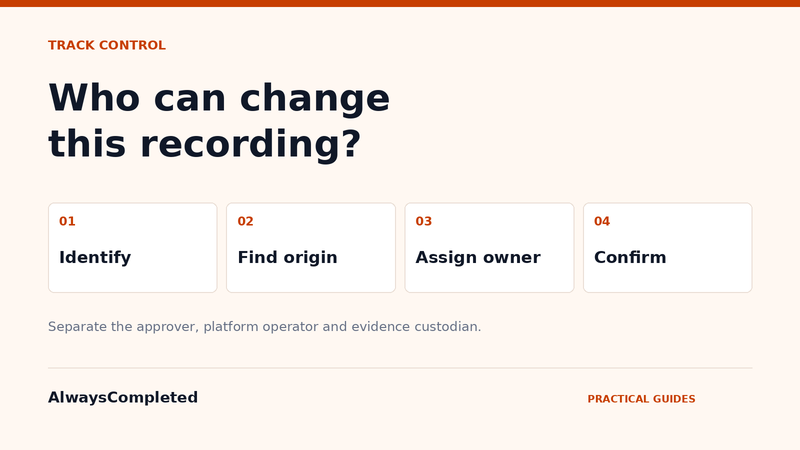
Who Controls SoundCloud Monetization? Artist, Label and Distributor Workflows
Before a SoundCloud campaign, find the person who can manage the specific recording you intend to promote. Being the performer, owning a profile or paying for promotion does not by itself tell you who controls that recording's delivery, metadata or monetization setup.
The practical output is a short ownership handoff: the exact track, how it arrived on SoundCloud, who can make the requested change and what evidence supports that assignment. This prevents a simple campaign adjustment from becoming a series of requests sent to people who cannot act.
The downloadable matrix includes three fictional recordings and a request for a missing rightsholder connection. Public documentation was reviewed on 26 November 2026. The examples contain no real account access, royalty figures or completed corrections.
Download the ownership routing matrix, three DEMO records and missing-rightsholder request
Identify the recording before assigning its owner
Start with the complete SoundCloud track URL and the displayed artist and title. Add the version or mix description and any release or delivery reference available to the authorized team. A campaign named after the album is not a sufficient identifier if several mixes or separately delivered copies exist.
Ask the person who supplied the link how that recording arrived on the platform. Look for a relevant upload record, distributor delivery record or confirmation from the rightsholder. If the answer is uncertain, mark the origin unknown. Do not fill the gap by looking at the profile name and assuming direct artist control.
The distinction matters even when the same individual performs several roles. An artist may upload one track directly and have another delivered by a label's distributor. Their name is the same, but the route for correcting each recording may differ.
Understand the three control routes
SoundCloud's monetization ownership guide describes three routes: an independent manual upload; content ingested through a distributor or label; and a manual upload connected to a rightsholder's network. It says distributor-ingested content is managed through that delivery relationship, while a missing linked rightsholder may require the rightsholder to allowlist the profile.
Use that model to choose whom to ask. It does not prove which route applies to your recording. The linked guide also retains legacy plan wording, so this article uses its ownership distinction without treating the old subscription terminology as current eligibility advice.
For a directly managed upload, ask the authorized uploader to inspect the relevant controls and confirm what they may change. For delivered content, bring the release and delivery references to the appropriate distribution contact. For a linked arrangement, establish both the uploader and the rightsholder contact rather than treating either as the sole owner of every task.
Separate operational control from rights evidence
A visible edit control tells you what the current session can attempt. It does not settle every contractual or rights question. Conversely, a person with an ownership document may still need the distributor or account administrator to carry out the platform action.
SoundCloud's rights-verification guidance explains the need for appropriate rights and supporting documentation. In your handoff, identify who holds the relevant evidence and who can supply it through the proper support route. Do not attach an entire confidential agreement to a public campaign brief.
Keep three responsibilities separate:
- Decision authority: the person authorized to approve the requested change.
- Platform operator: the person or organization able to carry out the relevant action.
- Evidence custodian: the person who can provide the documentation needed to support it.
One person may hold all three responsibilities. Recording them separately still helps if that person is unavailable or if a particular correction requires another party.
Route the actual change, not a general ownership question
Describe the desired result precisely. “Fix the track” could mean a misspelled title, an incorrect territory, a rights-verification request or an unresolved delivery. Each needs different evidence and may have a different operator.
| Proposed change | Evidence to prepare | Useful question for the responsible party |
|---|---|---|
| Correct displayed metadata | Current value, approved replacement and recording identity | Which record should be corrected, and who submits it? |
| Investigate territory access | Exact URL, observed message and intended market | Is this access intended, and who can inspect its configuration? |
| Resolve a rightsholder connection | Profile and recording references, expected relationship | Has the correct profile been connected to the intended network? |
| Clarify monetization status | Actual status observation and rights custodian | What remains incomplete, and which party owns the next step? |
Avoid asking for a takedown or replacement merely because it appears easier than locating the operator. The existing URL may already be used in creative, press materials or an active campaign. First understand whether the needed correction can be made through the established route and what the change would affect.
Build a handoff that survives a team change
The asset includes one completed record for each ownership route. The fictional examples do not simply label an owner; they specify the evidence, the requested action and the unanswered question.
For a manual upload, the handoff asks the uploader to confirm the approved metadata edit. For a distributor-delivered recording, it identifies the delivery reference and requests confirmation of the appropriate correction route. For a linked upload, it separates the artist's file record from the rightsholder's network confirmation.
In a real project, add a named contact and backup, a date and a place where the response will be stored. A message saying “the label will handle it” is not a durable handoff unless the label contact has accepted the task and knows which recording is involved.
Use a change log when the response arrives. Preserve the original approved value or state, record the authorized correction and note the evidence of completion. The team should be able to distinguish a requested change from a reported change and from an observed result.
Handle a missing rightsholder without guessing
If the expected rightsholder is absent from an available selector, preserve the exact profile and track references and ask the rightsholder to confirm the relationship. Include the name you expected to see and the evidence linking the recording to that organization.
Do not select a similarly named organization merely to complete the form. Do not treat an empty or unexpected option as proof that the artist owns every relevant right. The request template in the download asks for confirmation and the correct next step, leaving the platform action with the authorized parties.
No passwords, recovery codes or private payment details belong in this request. The useful evidence is the identity of the objects and the relationship that needs to be established.
Confirm campaign readiness separately
A recording can have an identified owner while still being unready for promotion. Verify the approved URL, public access for the intended audience, current version and the unresolved changes that might affect the campaign. If a correction is pending, assign someone to decide whether the campaign should wait.
The Spotify or SoundCloud release workflow covers the broader distinction between platform publication and distribution. This handoff focuses on control of the individual SoundCloud recording, so it can be attached to that broader release plan without replacing it.
The AlwaysCompleted SoundCloud promotion catalogue concerns promotion of eligible targets. It does not give a promotion operator control over a distributor's rights or monetization settings. If an existing order could be affected, provide technical support with the order reference and authorized change proposal before assuming a different URL or new order is appropriate.
End with a clear record: this person approves, this party operates, this evidence supports the request, and this destination remains approved for promotion. That is a usable ownership answer even when the team is still waiting for the platform action itself.
