Which SoundCloud Artist Plan Fits Your Next Campaign?
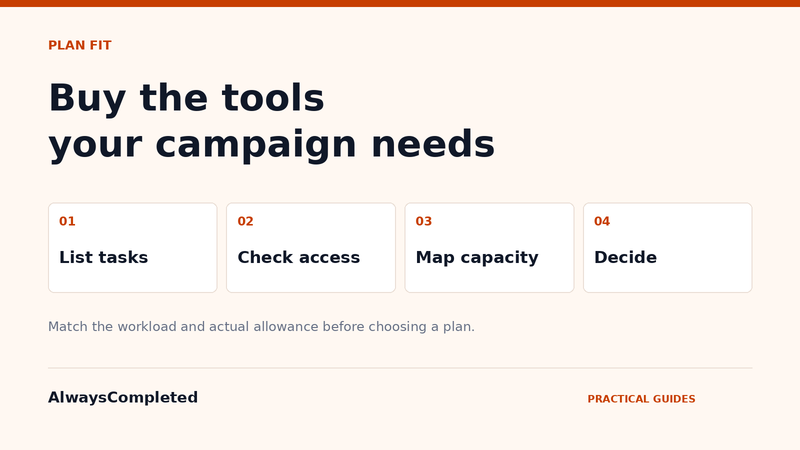
Choose a SoundCloud artist subscription from the work you need to complete during the next campaign period. A larger plan is useful when it supplies a required tool or capacity; the plan name does not establish that you will attract more listeners or recover its cost.
Start with a dated workload: the recordings you will upload, edits you expect to make, profile positions you need, distribution tasks and questions you want the reports to answer. Then compare that workload with the features actually available to your account and market.
The requirements matrix contains three fictional campaign plans, with current-price fields left blank. Public documentation was reviewed on 26 November 2026. No subscription was purchased or account eligibility tested for these examples.
Download the plan requirements matrix, three DEMO workloads and blank decision record
Define one planning period and its essential tasks
Use a specific start and end date, such as the month covering preparation and initial release review. Count the tasks you are actually proposing. “We may release more music someday” is not the same requirement as uploading an additional finished EP during this period.
For each task, record whether it is essential, useful or outside the present plan. This prevents an attractive feature list from expanding the campaign while you are trying to price it. An advanced report only belongs in the essential column if somebody knows what decision it will inform and will have time to review it.
Separate new uploads from replacements. Separate a prominently displayed track from an attempt to introduce it to more listeners. Separate delivery to other platforms from activity on SoundCloud itself. These distinctions make the feature comparison much more useful than a general “promotion tools” row.
| Planned task | Question before choosing a plan | Evidence to retain |
|---|---|---|
| Add recordings | How much actual upload capacity remains? | Current account allowance and planned file durations |
| Revise existing audio | How many replacements are genuinely required? | Version plan and available allowance |
| Feature the release on the profile | How many simultaneous Spotlight positions are needed? | Current feature access and profile plan |
| Use Amplify | Which recordings are intended, and are they eligible? | Actual feature availability and selected tracks |
| Distribute or monetize | Which authorized recordings need this workflow? | Rights readiness, account access and remaining allowance |
| Review audience evidence | Which report or Fans task supports a decision? | Available tool and named reviewer |
Check the account and market before comparing features
SoundCloud's artist subscription guide lists Basic, Artist and Artist Pro, with Artist available only in selected territories. The published Artist package includes a three-hour upload limit, three monthly replacements, one Spotlight position and limited monthly distribution, monetization and Amplify use. Artist Pro lists unlimited upload time, Advanced Insights and five Spotlight positions.
Use those published distinctions to identify candidate plans, then verify the actual offer and account state. Do not copy an advertised allowance into the “remaining” column. Previously used credits or existing uploaded audio can change what is available for the next task.
There is also a documentation inconsistency worth handling explicitly: the subscription comparison page gives different Basic upload limits in its introduction and table. This guide therefore does not choose one as a universal rule. Record the allowance shown in the relevant account and clarify a conflicting offer with SoundCloud before relying on it.
That is a practical reason to date your comparison. A saved planning decision should identify the evidence used, not merely the plan name.
Plan around capacity and credit timing
Suppose a fictional artist has one finished four-minute single and no planned audio revisions. Their immediate question is whether the current account has sufficient space and the specific release tools they need. Upgrading because another artist has a larger catalogue would not answer that question.
Now suppose a second project expects several review rounds. Count approved replacements separately from speculative drafts, and assign an audio approver. A more disciplined approval process may reduce unnecessary platform changes; a larger allowance does not resolve an unclear master-selection process.
SoundCloud's subscription guide says Artist credits do not carry over and relates the cycle to the initial purchase date. Use the actual subscription record to establish the relevant reset, rather than assuming every balance refreshes on the first day of a calendar month. Its upload guidance also explains why remaining capacity matters when adding audio.
Place task dates beside the allowance dates. If a required action falls before the next reset, the plan needs a specific decision: reduce or postpone the task where appropriate, verify an alternative allowance, or change the subscription. Do not quietly assume unused credits from an earlier period will fill the gap.
Check feature eligibility beyond the subscription label
Some tools have additional conditions. The Fans documentation describes a beta for Artist Pro with monetized, Fan-Powered Royalties-related requirements and rollout conditions. Buying the plan does not prove that a usable fan list will appear immediately in a particular account.
Write the actual need as a task: “review available fan information and prepare relevant individual follow-ups.” Then record whether the tool is visible and whether the necessary data exists. If it does not, choose a campaign review you can actually perform. Do not make a purchase decision depend on a presumed list of people you have not seen.
The same discipline applies to distribution and monetization. Feature access is one requirement; a recording's rights and delivery readiness are separate. The plan cannot supply missing permissions or turn an unapproved master into a release-ready recording.
Compare three workloads rather than three status labels
The download provides three original examples:
- One independent single: a small release with one approved master and a limited profile task. The decision begins with current capacity, not a presumption that Pro is necessary.
- Several revisions: a project with a defined audio approval sequence. The critical question is whether the planned replacements fit the actual period and allowance.
- Catalogue review: a campaign involving several recordings and a specific need for deeper reporting. Advanced tools are evaluated against the decisions the team will make.
Each example leaves account availability, current price and reset evidence open. The workloads are fictional; their counts are planning inputs rather than official quotas or recommendations for every artist.
For step-by-step use of an individual feature, consult the existing Amplify guide or profile and Spotlight audit. This matrix makes the purchase decision across tasks without repeating those setup guides.
Keep subscription and promotion spending separate
Record the current subscription offer, currency, billing period and any relevant checkout terms in one line. Put external creative work or promotion in another. That makes it possible to see what each commitment supplies and avoids counting the same planned task twice.
The AlwaysCompleted SoundCloud promotion page describes catalogue promotion activities, not the sale of SoundCloud's native Artist or Artist Pro subscription. Review the selected service's current View details after the destination and tool requirements are clear. Ask technical support about any uncertain target or deliverable rather than assuming a native feature is included.
End with a specific decision: keep the current plan, investigate an available upgrade, or postpone a nonessential task. Include the evidence that would change that decision. A sound subscription choice fits the work you have approved and leaves a visible budget for everything else the campaign still needs.
