Instagram Click-to-Message Ads: Design the First Useful Conversation
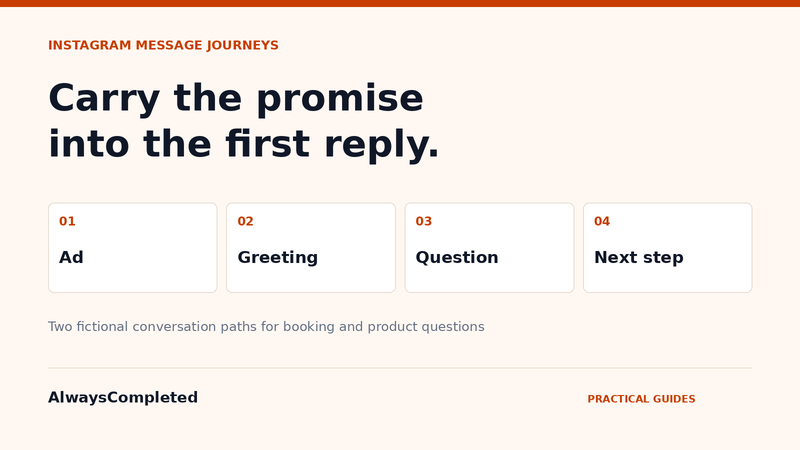
An Instagram click-to-message ad should begin a useful conversation, not merely open an inbox. The person who taps has just seen a specific promise. Your first reply needs to acknowledge that promise, ask a relevant question and make the next step clear.
The editable ad-to-DM script board uses a fictional photography studio to connect two ad promises with welcome copy, qualification branches and a human handoff. It distinguishes draft templates from replies that require a person to review the conversation.
Choose Instagram as the intended destination
Meta's click-to-message lesson describes messaging destinations including Instagram, Messenger and WhatsApp, with welcome templates and common-question responses. Decide which destination the campaign actually needs rather than treating all messaging applications as interchangeable.
If the ad promises an Instagram conversation, verify that the receiving identity and selected destination match. A team that also uses WhatsApp should not assume an Instagram visitor has consented to continue there. Explain any later handoff and let the person choose an appropriate contact route.
Write the receiving account, inbox owner, working hours and backup owner in the brief. Confirm the team can see and respond to the intended messages through its authorized setup. Meta's Business Suite overview explains the shared account and messaging environment, but the actual connected accounts and permissions still need to be checked.
Carry the ad's promise into the greeting
For the fictional Northline Photo studio, two campaigns may need different openings:
DEMO portrait ad: “Planning new team portraits? Message us on Instagram with your preferred month and team size. We will explain the studio and on-site options.”
DEMO product ad: “Need clear photos for a product launch? Message us with the product type and approximate number of items. We will help define the shoot brief.”
The portrait greeting should not ask about product dimensions. The product greeting should not assume an office headcount. If both ads enter the same inbox, preserve enough context for the responder to identify the intended conversation. Do not ask the visitor to repeat information that is already available and clear.
A simple welcome can be: “Thanks for contacting Northline Photo. Are you planning team portraits or a product shoot?” Use that shared entry only when the team genuinely needs to distinguish the two. A more specific welcome is preferable when the campaign context is known.
Ask questions that change the next step
Every question should have a reason. A preferred date helps assess availability; team size helps scope a portrait session; product type identifies the required setup. A question that nobody uses adds friction without improving the answer.
| Branch | First useful question | What it changes |
|---|---|---|
| Team portraits | Approximate team size and preferred month? | Studio versus on-site discussion and capacity check |
| Product photography | What type of product and how many items? | Shoot format and preparation requirements |
| Unsure about the service | What will the images be used for? | Clarifies whether either service fits |
Ask about a budget range only when it helps offer a suitable scope and the team is prepared to explain the options. Avoid presenting a range as a firm quote before the necessary details are reviewed. If the visitor's request falls outside the service, give a direct answer instead of continuing qualification for its own sake.
Separate a template from a human commitment
A welcome template can acknowledge the enquiry and state what information is useful. A human should confirm claims that require current judgment, such as availability, final scope or an agreed quotation.
Use clear internal labels: draft template, approved template, human reply, and pending review. Do not paste an unapproved draft into a live campaign merely because it reads naturally. The responsible business owner should approve the offer and response-time wording before configuration.
For an after-hours route, say when the team normally reviews messages without promising an immediate person. “We review enquiries during [hours and time zone]” is clearer than “Someone is typing” when nobody is available. Provide a useful question the visitor can answer while waiting.
Rehearse the booking and product paths
In the worksheet's fictional portrait route, a visitor asks about twelve colleagues next month. The first response confirms that the studio needs a preferred date and location before checking capacity. The conversation then moves to a human availability review. It does not mark a booking merely because the visitor supplied a date.
In the product route, the visitor has six reflective bottles. The response asks how the images will be used and whether the products can be delivered to the studio. The human then prepares a scope discussion. The template does not promise a price or claim the studio can meet an unreviewed launch deadline.
Also rehearse an ambiguous message and an unsupported request. A good flow offers a useful next step in both cases. If the visitor asks a question outside the prepared options, the team needs a human route rather than a repeated menu.
Measure conversation progress honestly
Separate an opened conversation, a substantive enquiry, an agreed quotation and a confirmed booking. These states answer different questions. A high number of greetings may show that people entered the chat, while saying little about the fit of the offer.
Define each state before reviewing campaign results. Record the evidence source and owner. Avoid copying private message content into broad marketing reports; a redacted reference and a clear status can support the review without exposing unnecessary personal details.
When improving the script, record what changed and why. For example, replacing “What is your budget?” with “What will the images be used for?” changes the qualification sequence. Treat any later performance difference as an observation that needs context, not automatic proof that one sentence caused the result.
Confirm the service you are buying
If the requirement is an Instagram messaging ad campaign, state it explicitly when comparing advertising and promotion options. Confirm account ownership, destination, setup responsibility and reporting scope. For separate Instagram promotion services, check the exact object and metric in the selected description.
Followers, Reel views and a click-to-message campaign are different deliverables. Technical support can clarify a catalog service's conditions; a metric-based order should not be presented as guaranteed enquiries or bookings. The completed conversation brief gives the business a concrete specification for the work it actually needs.
Documentation reviewed 26 November 2026. Examples are fictional; no customer account or campaign was tested for this guide.
