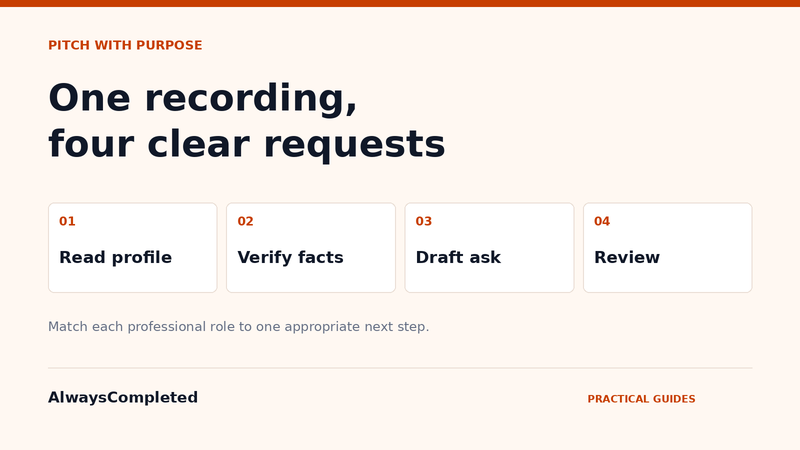
Build a Groover Campaign Brief: Match Each Professional to One Clear Request
A Groover campaign brief should make it easy for each professional to understand why you contacted them and what you are asking them to consider. A playlist curator, radio programmer, label and booker can hear the same recording while needing different information and offering different possible next steps.
Build one accurate core pitch, then add a short request that fits the recipient's published role and criteria. Personalization means connecting relevant evidence to a useful request; inserting a name into “please promote my song” does not do that work.
The download contains a fictional core pitch, four role-specific modules and an explicit no-fit decision. Documentation was reviewed on 26 November 2026. These are original teaching drafts, not messages sent to real professionals.
Download the core pitch, four personal modules and evidence-to-request cards
Define the professional outcome you want to request
Write the desired next step in a sentence. “Consider this track for your playlist” is different from “tell us whether the project suits your label's release focus.” Neither is the same as asking a booker to evaluate a live act.
Keep the request within what the recipient actually offers. You may want a record deal, but the immediate appropriate request might be consideration of a demo and confirmation of the correct next step. Do not convert an aspiration into an obligation implied by paying for a submission.
Groover's pitch guidance recommends identifying the aim, using a concise general pitch and adapting personal messages to different professional roles. The method here turns that guidance into a record of evidence, request and supplied material.
Read the profile before writing the personal line
For each candidate, save a dated reference to the relevant profile criterion. It might concern genre, release status, language, territory, format or the type of work the professional considers. Record what the profile actually says, without inferring an invitation from a familiar name or large audience.
Then identify the fact about your project that satisfies the criterion. If a programme accepts clean radio edits, the relevant fact is that an approved clean edit exists and can be supplied. A vague claim that the track is “perfect for radio” is less useful.
| Evidence-to-request step | Useful entry | Weak substitute |
|---|---|---|
| Observed criterion | Specific current profile requirement | “They seem influential” |
| Relevant project fact | Verifiable recording or release detail | “This will be our biggest song” |
| Requested next step | One consideration the role can offer | “Promote us everywhere” |
| Supplied material | Correct link or approved file reference | A folder with unexplained drafts |
| No-fit reason | Clear mismatch that excludes the recipient | Ignoring a restriction to enlarge the list |
A no-fit decision is a productive result. It preserves credits and attention for a request that makes sense. The worksheet deliberately excludes one fictional instrumental-only profile from a campaign for a vocal recording.
Prepare the listening route and basic release facts
Groover's first-campaign guidance describes accepted listening-link examples and the release information used in the campaign flow. Verify the current accepted format and make sure the actual link opens the intended version for the recipient.
A private listening link needs an access check. An unreleased song needs an accurate release date or status. A radio version and an explicit version need unambiguous labels. The brief should point to the approved file rather than leaving the recipient to decide which draft is final.
For each claim, keep a source within the team: approved metadata, a release plan, a permission record or a genuine performance record. You do not need to include every source in the short pitch, but somebody should be able to verify the statement before it is sent.
Avoid unsupported superlatives, invented support quotes and unverified audience totals. If the track is a debut, describe the actual recording and plan; it does not need a fictional history to justify consideration.
Write a core pitch with two useful facts
The fictional example in the download introduces Nera Aven's song “Glass at Dawn.” Its core facts are the approved release date and the arrangement's voice-and-piano foundation with a hand-played percussion section. Those facts are specific enough to be checked inside a real project.
The core also identifies the release status and points to the approved listening link. It leaves the professional request to the personal module. That keeps the shared text accurate across recipients without making every person read several unrelated ambitions.
Read the pitch aloud and remove sentences that only repeat excitement. Keep details that help the recipient understand the project or choose an action. If a fact changes, update the core once and review every planned use that depends on it.
Adapt the request to the work the recipient does
For a curator, connect an observed listening context to the recording and ask for consideration within that context. Do not ask the curator to manufacture streams or promise a fixed audience response.
For radio, identify the relevant edit, language or programme requirement and offer the appropriate approved material. A request for airplay should still respect the programmer's choice and any submission requirements.
For a label, explain the current release situation and the specific kind of relationship you want to discuss. Keep rights and availability accurate. A track already committed elsewhere should not be described as available for a deal without confirmation.
For a booker, connect the recording to an actual live format and usable performance evidence. Do not invent venue history or audience draw to make a studio-only project appear ready for a tour. If the necessary live evidence does not exist, that missing material is a decision to resolve before sending.
The four modules use the same fictional recording but make different requests. They are not four versions of a generic demand for exposure.
Check the campaign summary and response conditions
Review the actual recipient list, messages, listening link, release details and current cost before authorizing a campaign. Confirm that each personal module belongs to the intended recipient. A well-written radio request sent to a label is still a configuration mistake.
Groover's sharing guidance leaves coverage decisions to the professionals. Its response-period guidance distinguishes regular submissions from other products and explains applicable credit returns. Read the current rule for the chosen route; a response commitment is not a contract, booking, broadcast or playlist placement.
Assign someone to record actual replies. Separate a message received, an invitation to continue, a promised action and an observed publication. Those states should not collapse into one “success” count.
Reuse the facts while respecting a different service scope
The music blog pitch guide addresses a separate email-style editorial approach, while the curator outreach tracker helps manage real responses after a campaign. Use those tools where their task fits rather than treating every contact as the same workflow.
The AlwaysCompleted music release page describes Send Promo and submission routes with their own approval requirements. An approved pitch can help prepare materials, but it does not establish that a listing includes a Groover account or its professionals. Ask technical support to confirm the current accepted materials and deliverable for the service you are considering.
The final brief should answer four questions plainly: why this recipient, which verified fact matters, what single next step is requested and what material supports it. If those answers do not connect, revise the request or remove the recipient before spending.
