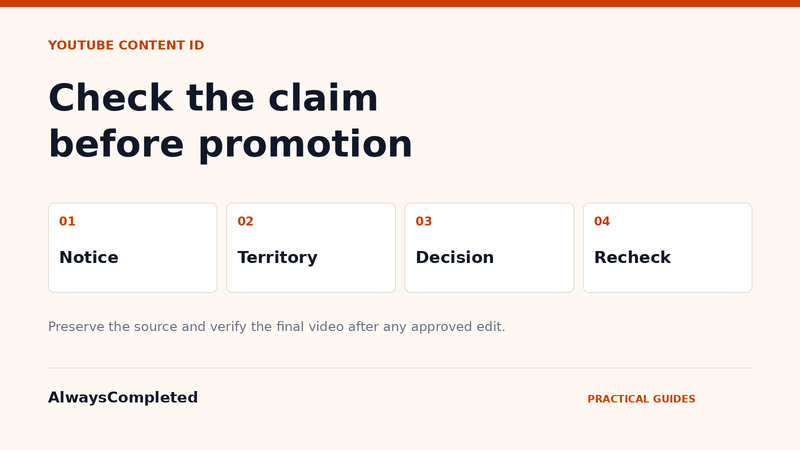
YouTube Content ID Preflight: Check a Video Before Promotion
Before promoting a YouTube video with a copyright notice, record the exact restriction, affected segment and relevant territories in YouTube Studio. Then decide who is authorized to resolve the issue and which checks must be repeated before the video is used. A claim label alone does not describe every effect on viewing, and a viewable video does not establish permission for every use.
YouTube distinguishes Content ID claims from copyright removal requests and strikes. Claims can involve blocking, monetization or tracking, and effects can differ by country or region. Inspect the actual video details rather than treating every notice as a channel-wide takedown. YouTube copyright claims.
The original preflight record includes three fictional DEMO cases: a tracked long-form video, a territorial block and claimed music. No copyright claim, edit or dispute was processed. The record supports an operational handoff, not a legal conclusion that the material is cleared. Official guidance was reviewed on 26 November 2026.
Read the video-level evidence first
Identify the exact upload, its publishing format and duration. Record the claimant shown, the matched segment and the displayed effect. If the notice includes a territorial distinction, retain it alongside the campaign's intended geography.
Keep the original text or a private screenshot reference. A team message saying “copyright problem” is too vague for a producer or operator to act on. The person responsible needs to know whether the video is unavailable, remains viewable with a claim or has another explicitly stated condition.
Do not infer the condition in one territory from a successful viewing test elsewhere. Record the test context and the platform's stated regional effect separately. When the promotion brief names a country, that country becomes a specific preflight requirement.
Treat a new notice as a new observation. An earlier clean check does not establish the present state after a content change or another rights-holder action. Keep dates with each observation so the promotion operator knows what was last verified.
Do not apply the long-form example to every Short
The format matters. YouTube's current guidance identifies special handling for Shorts longer than one minute with an active claim, so a tracked long-form example must not be reused as evidence that a claimed Short remains available. Check the relevant format and duration conditions in the linked claims guidance.
The DEMO track-only case deliberately uses a fictional four-minute horizontal video. Its example observation is that the item remains viewable in the checked context. That observation would still not establish rights for a new advertising use or availability everywhere.
If the planned campaign uses a separate Short cut, give it its own record. Different uploads can contain different music, edits and matched segments. A rights review of the full video is not automatically a review of the teaser.
Similarly, keep a Google Ads disapproval separate. A video can have a Content ID issue and an advertising policy issue at the same time. The video-ad correction guide covers the advertising notice and its affected object.
Assign the decision to the content owner
The operator arranging promotion should not guess whether a claim is justified or whether the owner should dispute it. Give the content owner the actual notice and relevant evidence, then record the authorized decision.
Possible operational decisions include leaving the upload unchanged while the owner investigates, preparing a permitted edit or using another approved asset. A dispute, if the owner considers it appropriate, is a separate process requiring the relevant basis and evidence. This checklist does not determine that basis.
Write down who controls the source project and audio. The person who can access YouTube Studio may not have the editing files or the authority to change a licensed master. Identify those dependencies before scheduling the campaign around an assumed quick fix.
Keep a working distinction between “promotion paused pending a decision” and “video prohibited forever.” The first describes the team's current readiness. The second is a much broader claim that the available evidence may not support.
Preserve the source before considering an edit
YouTube describes trimming a claimed segment, replacing a song or erasing claimed audio where the relevant options are available. It also warns that saved Studio edits can no longer be reverted through the former restore workflow. Preserve the source and review the result carefully before saving a consequential edit. Remove claimed content.
Create an edit decision record with the affected interval, proposed change and approved version. Note what the edit could remove from the story: spoken explanation, a demonstration step, a sponsor mention or a transition needed for continuity.
A technically successful audio change may make a video confusing. Preview the whole affected section and its neighboring transitions, then review captions and any timestamps in the description. If a claim affects the core material, a different approved creative may be more suitable than an edit that destroys the video's purpose.
Keep backup confirmation factual. “Source exists” should identify who has it and where the working reference is stored. Do not rely on an inaccessible old download or assume that the platform will restore the prior cut.
Three cases that need different handoffs
DEMO A: tracking on a long-form video
A fictional four-minute tutorial shows a tracking-related claim in the example record and is viewable in the checked context. The campaign operator preserves that observation and asks the content owner to confirm the intended use.
The next decision is not automatically to edit. The owner may need to inspect the claim and the relevant rights context first. The handoff remains conditional until the campaign's object, geography and use have been reviewed.
DEMO B: a block in the intended campaign territory
A fictional launch video can be opened in one context, but its claim details identify a block in the market named in the brief. A generic “video opens” check would miss the campaign-specific problem.
The operator pauses the affected promotion plan and gives the owner the exact territorial information. If the owner resolves the issue or selects another approved video, the final destination must be rechecked. The example does not claim that changing a campaign's region establishes rights or resolves the original notice.
DEMO C: claimed music in a demonstration
A fictional demonstration has a matched music segment overlapping the narrator's explanation. The editor considers the available audio options and their effect on the spoken content.
Before any change, the source backup and owner approval are recorded. After processing, the team would inspect the resulting sound, captions, claim state and availability. No successful edit or clearance is claimed in the DEMO.
Recheck the final object after processing
When an approved edit has been processed, inspect the actual published video and current restriction state. Do not mark the issue complete merely because an editing request was submitted. Retain the new observation time and any remaining notice.
Check continuity, audio, captions and the promised content. If the original video description references a removed segment, update the relevant editorial material through the authorized process. Keep the final URL and version with the promotion handoff.
If a replacement upload is used, explicitly map old and new references. Other scheduled posts or advertisements may still point to the old object. Change only the references that are meant to move, and preserve the reason in the working record.
State readiness narrowly
A useful final status says which video was checked, for which intended use and territory, what is currently observed and what remains unresolved. “Ready for the specified promotion handoff” is an operational decision supported by those facts; it is not a universal legal certification.
Before choosing an AlwaysCompleted order, compare the current YouTube service requirements with the accessible video URL, format and geography in that record. Confirm the actual accepted input and delivery scope in View. A promotion order does not remove Content ID claims or establish rights to the material.
For an existing order affected by a changed video state, give technical support its order ID and the exact object issue. Keep the content owner's rights decision and the service's operational response as separate records so both can be handled accurately.
