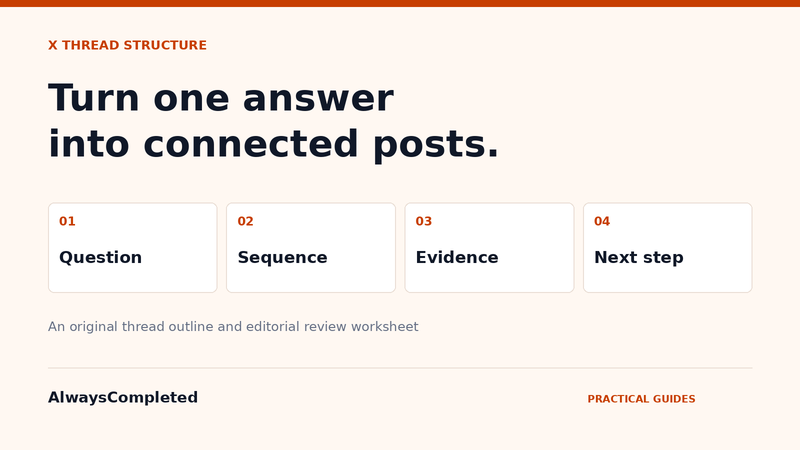
X Thread Structure: Turn One Detailed Answer into Connected Posts
Build an X thread around one question, then give each connected post a job in answering it. Choose the example and evidence before drafting the opening. This produces a sequence whose reasoning survives when a reader sees one post on its own or arrives halfway through.
The original seven-post example below belongs to a fictional shop and explains how to choose a pouch for a notebook. Its dimensions are DEMO values, not a real product specification. The downloads include the complete annotated sequence and an editable outline. No posts were published and no reach, sales or audience response was measured.
State the one question the thread answers
Start with a question a reader can recognize: “How do I choose a pouch that fits my notebook?” Keep the answer within that scope. A thread that begins with fit and ends with an unrelated story about starting a business asks the reader to assemble two different arguments.
Write a one-sentence answer before the first post: “Compare the notebook’s actual dimensions with the pouch’s usable interior and opening, then check any remaining fit uncertainty.” That sentence becomes your editing rule. Each post should help the reader understand or apply it.
Decide who the explanation serves. A first-time buyer needs to know what to measure and which product information to request. A product designer might need construction tolerances and material specifications. The DEMO addresses the buyer; it does not pretend to be an engineering fit standard.
Then define the reader’s final action. In this example, the action is to record the item’s dimensions and ask the shop for any missing interior or opening measurements. It is a useful next step even if the reader decides not to buy. That makes it a better conclusion than an unsupported promise that a particular size will fit everyone.
Choose evidence and the example before writing the opening
For a real shop, collect approved product dimensions, how they were measured and any relevant explanation of the opening or closure. Keep the source beside the draft. If the product page lists only outside measurements, mark the missing information rather than inventing an interior measurement.
The fictional example uses a notebook measuring 21 × 15 × 2 cm. One pouch has an internal length of 20.5 cm; another has a listed interior of 22 × 16.5 × 3 cm. These values let us demonstrate comparison, including an obvious length mismatch, without claiming that the second pouch has passed a physical fit test.
Choose an example that can expose a limit. If every example automatically proves the recommendation, the thread becomes a sales assertion rather than an explanation. Here, the opening and closure remain checks even when the interior dimensions look promising.
Keep observed and hypothetical material visibly different. “In our test, the notebook fitted” would require an actual test record. “In this DEMO, the listed dimensions leave room on paper” is a narrower statement that the numbers support. Do not let an attractive opening turn the second into the first.
For a result-based thread, the credible case-study guide offers an evidence worksheet for claims, dates and limitations. The writing format differs, but the habit of preserving what the evidence establishes is useful here too.
Give seven posts seven clear jobs
X defines a thread as a series of connected posts and documents adding posts in the composer before publishing them together. That connection supplies navigation; it does not supply the argument. You still need a deliberate order. See X’s thread guide.
The DEMO uses seven posts because the answer needs seven small steps. Seven is not a recommended minimum or a growth formula. If your answer is complete in four, stop at four. If an explanation needs a diagram or a longer source, give it the space it needs rather than cutting away an essential qualification.
Post 1: name the question and the answer
DEMO post: “1/7 DEMO shop guide: choosing a pouch for a notebook? Compare the notebook with the pouch's usable interior and opening. A size label alone does not answer the fit question. Here is a fictional worked example.”
The first post makes a promise the sequence can fulfill. It states that the example is fictional and offers a method, not a universal size recommendation. Avoid opening with a surprising statistic you cannot document simply to create suspense.
Post 2: define the input
DEMO post: “2/7 DEMO notebook: 21 x 15 x 2 cm when closed. Measure your own item, including any cover or binding that must fit. Write down all three dimensions; do not substitute the paper-size name for the whole object.”
This post tells the reader what to collect. It is useful by itself because the object and action are named. A vague continuation such as “Do this first” would make much less sense when reposted separately.
Post 3: identify the comparison data
DEMO post: “3/7 DEMO pouch comparison: A lists an internal length of 20.5 cm. B lists an interior of 22 x 16.5 x 3 cm. Check that the seller means usable inside space, not outside dimensions. Ask if the measurement method is unclear.”
Now the reader knows what the product information must describe. The post introduces both candidates without claiming an actual seller supplied these values. In a real thread, link or identify the approved specification where that makes the comparison checkable.
Post 4: show the reasoning
DEMO post: “4/7 With the DEMO notebook length of 21 cm, pouch A's 20.5 cm interior is 0.5 cm shorter. B's listed interior is larger on all three dimensions. That makes B a candidate to check, not a proven fit.”
The calculation is small enough to verify. More importantly, its conclusion stays within the evidence. The larger interior is a reason to investigate B, not a claim that the item has been inserted and the zip closed.
Post 5: introduce the missing condition
DEMO post: “5/7 Before choosing the DEMO pouch B, check its opening and closure. An item must pass through the opening as well as fit inside. Ask for the usable opening measurement and any stated fit limits.”
This limitation belongs beside the recommendation, where a reader might act. Do not hide it in a final disclaimer that can be separated from the claim. The thread should help a buyer notice the missing information before ordering.
Post 6: state what has not been tested
DEMO post: “6/7 These are fictional dimensions, not a physical fit test or a guarantee. Materials, shape and the closure can affect the result. For a real product, use its current specifications and ask the seller to resolve what is missing.”
The uncertainty is specific. It does not cancel the useful comparison; it explains what additional evidence would be needed. This is better than a generic “results may vary” sentence that leaves the reader unsure what to do next.
Post 7: finish with one usable next step
DEMO post: “7/7 Before ordering, note your item's three dimensions, the pouch's usable interior and its opening. If a field is missing, ask before choosing. Save that short comparison with the product link so you can review the actual specification.”
The final post turns the explanation into a small working record. A commercial link can follow when it points to the relevant approved product or guide. It should not replace the answer the thread promised.
Preserve context when a post travels alone
X documents different thread displays, including collapsed longer threads and separate posts on a profile. Readers may therefore encounter a fragment before the complete sequence. Keep the central noun, relevant condition and evidence label in the posts that need them. Source: X thread guide.
Read posts three, four and six without the others. Can a reader tell that the products and dimensions are hypothetical? Can they distinguish a candidate from a tested result? If not, restore the missing context locally rather than relying on the opening to protect every later claim.
Numbering helps orientation, but it is not a substitute for meaning. “4/7” tells the reader a position; “the DEMO notebook length” tells them what the comparison concerns. Use both when they make the sequence easier to follow, and remove numbering if it becomes misleading after a substantive revision.
Keep the reading burden sensible. Repeat the minimum context needed for accuracy, not the entire introduction. A post should normally have one main job. When it tries to introduce a problem, show three calculations and deliver a CTA, split it at the point where the reasoning changes.
Check references, media and the final destination
Before composing in X, check every fact against the approved source. For dimensions, verify units and whether the values are internal or external. For a numerical comparison, recalculate it. For a claim about a result, record the actual observation and period instead of relying on a remembered summary.
If an image carries a table or diagram, the essential meaning should also be available in readable text or an appropriate description. Do not make the image the only place where the example is marked DEMO or where a crucial limitation appears. Review labels at the size the audience will actually see.
Use the composer’s current limits for the account and format. This example keeps each post short, but the article does not claim one universal length limit for all X accounts or post types. A draft that looks short in a document still needs a final composer check, particularly after links or media are added.
Verify the destination attached to the final post. It should open the promised guide, specification or product, and its information should agree with the thread. An outdated product page can undermine an otherwise careful explanation.
Review the published order and keep a correction plan
Preview the whole draft in order, then check individual posts again. Confirm that every transition follows from the previous step. The reader should not need to infer a missing measurement or assume that an unperformed test occurred between posts.
After authorized publication, reopen the thread from its first post and from a middle post. Verify the connected sequence, visible media, links and any collapsed display. Record the real post URLs and publication time. The worksheet leaves those fields blank because this article’s example has not been posted.
X documents adding another post from a thread’s detail page. That can support an explicitly labelled clarification, but it does not erase an inaccurate original claim. Decide how to correct the specific mistake using the options available to the actual account, preserve a record and recheck the public sequence. Source: X thread guide.
When reviewing results later, distinguish whether people saw a post, opened the destination or completed a relevant action. Do not call a thread successful solely because one fragment gained attention while the explanation or destination remained unclear.
Downloads and next action
For a broader release plan, the music-release content series helps organize separate stories over time. This template is for one answer developed through connected X posts.
When considering X promotion services, identify the exact profile or post and its stated metric. Keep that brief separate from the editorial acceptance test: a reader should be able to follow the thread, verify the example and understand the next step.
