X Communities: A Membership and Publishing Workflow for Brands
Before planning a brand post for an X Community, confirm where that group actually operates now. A topic match, an old Community link and a membership-related service listing do not establish that the former publishing route is available. Start with the current destination, then check its rules and prepare something useful for the people discussing that topic.
There is a material status issue behind this advice. In a dated announcement on 23 April 2026, Nikita Bier gave 30 May as the deadline to transition to XChat. X's Communities Help still describes the earlier joining model. A surviving Help page should therefore not be treated as proof that every documented Community action still works today. Primary transition announcement
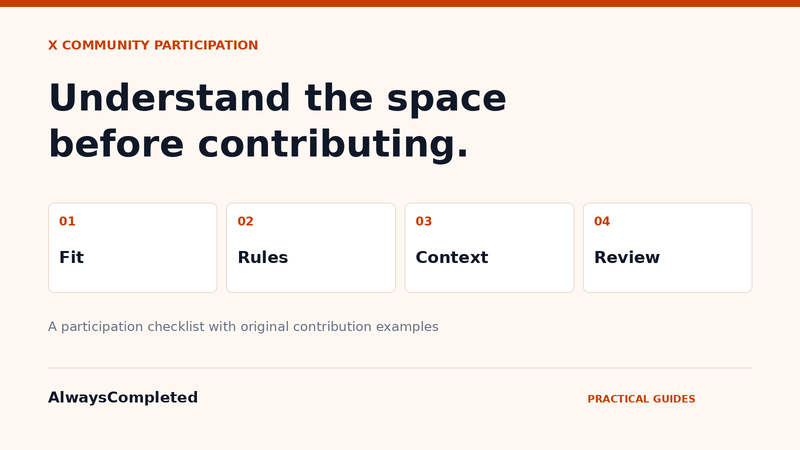
This guide turns that conflict into a practical decision process: identify an active venue, establish the actual entry route, review local rules, draft a contribution and record the response. The participation card and three teaching examples are original DEMO materials. No Community was joined, message sent or moderator decision observed for this article.
Confirm the destination before drafting
Open the group's current public information and look for an identifiable owner, a clear purpose and an actual participation destination. Record the address and date checked. If an old Community page points elsewhere, verify that the new destination is the one the owner currently identifies, rather than assuming any similarly named group is the continuation.
Keep three outcomes separate. An active and identifiable destination can proceed to a rules review. A page that only preserves older information needs further confirmation before you plan to post. A missing or unavailable route should be marked unavailable, with the contribution held or adapted for another appropriate venue.
Do not promise that membership, old posts, permissions or participant preferences transfer automatically. A discussion feed and a group conversation can require different pacing and expectations. Write down what the new group is for and what members have actually agreed to, rather than carrying an old promotional plan across unchanged.
Current X Chat Help documents public group invite links: people request entry and are added after approval; administrators can disable those links. That is a useful current starting point when the owner supplies a Chat destination. It is not evidence that an old Community has been migrated or that a particular request will be approved. X: current Chat Help
Choose by the problem people discuss
Write the member's question before writing the brand's objective. “How can I compare an organiser's usable space with the items I need to store?” provides a much better contribution brief than “Find people who might buy organisers.” The first gives you a practical question to answer even if no sale follows.
Read the current description and rules for the actual destination. Look for boundaries covering commercial affiliation, external links, product feedback, repeated material and any required discussion format. Record the relevant wording or reference. If a rule excludes the planned contribution, a more polished introduction does not create permission.
Buffer's general advice about Communities is to find relevant people and conversations. Retain that topic-first principle while checking platform availability against primary sources. Do not use an older feature walkthrough as proof that the same controls remain available. Buffer's X guide
For research across other venues, the subreddit discovery worksheet offers a separate topic-and-rules process. Its Reddit-specific controls and conventions do not become X rules. The transferable habit is to identify a concrete discussion and assess your proposed contribution against that venue's own requirements.
Establish the real membership state
Record the account that will participate, its relationship to the brand and the observed entry state. “We found the group,” “we requested entry” and “we can contribute” describe different situations. Assign one person to confirm the state, instead of treating a submitted request as completed membership.
For a current Chat invite route, confirm the actual link and the group's stated process. After requesting entry, wait for the relevant approval and inspect the conversation you can access. If entry remains pending, prepare the draft offline; do not report the group as joined or move the same unsolicited pitch into other people's inboxes.
The older Communities Help describes public-account eligibility, open joining after rules review, and restricted requests with or without member invites. Treat these as the documented legacy model. Use any such route only if it is actually available to the participating account and consistent with current owner instructions. X: Communities Help
Membership is an access state, not a standing approval of advertising. The same distinction is useful in the Facebook Group membership worksheet, although that article concerns a different platform. An admission decision does not settle the suitability of a later post, message or link.
Observe the contribution format
Read several recent relevant discussions before deciding what to add. Note the question being answered, how much context people provide and whether replies stay useful without an external click. This observation helps you write appropriately; it does not establish that every visible post received affirmative moderator approval.
A concise answer may fit an active chat better than a long resource announcement. A process explanation might fit a dedicated discussion when the rules permit it. If people ask for a comparison, answer the comparison before suggesting a resource. Avoid turning an unrelated conversation into a delivery channel for a prepared campaign message.
Do not invent a quota of helpful replies that earns promotional rights. The Reddit self-promotion guide explains why local rules matter even where ratio advice circulates. On X, use the actual venue's requirements and current platform policy, not an imported percentage or a count of previous interactions.
Keep the observation record small: the discussion reference, the relevant need, your intended answer and the applicable rule. You do not need a speculative profile of individual members. The purpose is to improve the contribution, not to classify every participant as a sales prospect.
Prepare a self-contained contribution
The first teaching draft answers a practical measurement question. It separates usable space, the item's widest point and the opening. The fictional author identifies their connection to making organisers. There is no sales link, fabricated test or claim that a particular product fits the reader's home.
The second draft explains a small piece of work actually constructed for the teaching material: a draft brief split into separate measurement fields. It is a process note, not a customer case. When adapting it to your business, use a real dated document and say exactly what you changed; do not borrow the DEMO voice as evidence of work you never did.
The third draft is an intentionally unsuitable link drop. It declares a product the best, asks for a purchase and adds a mailing-list request without answering the discussion. The correct response is not simply to soften the sales language. Remove the unsupported claim and decide whether you have a useful, permitted contribution at all.
Apply a link test: what specific information does the destination supply that the answer needs? If the answer works without it, consider leaving it out. If a link is essential but the rules prohibit that destination or activity, choose another permitted format or decline to publish there.
Make the commercial relationship clear
Tell readers when you made the resource, work for the brand or have a relevant commercial relationship. That context belongs beside the recommendation, where it can affect interpretation. A profile biography alone may not explain the connection when a short contribution is read outside its original setting.
For compensated third-party promotion, consult X's detailed Paid Partnerships Policy. It currently requires the Paid Partnership disclosure setting for covered organic posts and explains the relationships it covers. Check the actual composer and applicable policy before publication; do not assume a casual affiliation sentence replaces the required platform disclosure. X: Paid Partnerships Policy
The examples are teaching drafts, not completed disclosure checks for a real campaign. If the relevant control is unavailable, or the local group prohibits the promotion, hold that promotional draft. A clear label helps readers understand a relationship; it does not override the group's rules or validate an unsupported claim.
Verify visibility and participation separately
The Communities Help contains conflicting participation descriptions. Its introduction limits engagement to members, while its visibility section describes non-member replies subject to moderator restrictions. It also describes Community posts appearing beyond the Community. Do not infer privacy or a universal right for every non-member to reply from that page. X: visibility sections
For any available Community composer, inspect the selected destination and current reply controls before publishing. For Chat, inspect the actual conversation, membership and current Chat settings instead. Those are separate products and evidence checks. A public invite link is not itself a complete description of who can read every message or how the conversation is configured.
Record what you observed and when. If a required audience or participation control cannot be confirmed, keep the draft pending or choose a contribution that does not depend on that assumption. Use material you are authorised to share; do not place confidential client information in a discussion on the strength of an old Help paragraph.
Review the response and decide whether to return
After a permitted contribution is actually submitted, keep its reference and the feedback that changes the next action. A relevant follow-up question may justify a clearer explanation. A correction requires checking the claim. Silence is an absence of observed feedback, not approval, rejection or evidence of commercial success.
If a moderator identifies a rule problem, record the reason and revise the plan. X's legacy moderator playbook describes hiding rule-breaking posts and removing members. Do not repeatedly repost the same material to work around a decision. Use whatever clarification process the current venue provides, or stop participating there. X: moderator playbook
The AlwaysCompleted X service guide distinguishes a join request from completed membership and separates membership from discussion activity. Because the platform's Community route has changed, verify current availability and scope before considering any related listing. A service description cannot establish moderator approval, current access or permission to advertise.
The next useful action is specific: confirm one active destination, complete the participation card and adapt one contribution to its real discussion. Submit it only when access and rules support that action, then record the actual response. If the venue is unavailable or unsuitable, keep the useful work and choose a more appropriate place for it.
