Spotify Podcast Discovery Analytics: Find the Next Question to Test
Spotify podcast discovery analytics can show where your content appeared and what happened next within the platform's reporting definitions. Use that information to choose a specific check: inspect the show's promise, review the episode people encounter or examine a listening passage. A change in a chart does not, by itself, identify the title, Clip or algorithmic decision that caused it.
Begin by naming the object and period. A show-level discovery report, an individual episode's completion rate and a shared-link report describe different groups of activity. Putting their numbers beside one another is useful only when those differences remain visible.
This guide includes an original annotated DEMO report with three scenarios, a decision worksheet and a compact visual card. Every show, figure and proposed editorial action is fictional. The report is a teaching document, not a Spotify screenshot, account export or measured campaign result.
Select the show or the episode first
Choose show scope when the question concerns the catalogue's entry points or overall discovery pattern. Choose episode scope when you want to examine one recording's introduction, promise or listener route. Write the actual show or episode URL in the review record before copying any figures.
Spotify documents show discovery under Analytics → Discovery, and episode discovery under the selected episode's Analytics → Discovery. Individual sections can be exported as CSV. Discovery report locations
Keep the export intact and add interpretation in a separate working record. Retain the report name, period, filters and extraction time. If a metric is unavailable in the account or selected scope, record that condition instead of substituting a similarly named metric from another screen.
These instructions describe the documented creator workflow. They do not imply that an ordinary listener profile gives access to a show's analytics. The fictional report remains usable for learning the method without connecting an account or claiming a show you do not manage.
Match the measurement windows before comparing values
Decide whether the question needs a calendar interval or equal time since publication. A calendar week can describe a show's recent distribution. An episode comparison often needs a matching age window so a three-day-old release is not treated as though it had the same opportunity as a mature episode.
Write the release date and actual interval next to each episode. Save the selected dates even if the application offers a convenient preset. “Last week” loses its meaning when a screenshot or spreadsheet is revisited months later.
Separate freshness from scope. Spotify's current glossary lists different refresh schedules: plays update more frequently than impressions and completion measures. For example, impressions refresh on a 48-hour schedule, while completion rates update daily. Analytics glossary
An export made at one time can therefore contain measures with different update rhythms. Do not interpret a temporarily uneven refresh as a change in audience behavior. Note when the record was captured and schedule a later review if the intended interval is incomplete.
Historical definitions also matter. Spotify announced a 30-second play-count standard on June 11, 2026. When comparing an older saved report with a current one, check the definitions attached to both rather than assuming the same word guarantees the same measurement. This guide does not infer how every historical export was recalculated. Spotify's measurement update
Keep impressions, plays and completion distinct
An impression records a display of content, not a unique person or completed listen. Discovery conversion describes impressions leading to plays. The current play definition requires at least 30 seconds of watching or listening on Spotify. The glossary defines episode completion around reaching 95% during the first seven days after publication. Discovery definitions · Metric glossary
Do not turn that sequence into an invented person-level journey. The reports are aggregates. One person may encounter more than one item, and a play count is not necessarily a count of distinct people. Multiplying a play total by a completion percentage does not automatically produce a valid number of completed unique listeners.
Average completion at show level also needs its own cohort. Spotify's glossary refers to recent episodes with seven days of data; its Discovery guide describes completion for episodes published in the selected period. Record the actual eligible episodes and label shown in the report. Do not treat the rate as an average over every play in an arbitrary calendar interval.
Consumption time answers another question: how much watching or listening time accumulated. Spotify's Engagement guide separates total and average consumption time from its episode-completion view. Preserve those units. Minutes, percentages and counts should not be relabelled as one generic “engagement” total.
Read the source categories as exposure locations
Spotify groups discovery locations into Home, Library and Search. Search includes more than typed queries; the documentation also places charts and editorial recommendations there. Source categories
Use those labels to identify a change in where exposure occurred. They do not reveal why a recommendation was selected or tell you the exact words a person searched. A source label should remain a source label in your working record.
Check whether the rows belong to the same report and interval before adding them. Do not add a show total to its episode totals: that can count overlapping activity again. Do not add shared-link clicks to in-app impressions and call the result unique reach. The worksheet keeps these scopes in separate fields.
A new source mix can change an aggregate rate even when the same number of plays occurs. That possibility is a reason to inspect the source breakdown, not a claim that the breakdown alone explains the outcome. Audience intent, release activity and the content shown may also have changed.
Scenario one: review the promise at the entry point
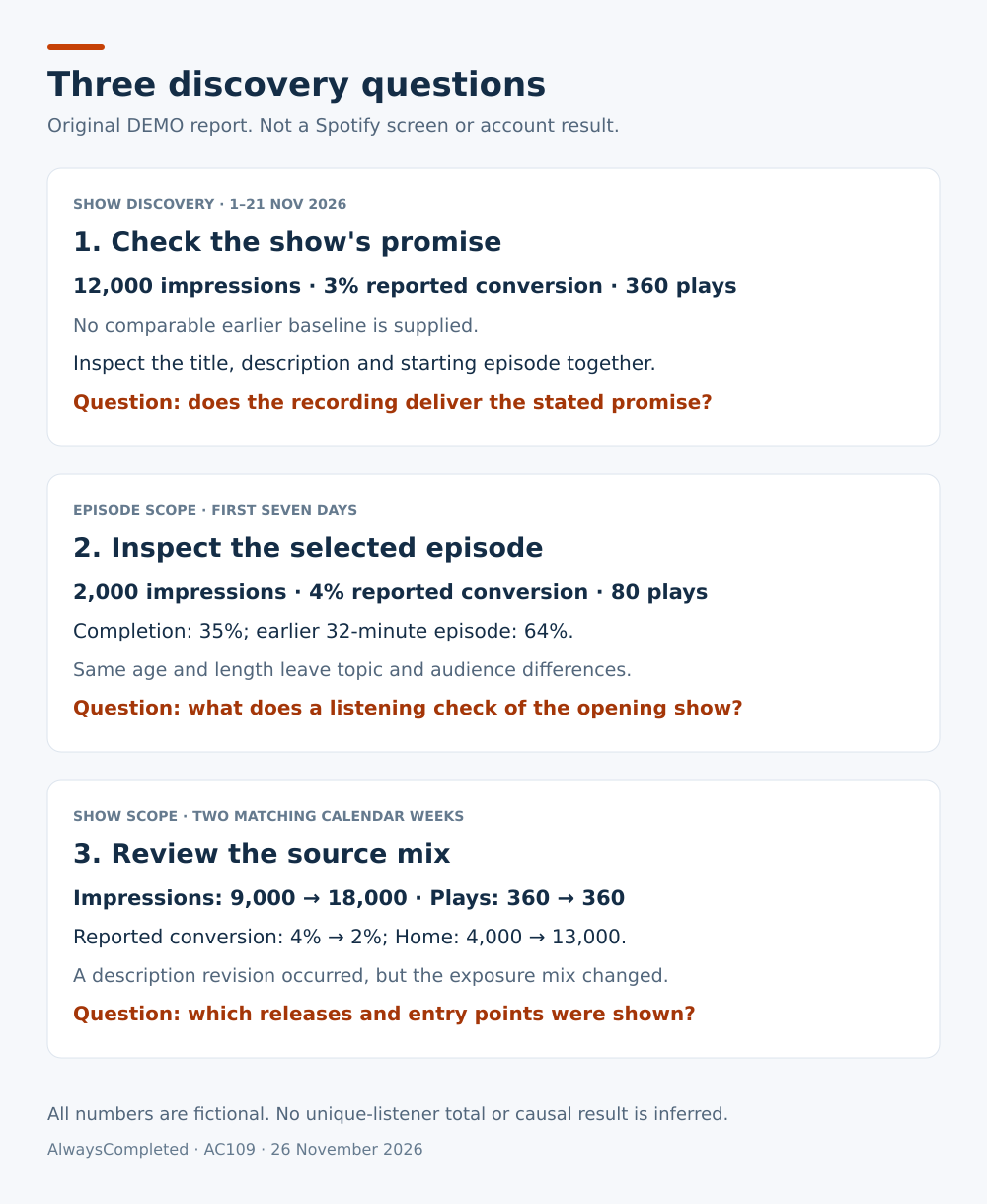
In the first DEMO, a fictional show records 12,000 impressions, a displayed 3% discovery conversion rate and 360 plays for November 1–21. The report has no equivalent earlier baseline. Calling 3% universally good or bad would add a benchmark that the evidence does not contain.
The proposed action is a public packaging check. Open the show and a relevant episode from the listener's context. Can a newcomer tell what the episode offers? Does the description support the title? Does the selected starting episode deliver that promise without requiring unexplained background knowledge?
The worksheet uses the fictional title “A Conversation About Sound” as a candidate for clarification. It asks the editor to identify the recording's actual question before proposing a more specific version. The episode-title worksheet provides that content-to-title review process.
This scenario does not claim that the existing title caused the conversion rate. It chooses a manageable inspection because the team's stated goal is to improve the clarity of the entry point. The audio evidence and proposed wording still need review.
Scenario two: inspect the chosen episode's opening
The second DEMO concerns one fictional 32-minute episode. Its first-seven-day record contains 2,000 impressions, a displayed 4% discovery conversion rate and 80 plays. Its episode completion rate is 35%; a previous 32-minute episode in a comparable first-week record shows 64%.
The difference identifies a question, not a diagnosis. The recordings may have different topics, guests, audiences and listening contexts. Before shortening anything, listen to the newer opening and compare its promise with the moment the main discussion begins.
A proposed check might be: “Does the introduction repeat context that the description has already supplied?” Save the actual audio timestamp and wording if it does. A useful edit can remove repetition while retaining a qualification or story detail the listener needs.
Do not compute 28 completed people by multiplying 80 plays by 35%. The denominator and unit of the completion measure are not established by that calculation. Keep the platform's reported rate and the observed audio evidence as separate records.
If the chosen question concerns an excerpt used to introduce the episode, the creator-uploaded Clips workflow helps check context, captions and the episode association. A Clip-specific report still retains its own attribution window; it is not a replacement definition for this entire discovery review.
Scenario three: investigate a changed source mix
The third DEMO compares two show-level weeks. Impressions rise from 9,000 to 18,000, the displayed conversion rate moves from 4% to 2%, and plays remain at 360. Within the fictional matching source table, Home increases from 4,000 to 13,000 impressions while Library and Search remain at 3,000 and 2,000.
A revised show description appeared during the second week. It would be tempting to say that the description halved conversion or that broader exposure proved a successful promotion. Neither conclusion follows from this before-and-after record.
The exposure mix changed at the same time. The next check is to identify what was published, which objects appeared and whether a comparable episode-level record is available. Preserve the description revision time, release schedule and other distribution activity. Those details can explain why a later comparison needs a narrower scope.
The two synthetic source rows reconcile to their respective impression totals. That arithmetic checks the teaching example; it does not establish deduplicated people or a causal allocation of plays to each source. The annotated report makes that distinction explicit.
Write one next action with an honest review note
Complete four fields before choosing a new promotion activity: the observation, measurement scope, plausible explanations and next check. Add an owner, an intended review interval and the evidence that would change the decision. Keep the action small enough to inspect.
A usable note might say: “The DEMO second week has twice as many impressions and the same play count. Home accounts for the extra displayed impressions. We will review the releases and entry points shown in that week. The record does not establish that the description revision caused the rate change.”
Choose one of three outcomes after the check: correct a verified mismatch, run a bounded editorial revision or retain the current material while collecting a comparable interval. “Collect more data” becomes useful when it names the missing scope and review date. It should not be an indefinite reason to avoid fixing a broken link or inaccurate title.
For optional services, the AlwaysCompleted podcast promotion page describes separate catalogue actions and episode coverage. Ask technical support which action, destination and reporting source a listing uses. A catalogue count does not establish native discovery placement, episode completion or a causal effect on Spotify's recommendations.
