SoundCloud Track Unavailable in a Country? Check Rights and Delivery Ownership
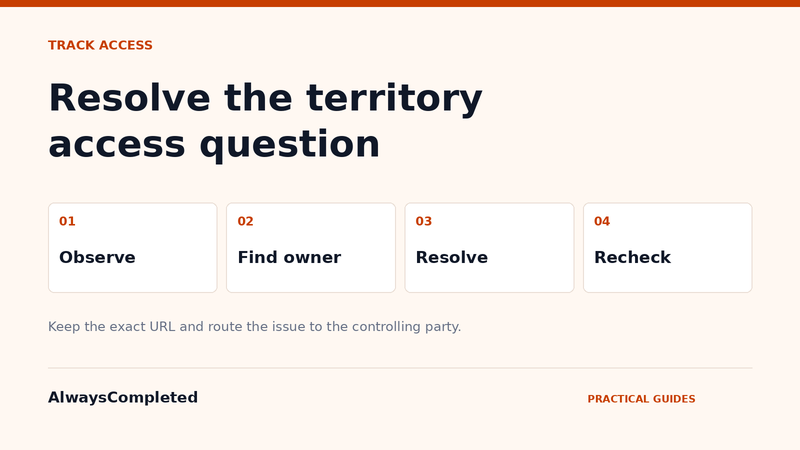
When a SoundCloud recording works for its owner but a listener receives an unavailable message, preserve the exact observation before changing anything. The immediate task is to identify which recording is affected, where the problem occurs and who controls the correction.
A public link alone does not prove availability everywhere. Equally, one failed attempt does not establish that every listener in a country is blocked. Begin with the evidence you have, keep its limits visible and route the issue to the party that can act on that specific track.
The worksheet below contains three fictional cases and a reusable escalation record. Documentation was reviewed on 26 November 2026; no regional account tests or customer campaigns were used.
Download the territory issue worksheet, three DEMO branches and support-request template
Capture the failure without losing the original URL
Save the complete track URL, displayed title and artist. Copy the exact unavailable message and record the time with a time zone. Ask the observer which country they were in, whether they used the website or an app, and whether they were signed in. Keep this limited to what is necessary to understand the observation; there is no need to collect their password or precise address.
If a screenshot helps, retain enough context to identify the track and message while removing private account information. “A fan cannot play it” is too broad for an actionable request. “The linked recording showed this message in this context at this time” gives the owner something they can investigate.
Record a working observation separately. The artist hearing the track in their own session can help establish that the file exists, but it does not invalidate a listener's experience elsewhere. Do not merge the two into an unsupported statement such as “the link works globally.”
| Observation | What it supports | What remains unknown |
|---|---|---|
| Exact track shows a country-related message | A specific access problem was observed | Which party set the relevant restriction |
| Another person can play the same URL | Access differs between the recorded contexts | Whether country alone explains the difference |
| Owner can edit a track | Some control is available in that session | Whether the owner controls all rights or delivery settings |
| Similar title appears at another URL | Another recording object exists | Whether it is the approved replacement or equivalent version |
Separate territory evidence from other access questions
SoundCloud's regional availability guidance explains that content partners may restrict territories according to their rights. That is a possible cause of a geographic availability problem, not a diagnosis for every greyed-out track.
Check whether the observation actually refers to a country restriction. An unpublished track, a changed private link or a different recording can require another investigation. Compare the exact message and URL before putting the incident into a territory workflow.
If the release was scheduled, consult the SoundCloud publication checklist to separate the intended publication moment from a metadata date. If publication itself remains uncertain, resolve that evidence first. A territorial escalation should not obscure a simpler mismatch between the planned and observed release state.
Do not try to demonstrate availability by evading the restriction. Ask an authorized owner or a legitimate observer in the relevant market to document the actual route. Keep each observation bounded by its time and context.
Establish how this track reached SoundCloud
Before requesting a change, identify the upload or delivery origin. SoundCloud's ownership guidance distinguishes directly managed uploads, distributor-delivered content and uploads connected to a rightsholder. The artist name on the page does not identify the operational owner of every setting.
Collect evidence from the person who delivered the recording: a delivery reference, the relevant release record or confirmation of who manages it. The question is specific: Who can inspect and correct the territory or delivery configuration for this URL? A general answer such as “the label handles our music” needs a contact and record attached.
The three cases in the download show different routes. In the first, the uploader can inspect the intended setup and escalate unresolved behaviour. In the second, a distributor contact owns the delivery investigation. In the third, a linked rightsholder must confirm the intended territory treatment. None of these assignments assumes that removing a restriction is permitted.
Ask for the intended rights position, not simply worldwide access
Describe the territory you need and why the campaign depends on it. Then ask the controlling party whether the recording is authorized and intended to be available there. The answer may be a correction, confirmation of a valid restriction or a request for more evidence.
This matters when a promotion brief targets a market that the release cannot legitimately serve. A successful technical fix is not always the appropriate outcome. Sometimes the right decision is to revise the campaign's scope or choose a different authorized recording through the proper approval process.
Keep rights documentation with its authorized custodian. The issue sheet can reference a relevant agreement or delivery record without copying confidential terms into a general campaign folder. Ask the custodian for the conclusion needed to proceed, such as confirmation of the intended countries and the person authorized to request a correction.
Send a request the recipient can act on
A focused request contains the track identity, the exact observed failure, the intended territory, the delivery origin and the change question. Attach or reference the relevant observation, then ask the recipient to confirm whether they own the next action.
Avoid claiming that promotion caused the restriction merely because the two occurred during the same week. Record the sequence of events, but keep the cause unassigned unless there is evidence. Similarly, avoid promising the team a resolution time that the controlling party has not supplied.
The downloadable request separates “please investigate” from “please make this authorized correction.” That distinction lets the recipient resolve uncertainty before a broad instruction changes the wrong release. Name a person to follow up and record the actual response rather than treating a sent message as a completed fix.
Recheck the affected route before resuming the plan
When a correction is reported, preserve the original incident and add the change evidence. Record who made the change, which object it affected and when. Then repeat the relevant access observation on the approved URL. A support reply saying “updated” and an observed working route are different pieces of evidence.
Recheck the specific target context first. Additional observations may be useful if the campaign covers several markets, but a small set of tests should still be described as a sample. Do not transform two working checks into a universal availability claim.
If an AlwaysCompleted order is already involved, send technical support the order ID, original target, incident and proposed next step. The SoundCloud promotion page includes access requirements for relevant listings, including repost destinations. Do not replace an active order's URL or place a duplicate order to work around uncertainty; clarify the applicable action with technical support.
Finish the record with one of three decisions: approved route verified for the planned scope, evidence still missing, or campaign scope needs revision. The outcome should explain what the next operator may rely on, without hiding unresolved territory or ownership questions.
