Use SoundCloud Fans to Plan Personal Follow-Ups After a Release
A useful follow-up starts with something a listener actually said or asked. The SoundCloud Fans tool can help an eligible artist notice those relationships, but a name appearing in a list does not tell you what that person wants next. Before writing, identify a reason for the conversation and make the next step optional.
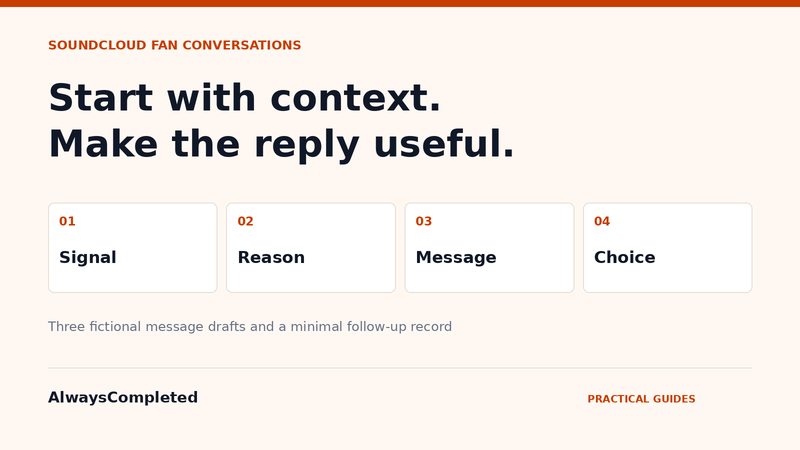
This guide turns the tool into a small, manageable release follow-up process. The accompanying message and follow-up workbook includes three original fictional drafts, a blank message card and a minimal record. It is designed for an artist answering people individually. It does not send messages or collect listener identities.
First check whether Fans is available to your account
SoundCloud currently describes Fans as a beta for Artist Pro subscribers using monetized tracks and Fan-Powered Royalties data. Its documentation distinguishes independent artists from label or distributor arrangements, and notes that rollout and data updates can affect when the list appears. Check your own account and the current eligibility guidance before planning work around it.
Record three separate answers: which subscription you have, whether the relevant recordings are monetized, and whether the tool is visible. If a label or distributor controls the recordings, ask that party to confirm the applicable royalty arrangement. A paid subscription alone is not evidence that a particular recording has the necessary setup.
If the tool is unavailable, you can still answer a public question or a message already received. Do not turn a missing feature into a reason to obtain contact details elsewhere. Keep the planned task narrow: respond to a real interaction you can see, through an appropriate available channel.
Read the signal without inventing the person
The source describes Fans as combining engagement and royalty signals. That explains why someone may appear; it does not establish their occupation, location, spending power, personal circumstances or willingness to receive promotion. Keep those guesses out of both the message and your notes. SoundCloud’s explanation of Fans is useful for understanding the tool’s purpose, rather than treating its order as a relationship score you must act on.
Use the strongest explicit context you have. “You asked how the drums were recorded” is a workable reason to reply. “You listened often, so you must want my merchandise” is an inference with a commercial request attached. Even a positive comment about a release may justify only a brief thank-you.
Before contacting someone, complete one sentence: “I am writing because they ___, and I can help by ___.” If the second blank contains only “asking them to stream again,” reconsider the message. A response should offer an answer, acknowledgement or relevant update that the recipient can use.
Choose one of three conversation jobs
| Job | Useful content | Optional next step | When to stop |
|---|---|---|---|
| Thank someone for a specific comment | Acknowledge the detail they noticed | None is required | After the acknowledgement unless they reply |
| Answer a question | Give the answer or identify what you still need to check | Ask one clarifying question if necessary | When the question is resolved |
| Share an update they requested | State what changed and why it matches the request | Offer the link or information they asked for | If they decline or do not continue |
These jobs help keep the message proportionate. A listener who asked about a sound does not need a release announcement, shop link and request to repost in the same reply. If there are several useful details, answer the immediate question first and let the conversation determine whether more is welcome.
Write the message in the artist’s own voice
The workbook uses a fictional artist and song. One example begins: “Thanks for the comment about the quiet ending of ‘Window Light’. I kept that section sparse so the last vocal line had room.” It acknowledges an observable comment and provides an explanation. It does not claim a private connection or invent a testimonial.
Replace the example with facts about your own recording. Keep the opening identifiable, the middle useful and the ending easy to ignore without pressure. If you cannot answer a production question, say what you will check. If another team member is replying, make that clear instead of impersonating the artist.
A practical editing test is to remove every sentence that asks the recipient to do something. Is there still a reason to send the message? If the answer is yes, you probably have a useful core. Add a question only when its answer will change the conversation. Avoid making gratitude conditional on a follow, repost, purchase or review.
Respect the recipient’s settings and response
SoundCloud lets listeners control incoming messages, notifications, reporting and blocking. Its Fans privacy guidance explains those controls. An unavailable message route is a boundary to respect. Do not switch accounts or channels to get around it.
The platform describes the tool as individual messaging, not a mass broadcast. A daily limit is a technical ceiling, not a recommended contact target. Send only messages with a specific, appropriate reason, and do not treat silence as an instruction to keep following up. SoundCloud’s usage guidance supports that distinction.
If someone says they do not want updates, record the preference and end promotional contact. If they reply with a question, answer that question. If they ask for a future update, record the requested subject so a later message remains connected to the permission they gave. An invitation to send one acoustic version is not a standing invitation to send every release.
Keep only the record you need
A follow-up log should help the artist avoid duplication and remember open questions. It does not need a fan database exported from the platform. Use a local case label, the interaction’s subject, the reason a reply is appropriate, the current response state and the next action. Keep account credentials, private payment details and inferred personal characteristics out of the workbook.
For example, a record might say: “Case F02; asked about guitar tuning; answer checked with performer; answered; no next action.” A separate case might remain “waiting for artist to confirm the sample source.” Do not mark either as a converted fan because a message was sent.
Give the log a review date. Remove notes that no longer serve an active conversation, while retaining a minimal opt-out flag where needed to avoid unwanted contact. If another team member takes over, transfer the unresolved question and communication preference, not a speculative profile of the listener.
Use the workbook before the next release conversation
Read the three DEMO drafts, then complete a blank card using an interaction from your own account. Verify the musical detail, choose whether a link is needed, and read the draft aloud. The final check is whether the recipient can understand why you wrote and decline the next step without an explanation.
Review the work by looking at questions resolved, promised answers still outstanding and preferences respected. A message sent is an action by your team. It is not evidence of repeat listening, a purchase or a campaign’s causal impact.
If you also need a separate promotion service, compare the exact track or profile action on SoundCloud promotion. Fans access, Fan-Powered Royalties and personal messaging are native SoundCloud workflows; a catalogue order does not automatically include them. Keep the follow-up task and the purchased deliverable clearly described when asking technical support about an order.
Common questions
Why is Fans missing even though I have a paid plan? Check the specific plan, monetization arrangement, eligibility and rollout information. A plan payment does not establish that every requirement has been met for the recording.
Can I send the same release message to everybody listed? The workflow here is based on a specific interaction and individual relevance. The tool is not intended as a mass broadcast list.
Should I follow up again if there is no reply? Silence does not create a new reason to contact someone. Close the item unless the person previously requested a specific later update.
