SMM API Keys: A Rotation and Redacted Logging Runbook
Rotating an API key is a deployment across every process that uses it. Replacing one environment variable is not enough if an old worker, scheduled job or deployment revision continues sending requests with the previous value.
Use this runbook to inventory consumers, plan the change and verify recovery without exposing the key. It describes your application's operating procedure. The AlwaysCompleted developer guide requires a server-side integration and keeping the key outside browser code. The public documentation does not establish an API endpoint for key rotation, a guaranteed overlap period for two keys or a zero-downtime rotation mechanism.
Inventory consumers before choosing a window
List every server process that reads the credential: order submission workers, status polling workers, catalog sync jobs, account monitoring and any authorized manual maintenance script. Include dormant deployment revisions and scheduled jobs that run infrequently. A service that has been quiet for a week can still fail at its next execution.
For each consumer, record its owner, deployment environment, secret reference, refresh behavior and verification method. Use a reference such as secret-store/ac-api/current, never the secret value. Ask whether the process reloads the reference dynamically or needs a controlled restart. Record where a rollback configuration lives and whether it would reintroduce an invalid or exposed credential.
The OWASP secrets-management guidance supports centralized secret handling and lifecycle management. The inventory here applies that principle to a small API integration: one accountable record of who consumes the key and how each consumer will change.
Confirm the actual replacement behavior
Before scheduling a routine rotation, confirm how your account replaces or regenerates its key. Use the authorized account controls or technical support. Determine when the old value stops working, whether there is any overlap, and what recovery options exist. Do not infer the answer from another SMM panel's interface or from a previous platform version.
If replacement invalidates the old key immediately, plan for an interruption. Pause new state-changing work, record in-flight attempts and prepare all consumer changes before performing the account action. A known maintenance window is more manageable than workers repeatedly failing with a mixture of old and new credentials.
For a suspected exposed key, the incident owner may need to prioritize revocation over continuity. The runbook should identify who can make that decision and how queued work is preserved. This article does not rotate any real credential or grant anyone account access.
Preserve the meaning of pending work
Stop admission of new paid submissions through your own queue controls before a planned change. Let known completed attempts be recorded, and isolate any request whose result is uncertain. A network failure during rotation does not prove that an earlier order was never created.
Keep the local intent reference, last attempt time and any returned order ID. After the new credential is deployed, do not replay every failed job indiscriminately. A failed status read can usually be read again under a bounded policy; an ambiguous order submission still needs reconciliation. The API timeout guide explains why that distinction matters.
Also distinguish a stopped worker from a cancelled customer order. Pausing your application does not cancel an order already accepted by the API. Customer messaging should describe the interruption and any confirmed order status without asserting a financial or delivery outcome you have not checked.
Execute a controlled handoff
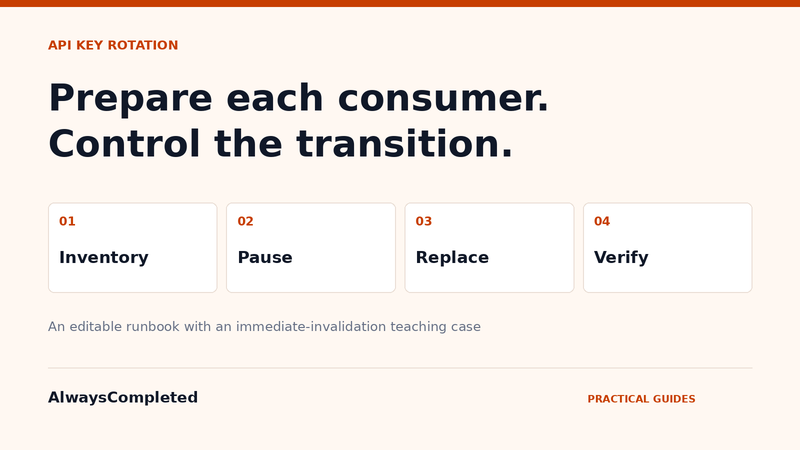
The downloadable runbook contains a routine-change checklist and an immediate-invalidation DEMO. Assign a coordinator who records when admission was paused, when account-side replacement occurred, and when each consumer received the new secret reference.
Update the secret through your approved secret store or deployment mechanism. Do not paste it into chat, source files, screenshots, browser bundles or incident notes. Change the consumers in the prepared order and verify that their configuration references are the intended ones. Avoid printing the secret merely to prove that it loaded.
Start with an authorized read such as the documented services or balance action. Verify that the response parses and matches the expected account context. A successful read establishes that this consumer can authenticate for that request; it does not prove that a future paid order will satisfy every service condition.
Resume read workers first, then deliberately reopen admission for new work after the queue owner has reviewed unresolved submissions. Record the first successful observation for each consumer, including infrequent jobs. Keep the maintenance record open until the inventory is covered.
Make rollback a decision, not a reflex
If the new configuration fails, keep submissions paused while checking the secret reference, deployment version and account replacement outcome. An immediately invalidated old key cannot be made valid by restoring an old deployment. A compromised key should not be restored simply because it previously worked.
A useful rollback decision records what is being restored: application code, a secret-store reference, queue settings or a deployment revision. State which operations remain unavailable and who owns recovery. Replacing code can be safe while restoring a retired credential is not an available recovery path.
This separation also helps during an unrelated deployment failure. The team can restore a known-good application build while preserving the current credential reference. Test that combination before reopening paid submissions.
Keep logs useful and free of credentials
Use a small event schema with locally generated identifiers, action, outcome category, timestamp and relevant order ID. Avoid logging raw request bodies, authorization material or complete exception strings. The OWASP logging guidance explains the need to exclude sensitive secrets from operational logs.
The redacted event example contains a local correlation ID and an order ID, not a credential. The offline allowlist example demonstrates how a program can construct that small schema from already classified internal values. It is not a universal sanitizer for arbitrary text. Keep free-form server responses outside the safe event or review them separately before sharing.
Download the rotation runbook, fill the consumer inventory and rehearse the immediate-invalidation case in an isolated test environment. The rehearsal should prove that queued intentions survive, old consumers are identified and uncertain writes are not automatically repeated. No live key or paid order is required for the planning exercise.
Finish with evidence
Record the consumer checks, outstanding exceptions and the time admission resumed. Review retired configurations and debug output for accidental retained credentials. Apply your retention and incident procedures to any exposure discovered; do not attach the sensitive material to a public ticket or article.
For a real AlwaysCompleted connection, use the API reference and ask technical support to confirm account-specific replacement behavior. The result of this runbook is a controlled credential transition and a clear record of unresolved work, not a promise that every campaign or order completed during the change.
