SEO for Musicians: Build a Findable Artist Website
An artist website should help somebody who has heard your music find the correct artist, identify a release and take a useful next step. Start with those tasks. A clear homepage, release page, shows page and contact route provide a stronger working brief than a request to “add more SEO keywords.”
This guide builds a six-page site for North Lantern, an entirely fictional artist used for teaching. The release name, page copy and planning examples are invented; there are no real concert dates, artist credentials or performance results. Download the six-page map and title examples, query-to-page worksheet, launch checklist and site architecture diagram.
Map the searches a listener might make
Imagine someone hears a song in a friend's playlist. They may remember the artist name, the track title or only part of either. Another person already knows the artist and wants a show date. A promoter needs an appropriate contact. These visitors should not have to solve the same navigation puzzle.
Bandzoogle's musician SEO guide frames the work around what listeners seek after discovering an artist. Use that audience perspective to write your own task map. Do not copy another artist's biography, navigation or keyword list simply because their site appears successful.
For North Lantern, the planning hypotheses are “North Lantern official,” “North Lantern music,” “Paper Boats North Lantern,” “North Lantern shows,” “North Lantern press kit” and “North Lantern booking.” These are invented query examples, not measured demand, search volume or confirmed rankings. The query map keeps that distinction visible.
Assign each task a primary destination. If the release query points to the homepage, the page must immediately make the release identifiable. If it has its own useful release page, prefer that more precise destination in the site's internal links. Two pages should not compete to provide the same thin answer while the actual task remains unfinished.
You do not need a separate page for every spelling variation or imagined search. Keep a list of genuine questions, inspect available search evidence later and add a page when it has enough useful information to stand on its own. An empty “tour” page for a city with no announced show creates an unsupported expectation.
Give six pages six distinct jobs
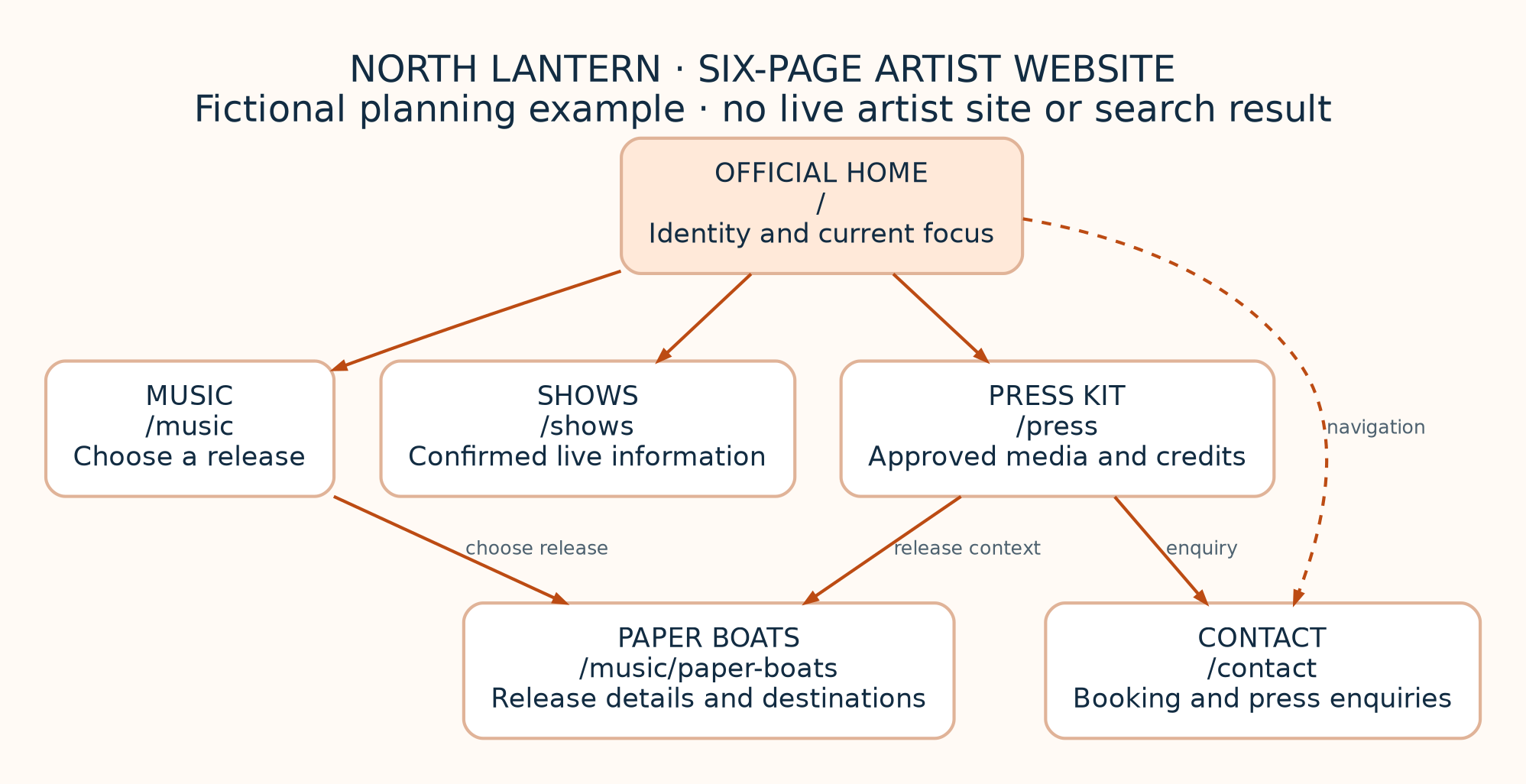
The example uses a homepage, music index, one release page, shows, press kit and contact. It is a starting architecture, not a requirement that every artist publish exactly six pages. A musician with one release may combine the music index with the homepage; a larger catalogue may justify more release pages.
| Page | Example path | Main task | Appropriate next step |
|---|---|---|---|
| Official home | / | Confirm the artist identity and current focus | Open music, shows or the relevant professional route |
| Music | /music | Browse the actual catalogue | Choose a specific release |
| Paper Boats | /music/paper-boats | Understand and access this release | Open a verified listening or purchase destination |
| Shows | /shows | Find current, confirmed live information | Use the correct ticket route, if one exists |
| Press kit | /press | Find approved editorial and promotional material | Download the appropriate asset or contact the right person |
| Contact | /contact | Route a legitimate enquiry | Send the necessary information through a working channel |
The diagram adds a contextual route from the press kit to the release, and another to contact. It does not require every page to contain every possible call to action. The main navigation establishes orientation; contextual links help somebody finish the task in front of them.
Make the official homepage recognizable
Use the same accurate artist name in the visible heading, relevant page title and identity information. If another musician has the same name, include truthful distinguishing context such as the type of project or location when it helps. Do not invent a city, genre, award or affiliation to manufacture uniqueness.
For the fictional homepage, the title is North Lantern | Official Artist Website and the H1 is North Lantern. A short introduction could say: “Explore North Lantern's music, current live announcements and approved press material.” That sentence orients visitors without inventing a career history. A real site can add a concise, verified biography and properly credited imagery.
Put the current release within easy reach, but keep the website useful after launch week. A homepage consisting only of a large image and an unexplained “Enter” button makes the visitor work before discovering what is available. Give the release a name, a small amount of context and a meaningful link.
Link to the artist's verified Spotify, SoundCloud and other official profiles after checking their exact identity. An artist name match is insufficient if the destination belongs to someone else. The website and streaming profiles serve related roles: the site can organize owned information, while the profile supplies its platform-specific listening experience. Neither should be described as replacing the other.
Google's SEO starter guide emphasizes understandable content, accessible navigation and helping search systems discover pages. It also makes clear that these practices do not guarantee indexing or a first-place ranking. Treat the homepage as an accurate, useful destination rather than a promise of a particular search feature.
Build a release page that remains useful after release day
Give an important release a stable page when you can provide a worthwhile answer there. Identify the artist, title, release format and verified publication information. Add relevant credits, a brief description and approved artwork where available. Use only information you have permission and evidence to publish.
The fictional Paper Boats page contains a simple content brief:
- Artist and release name, presented as text.
- An accurate description of the release, to be supplied by its real owner in a real project.
- Verified release date and credits, left unfilled in the planning template until confirmed.
- Approved artwork with a useful description and credit where required.
- Checked listening or purchase links labelled by their actual destination.
- A link back to the music index and a relevant press or contact route.
The downloadable record deliberately does not invent a release date or pretend to provide functioning official profiles for North Lantern. It is a planning example, not a fake artist launch. Before publishing your own page, replace unresolved fields with confirmed information or remove the unsupported claim.
Keep the page useful when a platform embed fails to load or is unavailable in a visitor's context. Retain the release identity and normal links outside the embed. Preview the exact version opened: a clean version, remix, live recording and original can share similar titles while being different destinations.
Do not change the URL merely because the release is no longer new. Update the page's current wording while preserving its identity and useful history. If a genuine site migration requires a URL change, plan the redirect and update internal links rather than leaving old promotion pointing to a missing page.
For the listening route itself, the music smart-link guide explains how to separate landing-page visits from outbound actions. A click toward a streaming platform does not prove a completed stream, follow or purchase.
Keep shows, press and contact accurate
The shows page should answer a current question. If no dates are announced, say so. If an event is confirmed, check the date, location, venue, ticket destination and any material qualification with the responsible source before publishing. Do not keep a past event looking like an upcoming booking.
In the fictional six-page plan, the shows page says “No show dates are announced in this planning example.” A real artist should use their real current status. If past shows are useful background, separate them clearly from upcoming dates and preserve the factual record without suggesting tickets remain available.
The press page serves a different visitor. Provide an approved short biography, useful photographs, credits, release information and a clear contact route. Label download formats and versions. A journalist should not need to extract a low-resolution image from an unrelated social post to understand what they may use. The music EPK template can help organize the actual approved material.
For contact, distinguish booking, press and general enquiries only when you have functioning routes for them. Avoid inventing a manager or agent to make the project appear larger. Test the form's successful submission and the recipient's receipt with an authorized test; a visible button alone does not prove the message arrives.
Ask for information relevant to the enquiry. A booking request might need the event date, location and proposal. It does not need the sender's unrelated personal details. Explain the intended response route accurately and avoid an instant-response promise the team cannot meet.
Write titles, headings and descriptions for the actual page
A page title helps identify the result; the main heading explains the page the visitor opened. They can differ while describing the same subject. Keep a clear primary heading and a logical section hierarchy. Do not repeat the artist name mechanically in every heading.
| Page | Example title | Main heading |
|---|---|---|
| Home | North Lantern · Official Artist Website | North Lantern |
| Music | Music by North Lantern · Releases | Music |
| Release | Paper Boats by North Lantern · Release Details | Paper Boats |
| Shows | North Lantern · Live Shows and Updates | Shows |
| Press | North Lantern Press Kit · Bio and Approved Assets | Press Kit |
| Contact | Contact North Lantern · Booking and Press | Contact |
Google's title-link guidance recommends descriptive, concise titles and explains that its displayed title can draw on several page signals. It may truncate the result to fit the display. A fixed character count is therefore an editing aid, not a guarantee of how the result will look.
For a release description, summarize the useful contents honestly: “Explore Paper Boats by North Lantern, with release information, approved credits and links to the available listening destinations.” Include only features the finished page actually provides. Avoid “official tickets” in the description if there is no confirmed ticket route.
Google creates snippets primarily from page content and may use the meta description when appropriate. Different searches can produce different snippets. Your job is to provide an accurate page and summary, not to promise that the description will always appear verbatim.
Use meaningful internal anchor text. “Explore Paper Boats” is more useful in a catalogue than six identical “Click here” links. Check that each link opens the intended page and that the destination offers a sensible continuation. Preserve a useful route back to the catalogue instead of leaving the release as a disconnected landing page.
Check publication and mobile tasks before promotion
Open the public pages without relying on an editor preview. Check that they load, show the intended content and expose the expected navigation. Ask the site owner or developer to verify indexing controls, canonical URLs and the sitemap where appropriate. A page being online and a page being indexed are different states.
Test a few concrete tasks on the desktop and phone contexts your audience uses: identify the latest release, open its correct listening destination, find current show information, download an approved press asset and submit an authorized contact test. Record the actual device or browser, date, result and remaining issue. A responsive preview alone should be labelled as that kind of check.
Inspect long titles, portrait artwork, menus, tables and buttons. Check that useful labels are visible and controls can be reached without horizontal page scrolling. An attractive desktop banner does not compensate for a release button that is hidden or unreadable on a narrow screen.
Fix a wrong destination or inaccessible contact route before spending on promotion. The website preparation checklist provides a broader release-readiness review. If you consider website SEO work, define the actual deliverable and evidence you expect instead of treating a purchased task as a guaranteed ranking or Knowledge Panel.
Measure discovery and listener actions separately
Search Console's Performance report provides search clicks, impressions, CTR and average position, with dimensions such as query, page, country and device. Use a consistent report scope and date range when reviewing which pages help people find the artist. A manual search from one device does not reproduce every person's result.
Then inspect what visitors do on the site using the measurement actually configured. GA4 enhanced measurement can record outbound-link clicks when enabled; links to domains configured for cross-domain measurement are treated differently. Verify the event and destination in the actual implementation before calling a listening button measured. Do not send personal information in analytics parameters.
Suppose a fictional release page records 120 search clicks and 38 outbound click events during the same calendar period. Dividing 38 by 120 does not automatically produce a search-to-stream conversion rate. The events may include visitors from other sources and repeated clicks, and an outbound action is not a stream. A defensible note names both scopes and says which journey remains unverified.
Keep separate questions: Was the page discovered for relevant searches? Could visitors complete the intended website task? What happened on the external service, if suitable evidence exists? An improvement in one layer is useful without pretending to establish every later outcome.
Review the map when a release, event or contact changes. Assign an owner to each page and retain the date of the last check. The result should be a dependable official destination with clear routes to music and information, supported by evidence about discovery and actions rather than an invented promise of search visibility.
