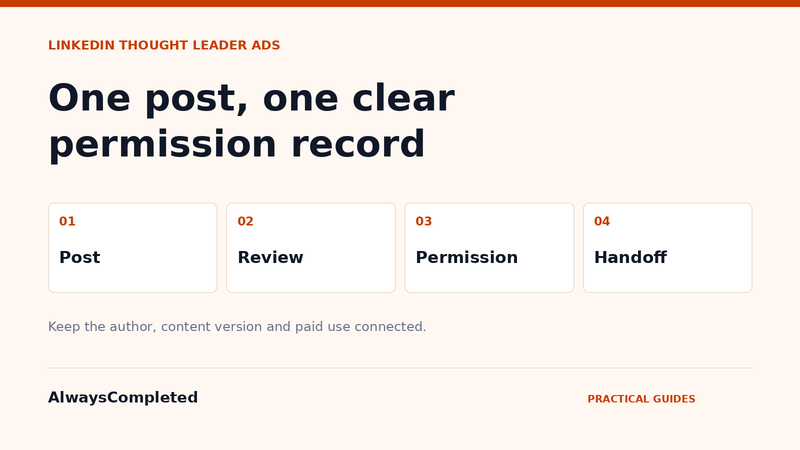
LinkedIn Thought Leader Ads: Prepare a Permission and Content Brief
Choose a Thought Leader Ad by the exact member post you can responsibly sponsor, then document the author's decision and the conditions under which the campaign may use it. A positive conversation with a colleague is useful context, but the native sponsorship permission and the approved content still need to be recorded.
Build one brief around one post. Identify the author, the public URL, the claim being made, the media involved and the planned paid use. This gives the author and campaign owner a concrete proposal to review and gives the operator a clear stop condition if permission or content changes.
The downloadable pack contains a fictional permission brief, a short unsent request, a version log and a revoked-permission contingency. All people, posts and decisions are DEMO. No author was contacted, permission requested or automatic approval enabled. Public LinkedIn documentation was reviewed on 26 November 2026.
Choose the post before choosing a budget
Start with the contribution the post makes. Does it explain a useful experience, demonstrate a method or provide a defensible observation? Save the exact version under review and identify any factual claim that depends on supporting evidence.
A post can be persuasive without claiming a dramatic result. The fictional example in the pack explains how an operations lead clarified who approves a marketing asset. It describes a method, with no invented time saving, customer endorsement or sales increase. That makes the proposed paid message easier to evaluate honestly.
LinkedIn's Thought Leader Ads guidance requires an eligible public member post and author permission. Supported post types and objectives are format-specific. Use the current format guidance and the account's actual selection controls for the exact post; being visible publicly does not establish that a post can be sponsored in every campaign.
The DEMO uses a single-image post as a candidate, with eligibility still to be checked in a real account. Preserve the original URL rather than copying the author's text into a new company asset and assuming the same permission applies.
Separate access, author permission and content approval
Three people may hold three different responsibilities. The operator needs the appropriate Page and ad-account access. The author decides whether the post may be sponsored. The company's reviewer decides whether the proposed message and use fit the approved campaign.
LinkedIn's creation instructions specify relevant Page permissions and creative-manager-or-higher access on the ad account for creating the ad, alongside the author's sponsorship permission. Record the actual account and Page scope; a role granted on another Page does not answer this check.
Keep media and claim review in the brief even when the author owns the post. A photograph, chart, quotation or client reference may require a separate review of its permitted use and accuracy. Ask the responsible person to document the basis. A native approval control should not be treated as a substitute for that content review.
Write down the proposed commercial relationship and any disclosure the responsible reviewer requires. Make it clear who is sponsoring the message and avoid rewriting a personal observation into an endorsement the author did not make. If the arrangement needs specialist review, attach that decision to the brief rather than inventing a universal disclosure sentence.
Make the proposed use specific
A vague request to “promote your content” leaves the author guessing about the post, period and context. Name the exact post and proposed campaign purpose. Describe the audience at an appropriate level, the intended run period and the limits of the requested use.
The pack's fictional request asks to sponsor one existing post for a defined planning exercise. It explicitly leaves approval with the author and says that changes require a new review. It is an editable draft, not a message that has been sent.
Include a contact for questions and withdrawal. The author should be able to reach someone who understands the actual campaign. A permission record is more useful when it names who can pause activity and how a changed decision will reach that person.
Do not encourage blanket approval merely to simplify operations. A single-post decision is easier to match to the agreed brief. If the author independently chooses a broader native setting, record what was actually granted and still apply the company's own content review to each proposed use.
Record the native decision without filling gaps
The current creation flow includes browsing existing member content and requesting approval for the selected post. LinkedIn's instructions describe Approved, Declined and Pending request states. Record the observed state, time and evidence reference after an authorised operator performs that step.
Before the request is sent, write “not requested.” After sending, preserve the actual pending state until approval appears. A prepared brief, an enthusiastic reply or an assumed colleague relationship should not be converted into an observed Approved status.
The version log should connect the request to the post and the content version reviewed. If a link, image or claim changes, revisit the approval basis. Record what changed and who must review it before the campaign proceeds; do not silently update the brief's date while leaving the old evidence attached.
A declined request is a completed decision. Respect it and consider another eligible asset with its own review. Do not copy the post into a different account or use a screenshot of it to bypass the author's choice.
Plan for permission to change after launch
LinkedIn states that revoking sponsorship permission turns off the affected ad; other ads can keep the ad set delivering. The creation guide describes that distinction. Your operational plan should therefore inspect the actual affected ad and the remaining campaign, rather than assuming everything has stopped.
The original contingency row names the notification owner, the evidence to preserve and the next decision. The operator verifies the affected asset's state, informs the campaign owner through the agreed internal process and reviews any replacement separately. The reporting owner marks the interruption so the final report describes the period accurately.
Do not treat the contingency as a reason to pressure the author into permanent permission. It is a way to make a changed decision operationally manageable. If the campaign depends on one post, acknowledge that dependency while planning the launch.
Keep the paid report attached to the approved asset
Save the ad reference and the sponsored post URL together. Record the actual run period and any permission interruption. This makes it possible to distinguish observations about the paid campaign from the public post's broader history.
LinkedIn's product guidance distinguishes Campaign Manager reporting from the author's aggregated organic and paid post metrics. Use the relevant source for the question you are answering. A total visible on the member's post should not be presented as the paid campaign's isolated result.
The existing LinkedIn agency reporting guide helps connect platform observations with later enquiries while preserving their definitions. Sponsorship permission itself proves neither audience fit nor a business outcome.
Approve a concrete handoff
The final brief should let another authorised operator identify the post, approved use, access evidence, native decision and stop conditions without reconstructing a conversation. Keep unresolved fields visible. The pack's fictional example leaves native permission and campaign checks unperformed because no private account was used.
When considering AlwaysCompleted LinkedIn services, compare their exact profile, Page or post activity separately. A reaction or follower listing does not establish Thought Leader sponsorship, permission to use a person's content or an endorsement. Ask technical support to clarify a catalogue deliverable while the responsible advertiser and author handle the native sponsorship decision.
