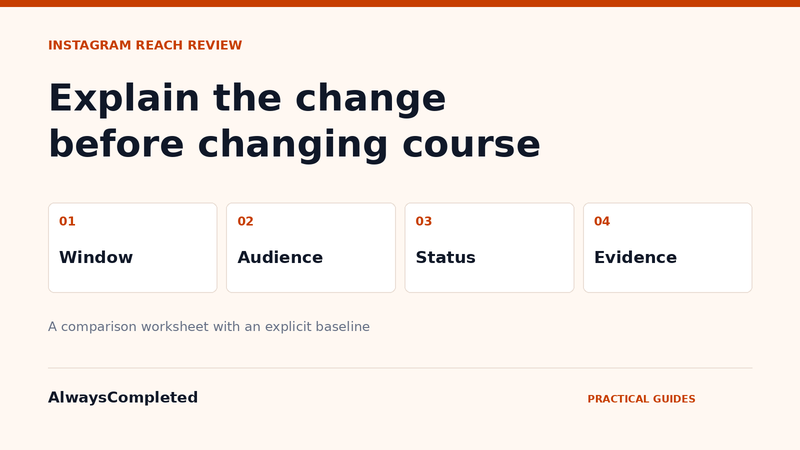
Instagram Reach Dropped: Check Account Status and Recommendation Eligibility
When Instagram reach drops, record where it changed, inspect Account Status and any relevant notices, then separate a documented restriction from a content-performance hypothesis. A low number alone does not identify an account penalty. A notice about one post or audience also should not be expanded into an unsupported claim about every part of Instagram.
Your first useful outcome is a narrow statement such as “non-follower reach fell on recent Reels; recommendation status has not yet been checked” or “Account Status identifies a specific restriction; the available review is pending.” Each statement points to a different next action.
Download the symptom and evidence matrix, the before-and-after observation log, the fictional two-post example and the editable status-review record. These are diagnostic tools. No Instagram account was inspected, and no recovery result is claimed.
Document which reach changed
Start with the exact report, metric and period. A Reel with fewer views is not necessarily the same problem as fewer accounts reached across the whole profile. If a report separates followers and non-followers, preserve those labels and values. If it does not, leave that split unknown.
Write down the surface or context you are investigating: Feed, Reels, Explore, Search, Stories, profile discovery or another available report. Do not invent a surface breakdown that the interface does not supply. A video format and the place where somebody encountered it are related concepts, but they are not interchangeable report dimensions.
Meta describes multiple ranking systems across Feed, Stories, Reels and other surfaces, combining predictions and user feedback to personalize what people see. That is a reason to locate the affected experience before applying a single explanation to the entire account. Source: Meta’s explanation of ranking systems.
Make the comparison fair enough to be useful. Compare posts at a similar age, separate different formats and note changes in paid promotion, collaborations, language or topic. A seven-day-old post and one published an hour ago have had different opportunities to accumulate reach.
Do not add the reach of several posts and automatically call the sum unique people reached by the account. Someone may have encountered more than one post. Keep the account-level report and per-post records distinct unless the reporting definition supports your calculation.
Read Account Status before changing the content library
Open Instagram’s settings from the account you actually publish with and locate Account Status. Use the current app’s navigation and help if the menu differs. The screen name is more useful than memorizing a path from an older screenshot.
Meta introduced Account Status to explain content removals and the policies involved. Use the current notices as your account-specific evidence, rather than inferring a decision from a graph. Source: Meta’s account-status explanation in its enforcement report.
For a public professional account, look for any recommendation-related assessment the current view provides. Also inspect notices about removed content, feature restrictions or access by particular audiences. The worksheet starts with those checks marked unknown; it does not assume every account exposes identical sections.
Save the date, exact wording, affected post or profile element, cited rule, stated scope and available next action. Prefer the text of the decision to a green or orange icon. If a notice points to a specific item, preserve enough context to identify it later.
Do not delete a large group of posts simply because reach fell. First establish whether there is an actual decision and what it concerns. Broad deletion can destroy useful evidence and make it harder to tell which change, if any, mattered.
The official Account Status help page and recommendation eligibility help page are the appropriate places to check current account-specific instructions. When a control is absent, record that fact rather than substituting an assumed review route.
Separate allowed content from recommended content
Meta’s Recommendation Guidelines explain that content can be permitted on its platforms while excluded from places that recommend content to people who did not choose to follow the source. A post remaining online therefore does not, by itself, establish recommendation eligibility. Source: Meta’s Recommendation Guidelines explanation.
Conversely, an eligible status is not a commitment to distribute a post to a particular audience. Eligibility and personalized ranking answer different questions: whether content may enter a recommendation context, and what the system selects for a particular person. A clear status does not prove the creative is effective, and low reach does not prove a hidden restriction.
Keep the scope of a notice precise. Does it identify one item, the profile, the account, a feature or a particular audience? Does it describe recommendation eligibility, removal or another restriction? Those are useful distinctions even when you do not know why the system made the decision.
There is also an important audience-specific exception to simplistic “followers are unaffected” advice. In an April 2026 update, Meta said certain accounts identified as regularly sharing age-inappropriate content could lose teen followers who were already unable to see or interact with that content, and that affected accounts would be informed through Account Status. That concerns a particular audience and policy, not a general explanation for every reach drop. Source: Meta’s updated Teen Accounts announcement.
Read the notice that applies to your account. Do not import a recovery timetable or policy threshold from a different account’s experience.
Use the symptom matrix to choose an evidence source
| Symptom | Evidence to collect | Next action |
|---|---|---|
| Recommendation-related notice is present | Exact Account Status text, scope, affected item and cited guideline | Read the specific decision; use its available correction or review route |
| Content was removed | Removal notice, content reference and reason | Evaluate that removal separately from the reach graph |
| A profile element is identified | The flagged element and its current state | Check the stated issue before making an unrelated profile rewrite |
| An audience-access notice appears | Named audience, affected content and policy explanation | Follow that notice’s scope; do not assume all audiences are affected alike |
| Non-follower reach fell, status has not been checked | Comparable post reports plus current status inspection | Complete the status check before choosing an explanation |
| Status shows no relevant issue, but recent Reels are weaker | Comparable Reels, post ages, topics and available response metrics | Form a content hypothesis and test one useful change |
| Only Stories or existing-follower interaction changed | The relevant report and audience context | Investigate that experience without treating it as proof of a recommendation restriction |
| A search or discovery complaint comes from one observer | Exact query, account context, date and reproducible observation | Treat it as a limited observation; compare with official notices and available reports |
These are diagnostic categories, not a reproduction of every current screen label. The full CSV includes a “conclusion to avoid” column so the team does not turn an observation into a stronger claim than it supports.
If you dispute a decision, use the available review
Open the affected item and read the linked rule before responding. If the interface offers a review, use that route and provide the context it requests. Keep a copy of what you submitted, the submission time and any resulting status.
Write about the decision itself. For example, an original performance mistakenly treated as reused material would need truthful information about the work and its source. A general statement that “reach is down” does not explain why the cited decision may be mistaken. This is an illustrative response principle, not a claim that a particular appeal category or upload field is available.
If you choose to correct something, record exactly what changed and when. If you choose to request review, do not mark the issue resolved merely because the request was sent. Submitted, pending, decided and verified are different states.
Avoid repeated unrelated edits while waiting unless there is a separate reason to make them. Otherwise the later record becomes difficult to interpret. There is no recovery deadline in this worksheet: use an actual deadline only when Instagram explicitly provides one for your situation.
A worked example: the same total drop can hide different questions
Consider two fictional Reels, each measured after 24 hours. Assume their illustrative reports provide the following mutually exclusive follower and non-follower counts at that observation point.
| Measure | Earlier Reel | Later Reel |
|---|---|---|
| Follower accounts reached | 400 | 400 |
| Non-follower accounts reached | 600 | 200 |
| Total accounts reached for that Reel | 1,000 | 600 |
| Account Status inspection | Not performed | Not performed |
Total reach is 40% lower: (600 − 1,000) divided by 1,000. Follower reach is unchanged in this example, while non-follower reach is about 66.7% lower. That narrows the question toward discovery beyond followers. It does not establish a restriction, because the status check is still missing and only one pair of posts is being compared.
Now imagine two possible next observations. If a relevant recommendation notice appears, document and address it. If the current status shows no relevant issue, preserve that evidence and compare the content and audience context. Neither branch should be filled in before it is actually checked.
The CSV keeps those status fields unknown. It does not invent an “all clear” screen, a successful appeal or a restored-reach result. It also does not add the two posts’ reach to estimate unique audience across both posts.
Inspect content changes separately from restrictions
Once the account evidence is recorded, compare what changed in the material itself. Was the earlier post a familiar topic and the later one aimed at a different audience? Did the new post delay the promised demonstration? Did a collaboration, promotion or current event change who was likely to encounter it?
Use the response metrics actually available for comparable content. An increase in one interaction does not automatically explain a change in reach, and a single weak post does not establish a permanent account-wide problem.
Write a hypothesis you can act on: “The next Reel will show the finished result before the explanation, because the current opening does not make the task clear.” That is an editorial experiment. Keep it separate from “Instagram lifted a restriction,” which requires status evidence.
Avoid changing the opening, subject, language, publication cadence and promotional support all at once if the goal is to learn what helped. You may reasonably need a larger redesign, but document it as a package of changes rather than attributing the outcome to one detail.
Keep a before-and-after record that preserves uncertainty
Before an intervention, save the status wording and the comparison report. Record the intended change, owner, reason and observation window. Afterward, revisit both the status and the relevant report using the same definitions where possible.
The log has separate fields for the status observation, content change and performance measurement. That allows you to record “notice no longer shown; current Reel has lower reach than the comparison” without forcing those facts into a recovery story.
A later increase is evidence of an increase under the recorded conditions. It does not prove the edit caused it, and it does not prove a review succeeded unless the decision or status confirms that. Similarly, a successful review does not guarantee a return to the highest previous reach.
End the review with one supported next action: resolve a specific notice, wait for a submitted review under its actual conditions, gather a missing report, or run a focused content experiment. If the original metric or scope was wrong, correct the diagnosis before spending more effort on the proposed fix.
Before ordering Instagram promotion services, confirm that the intended profile and publication are available and that the service’s stated requirements fit the task. A catalogue service cannot establish Instagram recommendation eligibility or guarantee removal of a restriction. The evidence record gives you a clearer basis for deciding what work is actually needed.
