Instagram Reposts: Plan Attribution and a Clear Next Step
An Instagram repost is most useful when it helps someone understand why the original content is worth opening. Preserve the source, add a short reason and make the next action clear. A repost count alone does not explain whether people watched the original, visited the profile or acted on its offer.
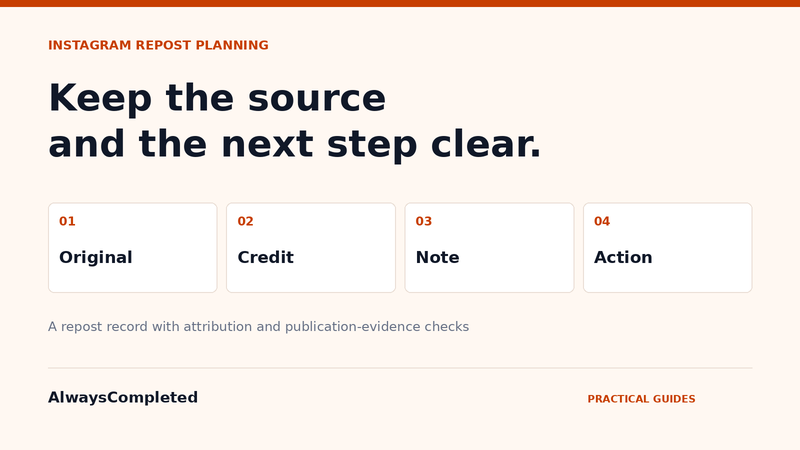
The editable repost routing card contains four fictional note examples and a clean record for your own campaign. It keeps native reposts, Story sharing and accepted co-authored content separate so the requested action is clear.
Identify the action you actually mean
Meta's native repost announcement describes reposting public Reels and feed posts, credit to the original poster, an optional note and a separate profile tab. That is a specific product action. It is not the same as downloading someone else's media and publishing a new copy.
Write “native repost of this public Reel” when that is the task. Include the original URL and author. If the plan instead uses a Story share, label that surface explicitly. If the intention is co-authored content, check the Collab workflow and acceptance rather than assuming a repost creates joint authorship.
Meta's Collab explanation describes an invitation and acceptance model for co-authored posts or Reels. The historical announcement is useful for that distinction; do not use its old participant limits as a current universal specification.
| Action | What the plan should establish |
|---|---|
| Native repost | Original public post/Reel, source credit and any added note |
| Story share | The intended Story publication action and supported source |
| Collab | The original publication and accepted co-author relationship |
These labels prevent a team or supplier from fulfilling a different action that happens to be called “sharing.” Current account and content availability still need to be checked.
Keep the original post as the reference
Before adding context, inspect the source. Confirm the author, content, date-sensitive information and destination. A repost of an expired event announcement can confuse followers even when the credit is correct. A product demonstration can be useful while its old price is no longer current.
If the original contains an unresolved claim, do not add a note that makes it sound verified. “This explains the setup process” is narrower than “This proves the product always works.” Choose wording that matches what you actually reviewed.
Keep a source record with the URL, author, reason for sharing and the next action. If the original becomes unavailable or materially changes, reopen the routing decision. Avoid treating the repost as a permanent independent copy whose context no longer matters.
Add a note that earns its place
A useful note tells the viewer what to look for. It can identify the relevant step, explain why the example fits a current discussion or point out a question the original answers. It should not simply repeat the entire caption or manufacture an endorsement from the source author.
Four fictional examples illustrate the difference:
Tutorial: “The useful part is the export check at the end. Try that step before sending your next client report.”
Event: “This is the organizer's current announcement. Open the original for the confirmed date and booking details.”
Product demonstration: “Watch how the compact model is used. Check the original product details for the available version.”
Creator collaboration: “This creator explains the lighting choice behind the scene. The original post contains their full process.”
These are DEMO notes, not copies of real posts. Replace them with accurate context for the source you have actually reviewed. Do not imply that the creator worked with your business, approved your wording or endorsed your service unless that relationship is confirmed.
Align the source CTA with the campaign
Ask what the viewer should do after opening the original. A tutorial might invite practice, an event announcement might lead to registration and a product demo might lead to current product information. If the source has no relevant next action, do not invent one by suggesting a destination it does not provide.
For content you own, check the original caption and profile route before arranging distribution. An interesting repost can create attention while the source still lacks a clear explanation of the offer. Fix the source journey where you control it; a note on someone else's repost is not a substitute for an accurate original.
If a commercial relationship requires disclosures or specific usage permissions, resolve that with the relevant owner before publication. Native attribution does not settle every separate agreement about reuse, advertising or endorsement. This article explains the publishing distinction and does not grant rights to third-party content.
Review publication evidence without double counting
Record the action actually observed: a native repost, a Story share or an accepted Collab. Save the original URL and the evidence that identifies the relevant publication. Do not substitute a screenshot of a button being selected for evidence that the intended action was completed.
Then separate downstream observations. A repost, a view of the source, a profile visit and an enquiry are different events. Where the available reporting cannot connect them reliably, preserve that limitation. Adding all visible counts together does not produce a meaningful number of interested people.
Use a consistent period and define the metric when reviewing a campaign. A later increase in profile activity may coincide with several posts, ads or other promotion. The routing card helps preserve what was done; it does not prove that one repost caused the change.
Handle time-sensitive changes
Events, stock, prices and availability can change after the original is shared. Assign an owner to review such content and correct or remove misleading messages under your control. If the source belongs to someone else, contact the appropriate owner when necessary and avoid continuing distribution of information known to be wrong.
For recurring campaigns, keep a small log of source versions and dates. A once-useful tutorial may show an outdated interface, while an updated source can require a different note. The record should explain why the item is still relevant, not merely that it performed well previously.
On Instagram promotion, the catalog distinguishes Reposts from sharing posts or profiles in Stories. Check the selected service's View description and ask technical support which action, destination and evidence it includes. The name alone does not establish audience quality, views of the resulting publication, new followers or further customer actions.
The completed routing card should make one sentence possible: “We are sharing this original, through this specific action, for this reason, with this next step.” That clarity is useful before publication and when assessing what actually happened afterward.
Documentation reviewed 26 November 2026. Examples are fictional; no customer account or campaign was tested for this guide.
