Why a Backlink Is Live but Not Indexed: What You Can Check
When someone says a backlink is “not indexed,” first identify the page they mean. The relevant index status usually belongs to the source page containing the link, while your own destination has a separate URL and index status. Finding a live link does not establish that Google has indexed the current source page or used that link as a ranking signal.
Google describes crawling, indexing and serving results as separate stages. A page can be found or fetched without being indexed, and an indexed page is not guaranteed to appear for a particular search. Treat placement evidence, index evidence and ranking outcomes as different questions. How Google Search works
This guide gives you a diagnostic sequence and an evidence matrix. Download the editable evidence worksheet and diagnostic diagram. Neither file queries Google or certifies an indexing result.
Separate the source page from your target page
Imagine a fictional article at
https://publisher.example/guide containing a link to
https://artist.example/release. The publisher’s article is
the source. The artist’s release page is the target.
Record both complete URLs, including the protocol and path. If either redirects, also record the final URL. A report that shows only the publisher’s domain or a screenshot of your own target page cannot establish the exact source page’s index status.
Your access to Search Console for artist.example does
not give you access to the publisher’s property. Checking your release
page can help diagnose the release page. It does not substitute for an
inspection of the third-party article that carries the link.
Also distinguish the wording of the claim. “The link is visible” describes current placement. “The source URL is reported indexed” describes a specific search-engine state with a timestamp. “The placement improved rankings” is a separate outcome claim requiring different evidence. None should be silently substituted for another.
Understand discovered, crawled and indexed states
In Search Console’s Page indexing documentation, Discovered – currently not indexed means Google knows the page but has not crawled it yet. Crawled – currently not indexed means it was crawled but not indexed; that label alone does not identify one particular cause or establish that a penalty exists. An alternate or duplicate URL can also be excluded because another URL is treated as canonical. Google’s Page indexing explanations
Those are Google’s reported states, not labels you should infer from your own browser request. A successful request by your laptop proves that your request received a response. It does not establish a Googlebot visit. An entry in a commercial crawler’s database similarly needs to be described as that crawler’s observation unless the tool supplies a different, verifiable source.
For a particular URL, Google directs site owners to URL Inspection rather than using the broad Page indexing report as an exhaustive list. The absence of a URL from a sampled report is not a complete diagnosis. Page indexing report scope
Follow the diagnostic sequence
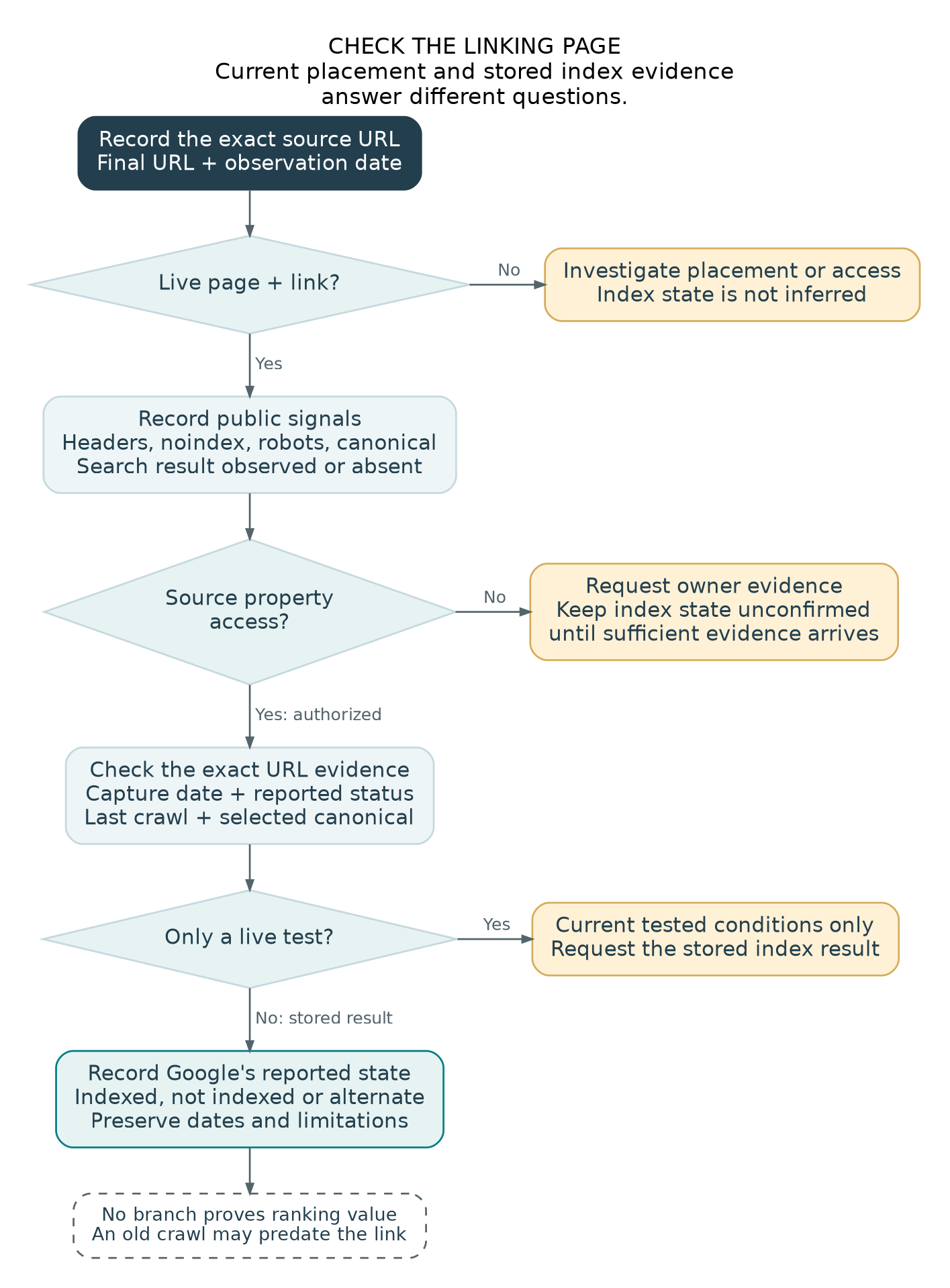
The branches lead to one of three practical outcomes: a placement issue to investigate, an index state supported by authorized evidence, or an unresolved state requiring the source owner’s help. A public inspection can be useful even when the last outcome is the honest answer.
1. Confirm the exact page and current link
Open the reported source URL and note the final address, response status, date and visible content. Check that it is the intended article rather than a login page, error message or unrelated redirect. A server can return a successful status while the content is still unsuitable for the claim being made; Google documents soft errors as one reason to inspect the page rather than rely on the code alone. Page indexing error explanations
Find the link and inspect its actual destination. Record the anchor
text and relevant rel values. If the link appears only
after rendering or a user interaction, describe what you observed and
how. Do not assume that a raw HTML search and the rendered page are
equivalent, or that your rendered view proves what Google last
processed.
If the link is missing or points to the wrong destination, resolve that placement question first. The page might still be indexed; a missing link is not itself evidence about the page’s index state.
2. Record publicly visible crawl and indexing signals
Look for a noindex instruction in the page’s robots
metadata or HTTP headers. Google must be able to crawl the resource to
discover such an instruction. A robots.txt block can prevent crawling
without ensuring that the URL never appears in search; it can also
prevent Google from seeing an on-page noindex. Google’s
noindex documentation
Write what was actually checked. “No noindex found in the retrieved HTML and response headers at this time” is narrower than “Google can definitely index it.” Access controls, rendering, the response received by Google and other factors may still need owner-level investigation.
Record the declared canonical URL. A canonical annotation expresses a preference; it is not a public display of Google’s final selection. If it points elsewhere, keep both addresses in the record and ask the owner which URL Google selected. Google’s canonicalization guidance
Do not change another site’s settings. Give the owner the exact observation and ask whether it is intentional. A page may correctly be excluded because it is a duplicate, a private resource or content the publisher does not want indexed.
3. Treat search observations as observations
A site: query can help find a visible result, but Google
explicitly says its results are not exhaustive and an indexed URL is not
guaranteed to appear for the query. A missing result therefore does not
prove non-indexing. Record the query, date and exact result URL if one
appears. Google’s
site operator limitations
A positive result is useful evidence that the displayed URL was served for that query at that time. Check whether it is the source URL, a redirected destination, a canonical alternative or a different page with similar text. It still does not prove that the current backlink was present in the version Google used, or that ranking credit was assigned to it.
For an “index checker,” ask what produced the label. Does it search public results, check its own crawl database, or retrieve authorized Search Console information? Preserve the method and timestamp. A green badge without a method is an unsupported summary, not stronger evidence merely because a third party displayed it.
Evidence matrix: what each observation can establish
Use this matrix to classify the evidence you receive. It is an original reporting framework based on the distinctions explained above.
| Observation | What it supports | What it does not establish | Who can check |
|---|---|---|---|
| Source returns HTTP 200 | That request received a successful response | Useful content, Google crawl or index inclusion | Anyone able to fetch the public URL |
| Link appears in retrieved or rendered content | The inspected version contains the observed link | Google processed that version or credits the link | Public reviewer; owner for Google’s stored view |
| No noindex found in the checks performed | No exclusion was observed in that inspected evidence | All indexing conditions are satisfied | Public reviewer, with method recorded |
| robots.txt contains a matching block | A crawl restriction is publicly declared | The URL cannot appear in search by other means | Public reviewer; owner checks Google’s state |
| Canonical points to another URL | The publisher declares a preferred alternative | Google selected it or the alternate contains the link | Public reviewer; authorized owner confirms selection |
| Source appears in a Google result | The displayed URL was served for that query/time | Current link processing, permanent inclusion or ranking value | Public reviewer |
| Source is absent from site search | No matching result was observed in that search | Definitive non-indexing | Public reviewer; owner investigates further |
| Authorized stored URL Inspection result | Google’s reported state for the exact inspected URL | A real-time guarantee or proof of link value | Authorized user of the source property |
| Successful live URL test | Current tested accessibility/indexability signals | Existing index inclusion or selected canonical | Authorized user of the source property |
| Third-party “indexed” badge | The tool’s reported result under its method | A stronger claim when method, URL and date are missing | Reviewer requests method; owner supplies stronger evidence |
Use URL Inspection only with appropriate property access
The inspected URL must belong to the Search Console property being used. Ask an authorized user of the source property to provide its stored inspection result. Keep that result distinct from a live test: Google says the live test checks current conditions, while the indexed result reflects stored information. The live test cannot predict Google’s selected canonical. URL Inspection documentation
For a useful evidence record, request the exact inspected URL, capture date, overall status, reported indexing reason, last crawl date where available, and Google-selected canonical where available. If the source was redirected, make clear which URL the result concerns. Do not accept a screenshot that omits the address and then infer which page was tested.
“URL is on Google” is evidence of the reported indexed state, but Google does not present it as a guarantee of appearance for every query. Preserve the actual result rather than rewriting it as “permanently indexed.” Meaning of URL Inspection results
If the stored crawl predates the link’s addition, the screenshot cannot demonstrate that Google processed the new placement. If it postdates the addition, inspect the available stored page evidence where the owner can provide it; chronology alone still does not prove ranking treatment.
No Search Console property was accessed for this article. The workflow describes what the authorized owner can verify, not a completed inspection of a purchased placement.
A fictional example: live placement, index status unresolved
Suppose a provider reports a link added on 20 November to
https://publisher.example/guide. On 25 November, the buyer
retrieves the page, gets HTTP 200, and finds the expected anchor linking
to https://artist.example/release. The retrieved HTML and
headers show no noindex; the canonical points to the source
URL itself. A site: query returns no matching result.
The provider sends a screenshot of a successful live URL test. The buyer has no access to the publisher’s Search Console property.
The defensible record is:
- Placement: observed live at the recorded time, with the expected destination.
- Public signals: no exclusion found in the specified checks; self-referencing canonical declared.
- Public search: no matching result observed; this is inconclusive for index status.
- Owner evidence: live-test screenshot supplied; stored index result not supplied.
- Conclusion: source-page index status remains unconfirmed.
- Next step: request the stored inspection result for the exact source URL, including its date and canonical details.
Now imagine the provider instead supplies a stored result captured on 25 November that reports the URL indexed, but its last crawl was 15 November. You can record the reported index state, while separately noting that this crawl predates the claimed link addition. The additional evidence improves the record without proving that the new link has been processed.
All URLs, dates and observations in this example are invented for teaching. They are not findings about a real publisher or an AlwaysCompleted order.
Ask the placement owner for a specific response
A short evidence request is more useful than asking someone to “index the backlink again.” You can adapt this draft:
Please confirm the status of the exact source URL [URL], rather than the linked target. We observed the placement on [date/time]. Could you provide the stored Search Console URL Inspection result for the source property, with the inspected address, capture date, indexing status/reason, last crawl and selected canonical where available? Please label any live-test result separately. If that evidence is unavailable, please state the limitation and the next check you can perform.
The request does not require sharing account credentials or giving the buyer access to unrelated properties. An authorized owner can provide appropriately scoped evidence. If the owner cannot or will not provide it, retain “unconfirmed” and assess the placement against the evidence standard actually agreed for the service.
Do not buy a guaranteed indexing outcome
A site owner can investigate technical problems and use permitted discovery or recrawl mechanisms. A submitted indexing request does not guarantee that Google will include the page. Agree on the work and evidence being delivered, rather than treating submission as the completed outcome. Google’s indexing request limitations
Google’s Indexing API is restricted to pages with
JobPosting or BroadcastEvent embedded in a
VideoObject. It is not the appropriate submission route for
ordinary articles or generic backlink pages. Do not relabel a page with
irrelevant structured data to fit that API. Indexing
API scope
Indexing is also separate from the acceptability of a link
arrangement. Google identifies buying or selling links for ranking
manipulation as link spam. It recommends rel="sponsored"
for advertisements and paid placements; nofollow remains
acceptable for that qualification. These link attributes are different
from the source page’s noindex instruction. Google’s
link-spam policy, outbound-link
qualification
When reviewing website SEO services, ask whether the deliverable is a placement, a technical check, a submission action or dated index evidence, and what happens if that evidence is unavailable. Use the FAQ and the specific service description to clarify the agreed scope. None of those deliverables should be renamed a guaranteed ranking improvement.
Keep the exact source URL, observation date, method, result, limitation and responsible owner together. That record tells you what can be accepted, what needs correction, and what remains unknown without confusing a live link with a verified search outcome.
Primary Google documentation checked 25 November 2026. Real placement observations should carry their own timestamps, separate from this article’s editorial review date.
