Claim an Audiomack Artist Profile: Identity Evidence and Badge Differences
To claim an Audiomack artist profile, first establish how that profile was created. A distributor-delivered page that you cannot manage is a different problem from a self-created account with working access. Authentication, verification and a paid Creator Pro badge are separate questions again.
This guide helps an artist or manager choose the correct route, prepare identity evidence and keep a clear request record. It includes a four-state decision tree and a reusable evidence sheet with fictional examples. Official public instructions were checked on 26 November 2026. No claim was submitted, account accessed or badge awarded while preparing the material.
Identify the profile before choosing a procedure
Open the public profile and copy its exact URL. Confirm that it contains the artist's releases, then compare the display name and release credits with the distributor's records. Similar names and similar artwork are not enough to establish that a page is yours.
Ask who created the profile and whether the artist can currently manage it. Check the team's existing account and distribution records before making a new account. A manager may know that a distributor delivered a release without knowing whether the artist already completed a claim.
Audiomack's claim instructions describe the claim process for profiles associated with distributor or label releases. They say a person who created their own profile and has its login credentials does not need this claim process. Use that distinction to identify the task before collecting evidence.
If you cannot establish the profile's origin, record the uncertainty. Ask the artist and distributor to confirm the destination they recognize. An unclear origin is a question to resolve, not a reason to claim every matching search result.
Use the four-state decision tree
The downloadable tree starts with access, then checks claim and management history before profile origin. When working access is unavailable, a previously claimed or managed profile belongs to State C, even if a distributor created it. Unclear history also belongs to C. Use State B only for a known distributor or label profile confirmed never to have been claimed or managed.
- State A — existing profile, working access: review the existing profile and account settings, whether it was self-created or already claimed. A new distributor-profile claim is not the task.
- State B — confirmed unclaimed distributor or label profile: the artist lacks management access, and the profile has never been claimed or managed. Prepare the identity evidence and consult the official claim route.
- State C — prior claim or management, or uncertain history: with access lost or unavailable, investigate account recovery or the ownership history through official technical support before opening a new claim. Distributor origin does not override this route.
- State D — working access, but the goal is a badge: identify whether the question concerns authentication, verification or a paid plan, then consult that procedure.
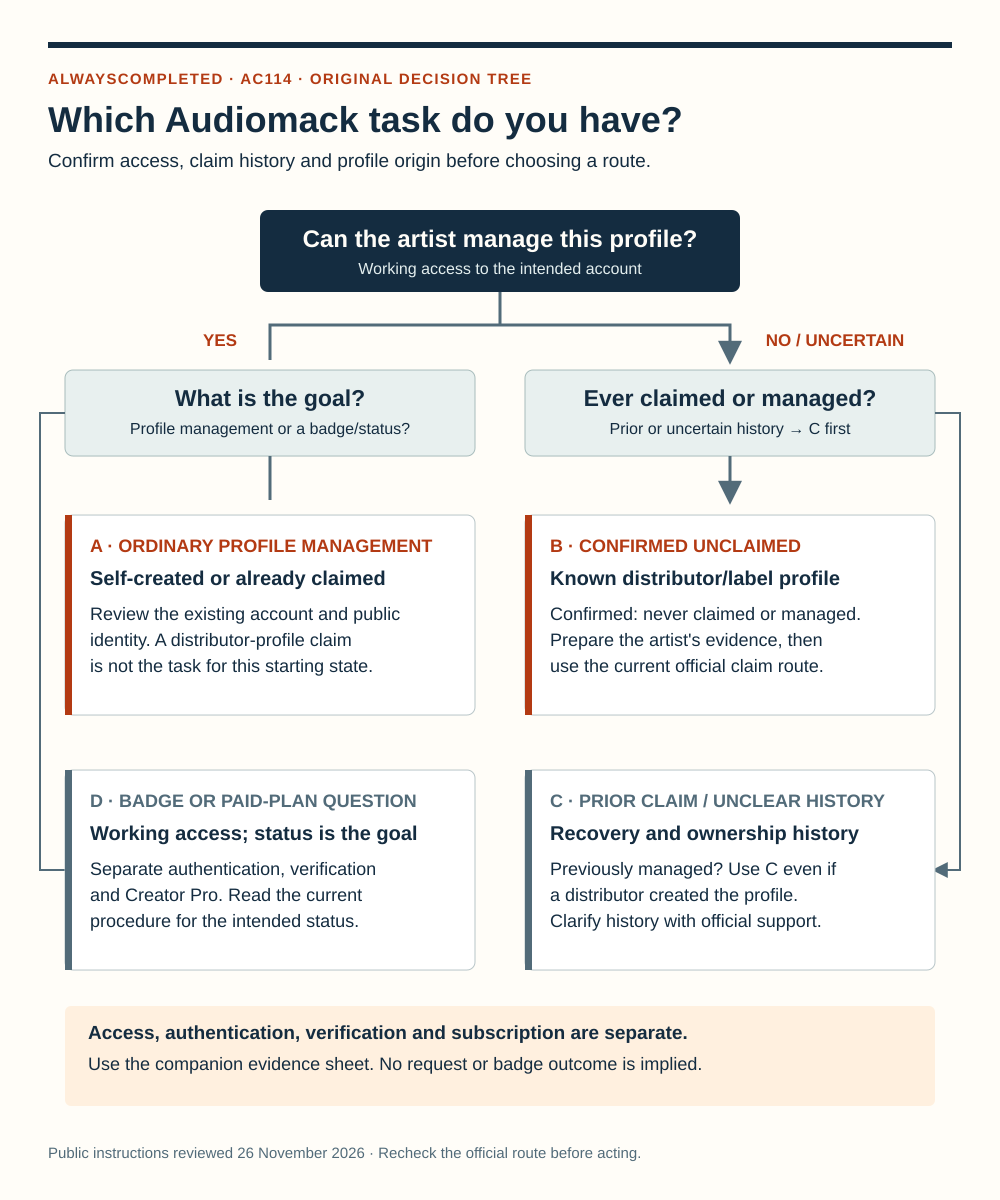
State C is a diagnostic recommendation, not a promise that every recovery case follows one route. If releases appear on the wrong profile or the artist disputes ownership, explain that exact issue to Audiomack. Do not silently turn a mapping problem into a claim for an unfamiliar account.
A manager can prepare the record and help reconcile the release information. Keep the artist's involvement explicit. The worksheet has separate fields for the preparer, artist and person responsible for following up, so organizational help does not become an unsupported claim of personal identity.
Separate access from the three badge categories
Claiming concerns control of an existing profile. A visible badge concerns a different status. Use precise words in your notes and messages so “verified” does not ambiguously mean “we checked the URL,” “the claim was accepted” and “the profile has an editorial badge.”
Audiomack's current badge comparison distinguishes the gray Authenticated Artist badge, the yellow Verified Artist badge and the Creator Pro badge associated with a paid upgrade. It describes verification as discretionary editorial review. Meeting a listed numerical condition is therefore not the same as receiving approval.
| Question | Record to inspect | What it does not establish |
|---|---|---|
| Can the artist manage this existing profile? | Account access and claim correspondence | An authentication or verification award |
| Has creator authentication been approved? | Actual authentication status | Editorial verification |
| Has the artist received verification? | Actual verification decision and public status | That purchasing a plan caused the decision |
| Is a paid plan active? | Current subscription information and applicable benefits | Ownership of somebody else's profile or guaranteed editorial approval |
Do not use the presence or absence of a badge as your only evidence of ownership. Your evidence record should establish which artist and release the request concerns independently of the desired status.
Read current requirements without merging different checklists
The public sources are not perfectly aligned. The dedicated authentication article was updated in December 2025 and includes an original-upload minimum. The September 2026 badge comparison emphasizes matching artist names and linked social identity, among other conditions. Both discuss creator identity and content rights, but their lists are not identical.
Consult the current application and its linked instructions when you are ready to apply. Keep the document title and review date in your record. If an eligibility point remains unclear, ask Audiomack technical support about that point. Do not combine two pages into a supposed universal checklist or assume an omitted item has definitely been removed.
The authentication page describes an application through the Creator Dashboard. That is separate from the profile-claim correspondence described below. A paid promotion order, a follower count or a completed worksheet cannot substitute for the platform's own eligibility and review process.
Build an evidence sheet that identifies one artist and one profile
The core record should connect the public profile to the artist's release history. Include the profile URL, distributor or label name, relevant release titles and any available release identifiers. Copy identifiers from the distributor's record instead of typing them from memory.
Keep release-level and recording-level identifiers labelled. IFPI's ISRC guidance distinguishes the recording identifier from product identifiers such as UPC/EAN. Do not place both in an unlabelled “code” field. The worksheet gives them separate spaces and lets you mark an unavailable identifier honestly. A missing value should lead to a targeted question to the distributor, not an invented replacement.
Add the artist's official identity destination and the contact intended for the request. Record who checked that the destination belongs to the artist. Public links can help explain identity, but they do not remove the platform's right to request further evidence.
Use a controlled copy of the sheet for personal contact details. The public DEMO uses placeholders for emails and identifiers. Never put a password, recovery code or claim code in the general team register. The register needs the state of a sensitive step, such as “artist received instructions,” rather than the secret used to complete it.
Follow the official artist-led claim route
At the review date, Audiomack directs the artist to its linked @audiomackartist Instagram account. The requested message includes the unclaimed profile URL, distributor or label and available UPC/ISRC information, plus an email not already linked to an Audiomack account. The guide says only artists can claim; managers should direct the artist through the process. Accepted requests receive further instructions and a claim code by email. Reopen the official guide before acting so you use its current destination and instructions.
Prepare the message around the ownership problem. Explain that the artist wants control of the identified distributor-delivered profile, then provide the requested evidence clearly. Keep a request for a badge out of that message unless Audiomack asks for it as part of resolving the issue. Combining unrelated goals makes it harder to tell which problem has been answered.
The evidence sheet includes a drafting area, but it does not send anything. The artist should review the destination and contents before submission. If the platform asks a follow-up question, answer that question in the existing conversation where possible and record what was supplied.
Track submitted, replied and access-confirmed separately
Use a log that shows what actually happened. “Prepared” means the artist has a usable draft. “Submitted” means the authorized person sent it. “Replied” means a response was received; it does not necessarily mean the request was accepted. “Access confirmed” means the artist completed the required steps and checked the intended account.
Keep a request reference or a private location for the correspondence, the submission date and the next action owner. Avoid recording an invented completion date merely because a general support article gives a typical review time. A pending case remains pending until there is actual evidence of a change.
If the reply requests additional distribution information, add that evidence to the same record. If it points to a different workflow, record why the route changed. Preserve the original question so the next team member can understand the history without asking the artist to start over.
Before sending another request, check the existing thread and any stated follow-up instructions. A scheduled internal review can remind the team to inspect the case; it does not need to produce another message automatically.
DEMO: one claim case and three alternative starting states
The worksheet uses the fictional artist Cedar Signal and the fictional release Glass Platform. Its profile was delivered by a fictional distributor, Harbor Distribution. The artist can identify the release but has no management access; the scenario also confirms that the profile has never been claimed or managed. This is State B, the claim-preparation state: the team assembles the public URL, distribution record and contact placeholders, then leaves submission marked NOT_RUN.
Three shorter cases show why the same template should not become an automatic claim generator. Moss Arcade has a self-created account and working access, so the next task is a profile review. Rin Vale previously claimed and managed a distributor-created profile but cannot now access it, so State C takes priority: clarify recovery and ownership history. June Static has working access and wants a badge, so the next task is choosing the correct status procedure.
These are teaching examples, not clients or successful account recoveries. None has an approval, a measured waiting time or a purchased route to verification.
Recheck the account and the public destination
After a real claim is completed, the artist should confirm that the account corresponds to the intended public profile and expected releases. Check the display name, image, linked identity destinations and relevant release credits. Record any mismatch instead of assuming the claim process also corrected every catalogue field.
The Audiomack upload metadata checklist can help organize a separate release review. If the next goal is editorial consideration, use the Trending submission guide as a different task with its own conditions.
For questions about an AlwaysCompleted order, use technical support and the FAQ. Review current Audiomack promotion listing terms separately. Buying followers or another catalogue quantity does not prove profile ownership or guarantee authentication, verification or editorial selection.
