AEO and GEO Reports: What Counts as Evidence?
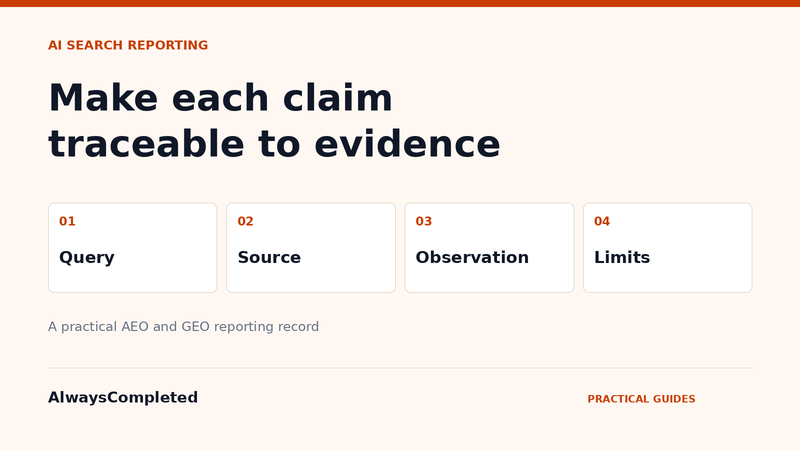
An AEO or GEO report should let you inspect three separate things: the work completed on your website, the answers actually observed in a defined sample, and any visits or business actions measured afterward. Ask for a dated change record, a reproducible observation procedure and the original reporting definitions. A screenshot can document one answer; it cannot establish lasting visibility or a campaign's return.
The practical question is whether the evidence supports the sentence written beside it. “We published the approved explanation” needs a page and version record. “Our page was cited” needs an observed answer and its source link. “This work generated enquiries” needs a separate attribution record. One kind of evidence does not automatically satisfy the others.
Use the original three-record teaching log, blank observation log and buyer review checklist. The examples are simulated, including their dates, prompts and outcomes. No AI visibility experiment, account inspection or client campaign was conducted for this article. This is a reporting method you can adapt, not an official cross-platform measurement standard.
Agree what the supplier will deliver
Before comparing a package, translate its label into inspectable work. Which pages will change? What will be researched, written, corrected or implemented? Who approves the changes? What record will show that the agreed version is live?
A useful scope might specify a revised service explanation, a corrected factual inconsistency, clearer supporting evidence and a documented technical review. Each item should have an owner, acceptance condition and evidence location. “AI ready” is too vague to tell you whether the assignment is complete.
Separate delivery acceptance from outcome review. You may accept a correctly implemented page change while recording that no subsequent visibility observation is available. Conversely, an answer mentioning the business does not prove that the supplier completed the promised work or caused the mention.
Keep a change log with the exact URL, previous state, approved change, implementation time and verification result. Record other relevant changes during the same period, such as a release, publicity, site migration or revised product offer. These can matter when interpreting a later pattern. Do not erase them because they complicate the campaign story.
| Report layer | Appropriate evidence | A conclusion that needs more evidence |
|---|---|---|
| Work delivered | Approved version, live URL, dated implementation and acceptance check | The work caused an answer system to select the page |
| Visibility observed | Exact query, interface, context, answer capture and inspected source links | The brand appears for all relevant people or queries |
| Referral activity | Named analytics report, source definition, period and landing-page scope | Every recorded visit came from a particular saved answer |
| Business response | Defined enquiry or purchase record and an explained attribution method | Visibility alone produced incremental revenue |
The backlink report audit applies the same evidence discipline to another deliverable: inspect what was supplied before inferring its effect. Keep the two audits distinct; a live backlink is not an AI citation.
Check the documented rules for the named system
Google says its existing SEO foundations apply to AI Overviews and AI Mode. Supporting pages must be indexed and eligible for a search snippet; there is no additional technical requirement or mandatory special AI file or schema. Eligibility does not guarantee inclusion. These statements concern Google Search, not every answer product. Google's AI features guidance.
When a proposal refers to another system, ask which exact product and feature it means, which current official documentation supports the claim, and when that source was checked. A rule about one crawler, search feature or training control cannot be transferred to another product merely because both use AI.
This article does not prescribe crawler settings for ChatGPT, Perplexity or other services. A report can name the interface it actually observed without pretending that the observer has established its full selection mechanism. Leave undocumented technical explanations as hypotheses, and keep access-policy changes outside a casual reporting exercise.
Treat a guarantee of universal inclusion as a claim requiring evidence and defined conditions. Ask what happens when the relevant feature does not appear or no answer can be inspected. Those cases belong in the method before the first report, rather than being removed afterward to improve the percentage.
Define the question set before collecting answers
Choose queries that correspond to real reader decisions. A customer comparing options asks a different question from someone looking up your company by name. Keep branded lookup, category discovery and detailed problem-solving in separate groups so an easy branded mention does not inflate a discovery claim.
Record why each query belongs in the sample. Useful inputs include genuine customer questions, relevant site content and available search data. The selected set remains a sample. Without a defensible sampling frame, do not call it a measurement of the whole market.
Freeze a version of the exact wording before collection. Save punctuation, language and any follow-up context that materially shapes the request. If you change “Which tool helps a small label plan a release?” to “Explain why our tool is the best release planner,” you have changed the task, not merely repeated the measurement.
Use neutral questions where the aim is to observe unaided inclusion. Keep diagnostic prompts that explicitly name your brand in a separate group. Both can be useful, but they answer different questions. Do not combine them silently into one presence score.
Decide the planned number of queries, repeat observations, products and contexts. Also define the start and end of the collection window. A small team can begin with a modest, consistent panel; there is no universal minimum in this worksheet. The purpose is to make the limits visible, not to manufacture statistical confidence from a convenient number.
Preserve the observation context
One row should represent one observation attempt. Keep the exact query and its stable ID, product and feature, visible model label if available, language, location setting, device or interface, date and time zone, and a session reference. Record whether earlier conversation context was present and whether the session was signed in when that is relevant and known.
Do not invent hidden information. If the interface does not expose a model version, write “not displayed.” A declared country setting is not proof of the physical location of every user represented by a report. Describe what was configured or observed rather than upgrading it into a stronger claim.
Use a non-identifying session code to distinguish independent attempts. Never put passwords, cookies, private conversation links or raw account identifiers into a shared client sheet. Keep any necessary source capture in an approved evidence location and redact unrelated personal or confidential content.
Save enough context to review the result: the full relevant answer, the visible source panel where applicable, the exact destination of a claimed citation, and any failure message. A screenshot cropped to the brand name can omit a warning, a negative comparison or a citation to somebody else's page.
Preserving the procedure allows another reviewer to understand and repeat the attempt. It does not guarantee an identical later answer. Google explicitly notes that its AI features can produce different responses and supporting links. Search Console also explains that ordinary search results depend on context such as time, place, device and recent history. Google AI feature behavior; Search Console reporting context.
Classify mentions, citations and incomplete checks separately
Define a mention as the visible reference you are counting under a written matching rule. Decide how you handle alternate spellings and ambiguous names. Inspect the surrounding statement: an incorrect or unfavorable mention is still different from a useful, accurate recommendation.
Define a citation as an inspected supporting link to the relevant domain or exact page, according to the report's declared scope. Record the destination, not just the label displayed in the answer. A brand can be mentioned while the answer cites another site; a page can be cited without the brand appearing prominently in the prose.
Keep correctness as a separate review field. Did the answer describe the product or fact accurately? Does the cited page support the associated statement? This is a human review question in the worksheet, not a claim that a visible link makes the whole answer reliable.
Use explicit completion states. “Completed, no mention” means the defined answer and source area were inspected and the matching rule found none. “Incomplete” means the attempt could not support that classification, perhaps because generation failed or a required source panel was not inspected. A missing result is not automatically a zero.
Read the three simulated records correctly
The following exercise uses one fictional interface, one invented product called Harbor Plan, and the same neutral question in three attempts. The query is: “What should a small independent label include in a release-planning checklist?” All timestamps and outcomes in the download are invented. The sample source URL uses the reserved example.org domain and is not evidence of a published resource.
| Record | Simulated inspection | Mention / citation | Correct interpretation |
|---|---|---|---|
| E01 | Complete answer and source area inspected in the exercise | Harbor Plan mentioned; one illustrative supporting page recorded | One positive observation in this fictional sample |
| E02 | Complete answer and source area inspected in a separate exercise session | No matching mention and no matching citation | A completed absence, retained in the denominator |
| E03 | Answer incomplete; source area not inspected | Unknown / unknown | Incomplete attempt, excluded from the completed-result denominator |
There are three planned attempts and two completed observations. Within that fictional completed set, one mention out of two is 50%. Coverage of the planned exercise is two out of three, or 66.7%. Reporting both exposes the missing attempt. Counting E03 as a negative would answer a different question; deleting it entirely would hide the gap.
That 50% is a sample presence fraction under the worksheet's rule. It is not audience reach, market share, a Google metric or the probability that a future visitor will see the brand. The same caution applies to citation fractions. Do not label the result “share of voice” without defining the competitor set, query sample and denominator.
The CSV keeps mention and citation fields blank for E03. A separate status explains why. Its evidence reference is also empty because these are teaching records, not saved real answers. When using the blank version, replace the exercise with actual observations and retain the missing-data distinction.
Keep referral reporting in its own section
Google includes traffic from AI Overviews and AI Mode in Search Console's overall Web performance reporting. A standard Web export therefore cannot simply be renamed a dedicated AI-visibility report. Preserve its actual search type, dates, filters and grouping. Google's measurement guidance.
Search Console defines clicks, impressions, CTR and average position for its own reporting scopes. Its chart and table can use different aggregation. Keep the exported scope beside any number you quote; a change in the general Web total does not identify which saved AI answer caused it. Performance report definitions.
For website visits, GA4 Traffic acquisition uses session-scoped source dimensions and can be filtered by source or page context. Record the exact dimension, source values, date range and relevant landing-page selection. An observed referral classification is useful evidence about the analytics record; it is not a complete census of AI answer impressions. GA4 Traffic acquisition.
A saved citation with no matched visit does not prove nobody saw it. A recorded referral does not identify the original prompt unless you have a separate legitimate way to establish that connection. Keep unknown attribution unknown. Do not create a convincing-looking journey by joining aggregate counts that have no common identifier or compatible definition.
If you report enquiries, specify what qualifies, how duplicates are handled and what evidence connects the enquiry to a source. A useful next step may be to improve measurement or ask a voluntary, clearly worded enquiry question. It is not to retroactively assign all new business to the latest visibility campaign.
Review change without promising causation
Repeat the predefined observation procedure at the agreed intervals and preserve every attempt. Keep the original panel separate from newly added queries. Record changed wording, feature availability, session conditions and relevant website changes so a reviewer can judge whether periods are comparable.
If one observation changes from absent to present, describe that change at its actual scope. You can investigate whether the revised page is now cited, but the sequence alone does not isolate the cause. Other content, publicity, competing pages or changes in the system may provide alternative explanations.
Use a clear conclusion format: what was delivered; what was observed in the stated sample; what website activity was measured; what remains unknown; and what action follows. A report can justify correcting an inaccurate answer, improving source clarity or collecting another round without claiming proven revenue lift.
Before ordering work under website SEO services, agree on that reporting structure and the acceptance conditions for the actual deliverables. Keep purchased website traffic distinct from independently observed answer citations and search performance. The most useful report leaves a buyer able to inspect the evidence and make the next decision without relying on a label or a single screenshot.
