YouTube Title and Thumbnail A/B Tests: A Practical Experiment Log
Use YouTube’s native A/B test when you want to compare video packaging under the same running experiment. Decide first whether you are testing a title, a thumbnail or a complete title-and-thumbnail concept. Write down the hypothesis and decision rule before launch, then preserve the reported result even when it does not identify a winner.
Changing a thumbnail on Monday and a title on Friday gives you a sequence of observations. It does not, by itself, tell you which change caused a difference in performance. The useful output of a test is a decision with evidence and limits, not a reason to declare the last design the best.
Download the editable experiment log, the three-variant planning CSV and the original thumbnail concept board. The examples are fictional and have not been run on a channel.
Check the current feature and video eligibility
The public instructions checked on November 25, 2026 describe desktop YouTube Studio access with advanced features enabled. Eligible long-form videos and live archives can use the tool. Shorts, scheduled live streams, active Premieres, private videos, made-for-kids videos and mature-audience content are excluded; a completed Premiere can become eligible as a long-form video. Check your actual video and channel before preparing a test. Source: YouTube’s A/B testing requirements.
This guide follows that documented workflow. It does not represent a test of your signed-in account. If the control is absent, record the video type, visibility and feature-access status you can verify, then resolve the specific eligibility issue. Do not change an accurate audience or age classification to obtain access.
Choose a video with a clear, honest promise. If you cannot explain what the viewer will receive, a test may only compare three different misunderstandings. Before writing variants, watch the opening and identify where the promised demonstration, answer or performance actually begins.
Write one hypothesis with a practical consequence
A useful hypothesis names a communication problem, an intended audience and a meaningful difference between designs.
For our fictional teaching video, the working title is “Three Mic Positions in a Small Room: Hear the Difference.” Assume the planned video genuinely demonstrates those three positions and includes listening comparisons. We have not recorded it or verified any acoustic result.
The hypothesis is: “A simple room-position diagram will communicate the comparison more clearly than a microphone portrait or a listening-focused graphic, producing a stronger watch-time result in the native experiment.”
That gives the design work a direction. It does not predict that the diagram will win. If the video only discusses microphone purchasing, all three concepts below would need to change because they promise the wrong material.
Add a decision rule: adopt a clear native winner if it remains truthful and usable; otherwise choose the clearest accurate default and record that the test supplied no demonstrated performance advantage. This prevents a team from changing its standard after seeing a favorite design slightly ahead.
Choose the question your test can answer
| Test mode | Keep fixed | What the result can help you choose |
|---|---|---|
| Title only | Thumbnail and video | A title among the submitted alternatives |
| Thumbnail only | Title and video | A visual concept among the submitted alternatives |
| Title and thumbnail | Video | A complete packaging option, without isolating the contribution of each element |
Those three modes are documented in the native tool, with up to three variants. Source: YouTube’s setup instructions.
For the teaching example, start with Thumbnail only and keep the title identical. The three designs differ in visual concept, including composition and wording. This is a comparison of thumbnail concepts, not an experiment isolating the effect of a single arrow, color or word.
A combined test is useful when title and image need to work together. You might compare a problem-led package with a demonstration-led package. If one performs better, write “this package won this test,” not “the word ‘room’ increased watch time.” Establishing the latter would require a more focused design.
Three original thumbnail concepts
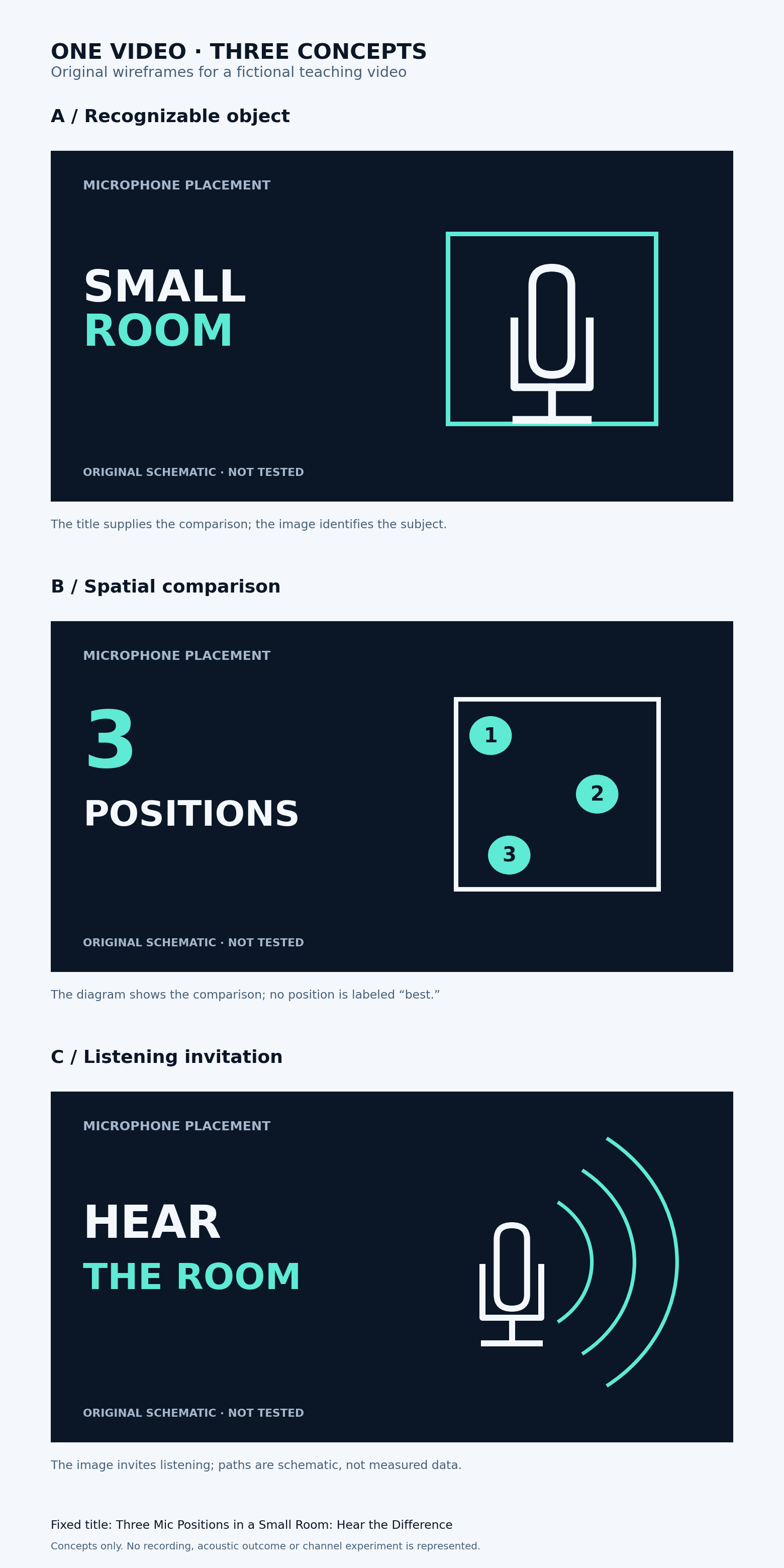
The downloadable board contains original schematic layouts. It is not a screenshot of YouTube Studio or a set of proven thumbnails. Replace the diagrams with your authorized production assets where appropriate, and check every promise against the actual video.
A. The recognizable object: “SMALL ROOM”
Use one large microphone silhouette or your own microphone photograph, a simple room boundary and a short location cue. The title supplies the comparison; the thumbnail supplies an immediately recognizable subject.
This is a straightforward reference option, useful when you want to learn whether the more explanatory alternatives add value. Its possible weakness is ambiguity: someone could interpret it as a microphone review. Do not add a brand logo unless that product is actually relevant to the video.
B. The spatial comparison: “3 POSITIONS”
Show a clean top-down room diagram with three labeled microphone positions. Keep the diagram simple enough to understand at a reduced display size. The image’s job is to communicate that the video compares placement, rather than three products.
The conceptual difference is explicit structure. Its possible weakness is visual complexity. If the room plan needs a legend or a long paragraph, simplify it before using it. Do not mark a “best” position until the video actually supports that statement.
C. The listening invitation: “HEAR THE ROOM”
Use a microphone and schematic sound paths to suggest attentive listening. Avoid fake before-and-after waveforms that imply a measured improvement. The concept asks the viewer to experience the difference instead of seeing an answer in advance.
Its possible weakness is a less concrete promise. That is why it is a useful alternative to the spatial diagram: both can be truthful, while offering different ways into the same material.
These are creative hypotheses, not universal thumbnail rules. Preserve recognizable differences between variants; changing only a tiny accent may answer a narrower question than your team intended.
Prepare the log before launch
Save the exact title strings and final image files, including version identifiers. “Blue thumbnail” is not enough if the designer later exports three different blue versions. Our example uses mic-room_A_v01.png, mic-room_B_v01.png and mic-room_C_v01.png as planned production filenames; those final photographs or designs have not been created.
Record the following in the log:
- Video URL, test owner, mode and reason for choosing this video.
- Hypothesis, fixed elements and the intended difference between variants.
- Exact submitted order, titles, asset filenames and a copy of the submitted setup.
- Planned decision rule and conditions that would require stopping for accuracy or another substantive issue.
- Actual start and end times, native result, evidence location and any interruptions.
- The final choice, what the evidence supports and the next unanswered question.
Keep planned and actual fields separate. A scheduled review date is not a completed test date. A thumbnail approved internally is not a variant that YouTube has actually served.
Preview each title and image together at a small size. Check spelling, legibility, cropping, rights to the image and whether the opening delivers the promise. These checks cannot establish which version performs best; they prevent an avoidable production error from becoming part of the experiment.
Launch once, then preserve the experiment
In the documented desktop workflow, open the video, select A/B Testing in the title or thumbnail area, choose the mode, add variants and confirm with Done. YouTube says changing the title or thumbnail during the test stops it and requires a restart; completion can take up to two weeks. Source: YouTube’s test workflow.
After launch, save the actual setup and start time. Do not assume a draft was submitted simply because all files were ready. Agree who may change the video’s packaging while the test is running.
If you discover a false claim, the wrong image or an unauthorized asset, correct the issue. Record why the original experiment was interrupted and give any replacement run a new identifier. Protecting a test design is not a reason to leave a material error public.
Also log relevant contextual changes, such as a major external campaign starting during the run. Such a change does not automatically invalidate every observation, but it can change the audience the result describes. Do not quietly remove those facts from the report because the final choice seems attractive.
Read the native result before the surrounding metrics
YouTube’s official announcement explains that its test optimizes for watch-time performance rather than CTR alone. Its reported outcomes distinguish a winner, similar performance and an inconclusive result; absent a conclusive result, the first submitted option becomes the default. Source: YouTube’s official title-testing announcement.
| Reported outcome | Decision to record |
|---|---|
| Winner | Save the report and chosen option; state the tested context and remaining limits |
| Performed Same | Choose an accurate, practical option without claiming demonstrated superiority |
| Inconclusive | Preserve the uncertainty; decide whether a different future test is worth the effort |
Do not rebrand a small numerical lead as a statistically established win. The native result is evidence about this experiment; it is not proof that the same design will outperform on another topic, channel or audience.
Here is illustrative arithmetic, not a recreation of YouTube’s decision system. Suppose each of two options has 1,000 counted impressions. A produces 100 views averaging one minute; B produces 70 views averaging two minutes. A has 10% CTR and 100 watch minutes, while B has 7% CTR and 140 watch minutes. The higher CTR does not identify the option with more watch time in this simple example. Those totals alone also do not supply a statistical significance test.
The ordinary CTR report remains useful context. YouTube explains that CTR depends on content, audience and placement, and only covers views associated with counted impressions. Dividing all views by impressions can therefore produce the wrong calculation. Source: YouTube’s impressions and CTR FAQ.
For a broader traffic-source diagnosis, use the impressions but few views guide. Keep that diagnosis separate from the decision produced by the packaging experiment.
Handle an unclear result without inventing certainty
Imagine the native report says Inconclusive, with illustrative watch-time shares of 36%, 34% and 30%. The shares add to 100%, but their ordering alone does not overturn the reported uncertainty. Without the required underlying data and method, you cannot infer a confidence level from those three percentages.
A useful log entry would say: “No clear performance winner. Selected B because its room diagram most accurately signals the content. This is an editorial decision, not a demonstrated lift. Next test: compare two genuinely different title promises while keeping B fixed.”
That is more actionable than “B won” or “testing does not work.” It preserves a design decision while leaving the empirical question open. Another reasonable decision may be to stop testing this video because the effort is more valuable on the next production.
Do not keep restarting a test until the preferred option receives a favorable label. Repeated attempts and selective reporting can produce a misleading story. Archive every run, including inconclusive and interrupted ones, with the reason for any follow-up.
Close the test and carry forward one lesson
At closure, capture the native result, the actual selected packaging and the decision owner. Keep the original files even if the team later develops a new design. Write the lesson at the right level: “the comparison diagram performed better in this run” is narrower and more useful than “diagrams always work.”
If you are preparing a promotional campaign, finish the packaging review before treating additional delivery as a solution. When assessing a YouTube service, ask what work is supplied and how it will be reported. An order volume is not a substitute for a native test, proof of better content or a promise of recommendation exposure.
Your next experiment should begin with the question the last one could not answer. The attached log keeps that question visible alongside the result, so the team can learn without rewriting its own history.
