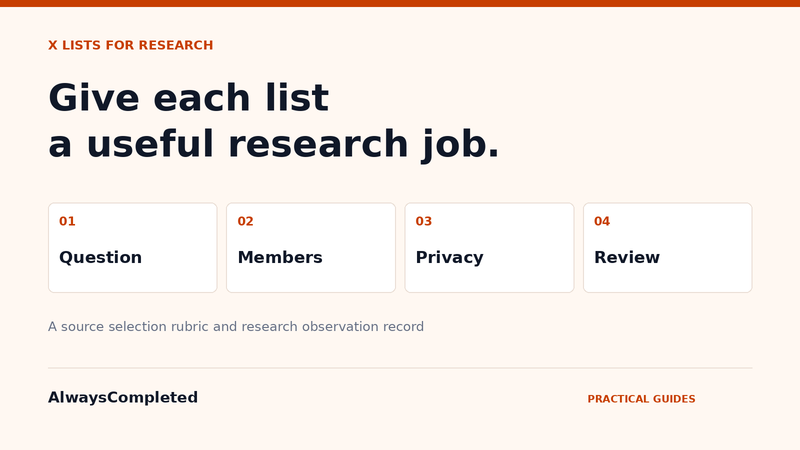
X Lists: An Editorial Research System for Small Teams
An X List becomes useful when it has a clear editorial job: show a particular set of sources, help the team notice meaningful changes and produce questions worth checking. Build it around the role of the source, not just a collection of famous accounts. Then keep a short record of why each account belongs and what the team learned from reviewing it.
For a small agency, musician or maker business, the goal is a manageable research routine. A platform announcement, a practitioner's explanation and a discussion about audience needs offer different kinds of evidence. Separate those roles so a popular opinion does not accidentally become the source for a platform requirement.
The downloads contain an original List charter, a review sheet and three fictional research structures. They use account categories rather than a contact list of real people. No Lists were created, no accounts were added and no outreach was performed for this guide.
Give each List one editorial purpose
Start with a question the team needs to answer repeatedly. An agency might ask what changed in the tools it uses. A musician might track how peers explain release decisions. A maker brand might look for questions about how people use a product. The List should help with that recurring question instead of becoming a second unrestricted main feed.
X describes a List timeline as a stream from the accounts included in the List. You can create your own or follow a List someone else maintains, and you do not need to follow every individual account to use this organisation method. X: how to use Lists
That gives you a way to separate research from the accounts you want in your ordinary following feed. It does not make the List a complete industry archive or establish that every relevant account has been found. Keep a short note of what the selection leaves out, such as another language, a different market or sources that publish mainly elsewhere.
Buffer's professional guide also treats Lists as curated research feeds. The workflow here adds an inclusion reason, source role and verification step so the output is more useful than a stream of saved posts. Buffer's X guide
Separate announcements, practice and context
Use source roles that match the decisions you make. An official product account can point to a release note, while a practitioner can show an implementation problem and an audience discussion can reveal a confusing question. None of those roles is automatically superior for every purpose.
| Source role | Useful signal | Check before using it in your own content |
|---|---|---|
| Primary announcement | A documented change, release, event or requirement | Original document, date, scope and current status |
| Practitioner explanation | A method, limitation or worked experience | What was actually done, under which conditions and with what evidence |
| Cultural or audience context | Questions, language and topics people discuss | Whether the example is representative enough for the claim you intend |
Keep a source in the role it can support. A designer's difficulty with a tool can inspire a useful troubleshooting question without proving that the tool fails for everyone. An official launch post can establish an announcement while leaving actual account availability unresolved. Record that boundary in the review sheet.
You can start with one List and role labels in your notes if three Lists would be too much to maintain. The supplied structures show options, not a required number. Split a List when the mixture makes review harder, and combine two when they serve the same question with the same sources.
Write inclusion and removal criteria
For each candidate account, record its connection to the topic and the kind of signal it adds. “Publishes original release notes for the product we use” is a stronger inclusion reason than “has a large following.” “Shows the workshop process and explains material choices” is more useful than “posts attractive photos.”
Check the account's actual identity and linked source before relying on it. A familiar display name, copied logo or repost of an announcement is not the original publisher by itself. Follow a useful claim to its supporting website, document or publication and retain that reference with the post.
Set removal or review triggers in advance. An account may change topic, stop supplying original material or duplicate sources already covered. Removing it from a research List can be a routine scope decision; it does not need to become a public judgement about the person or every post they have written.
Avoid an inclusion rule that selects only agreement. A practitioner with a different method may be useful precisely because they reveal an assumption your team should test. At the same time, disagreement alone is not evidence of quality. Keep the criteria focused on relevant, interpretable material and identifiable sources.
Choose visibility deliberately
X's current instructions distinguish public Lists, which others can follow, from private Lists, which are accessible only to their owner. The mobile creation guidance describes public as the default. Inspect the selected visibility before saving, especially when the List's title would otherwise reveal an internal research question. X List visibility
Use a public List when you intend to offer a maintained source collection to other people. Give it a descriptive name and a clear purpose. Inclusion in a useful reading list should not be presented as endorsement of every statement an account makes, a ranking of personal worth or permission to reuse its content.
Use a private List for an individual research view that should not be published as a curated recommendation. Private does not mean a shared team workspace. X explicitly says only the owner can view their private Lists; another colleague cannot simply follow one to obtain the same private view. X: help with private Lists
For teamwork, share the permitted editorial notes and public source references in the team's normal workspace, or maintain separate research views. Do not solve the visibility limit by circulating account credentials. Also distinguish a private List from protected posts: making the List private does not change the underlying publications' visibility or turn them into confidential team material.
Make the feed part of a short routine
Choose a review rhythm the team can sustain. A small team might review selected Lists twice a week and leave a separate route for urgent official changes. That is an operating choice, not a platform rule or a guarantee that nothing important will be missed between reviews.
During a review, capture only the signals that could change a decision or improve an explanation. Save the exact post URL, account role, date and one sentence describing the useful observation. Then write the question it creates. A queue of questions is easier to act on than a large pile of screenshots with no context.
For example, a fictional agency reviewer sees a tool announcement about a changed export field. The editorial question becomes: which step in our reporting handoff would need an update if the change applies to our account? The record stays unresolved until the release documentation and relevant setup are checked. No real platform change is claimed by that example.
End the review by assigning the next action: verify a source, ask an internal subject expert, draft a small explanation or take no action. Not every interesting post needs a publication. A deliberate “outside this month's scope” decision helps protect the team's attention without losing the reason it was passed over.
Verify the post before turning it into advice
Open the full thread, linked document or original announcement. Check the publication date and the date the described event happened. An old launch post circulating again may describe a feature that has changed, while a current commentary post may refer to research from another period or market.
Separate what the source says from what you infer. “The help page names a new option” is an observation. “Every customer can now use it” needs additional support. Put the uncertainty next to the planned action so a later writer does not remove it while shortening the note.
For a practical example, inspect the method and evidence. Was it a real account test, a simulation, an opinion or a proposal? If you use the example, describe it at that level. A maker's personal experience can support a discussion of that experience without becoming a universal durability claim about a material.
Use the X advanced-search query pack when a question needs a targeted search beyond the selected accounts. Lists support ongoing observation; a search helps investigate a particular term, time period or conversation. Neither removes the need to check the original evidence.
Turn the verified question into a useful output
Choose an output that fits the uncertainty and the reader's task. A confirmed process change may need a revised checklist. Several recurring questions may justify an explainer. An unresolved dispute may be better retained as a research question than packaged as a confident conclusion.
Connect the output to an editorial plan only after defining its value. The LinkedIn content calendar for agencies covers scheduling and ownership in that channel; the research record supplies the question, source and limitation. Do not fill a calendar simply because a List produced a busy day of posts.
Keep observation separate from contacting people. Adding an account to a List does not create an invitation to pitch it, and a public question does not automatically justify a promotional reply. If an actual conversation would help, handle it individually in its context rather than turning the source register into a bulk outreach queue.
Retain the original link and a concise factual note when you publish your own explanation. That makes later corrections easier. If the source changes or the claim is revised, the team can find the affected output instead of trying to remember which saved post inspired it.
Maintain the collection as the work changes
Give each List an owner and review date. Check whether its question still matters, whether the account mix supplies useful evidence and whether its visibility remains appropriate. The supplied charter includes a removal reason and a change log so edits are deliberate rather than unexplained churn.
Do not judge the List by follower count or the number of accounts it contains. Review whether it helped the team verify a meaningful question, correct an assumption or produce a useful resource. Those are operational observations you can document without claiming an algorithmic or commercial result.
The AlwaysCompleted X service guide describes separate profile, post and session-related promotion listings. A research List is not the same destination or deliverable. Prepare a useful publication from the verified work, then compare any selected service against its actual scope and confirm questions with technical support.
