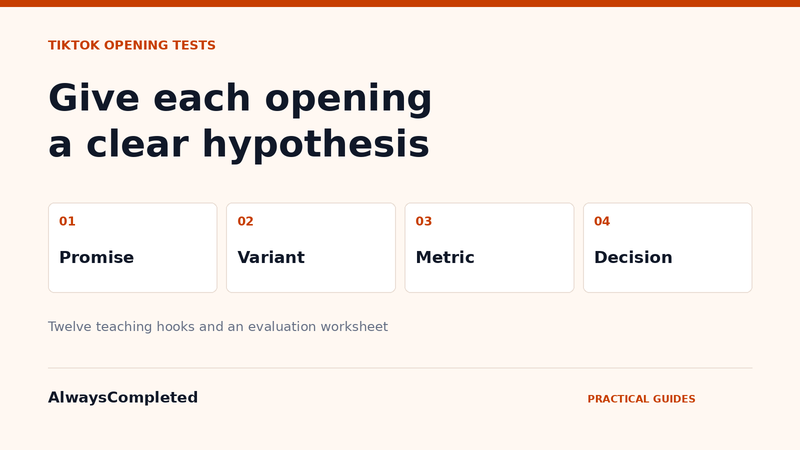
TikTok Hook Testing: Build a Creative Matrix You Can Actually Learn From
To test TikTok hooks, keep one audience, one promised benefit and one video body, then compare clearly different openings. Define the result you want before distribution, record the context and distinguish a controlled advertising split test from observations across organic posts. A higher early-view number is useful evidence, but it does not automatically identify the best creative for your business goal.
This guide includes 12 original openings for one fictional product. Download the hook matrix (CSV), the results log (CSV) and the editable evaluation sheet. They contain production instructions and blank review fields, not claimed campaign results or universal performance thresholds.
Define the audience and the promised value
Our teaching product is an unnamed reusable cable wrap. Its fictional demonstration shows a charging cable coiled and fastened before being placed in a work bag. The audience is people packing a charger for travel or a commute. The single promised benefit is keeping the coil together during that packing routine.
There is no fictional customer testimonial, price, sales claim or guarantee that cables can never tangle. The product and scripts exist only to demonstrate the testing method. For a real product, show only behavior the actual item can support.
The creative brief is deliberately narrow:
- Audience: someone packing a charging cable into a bag.
- Value: show how the wrap holds the coil together.
- Evidence: a visible coil, fastening action and packing demonstration.
- Next action: “See the wrap details,” using the same destination and call to action across the comparison.
Write an equivalent brief for your own product, service or release. If one opening promises a discount while another promises convenience, you have changed the offer as well as the opening. That may be an interesting comparison, but it will not isolate how you introduce the same value.
Keep one body and vary the opening treatment
TikTok’s Creative Codes recommend a hook, body and close structure for advertising creative. We will use that structure with a fictional 20-second video: an opening from 0–3 seconds, a demonstration from 3–16 seconds, and a close from 16–20 seconds. These timings are a production choice for this exercise, not a universal TikTok requirement.
Film one approved body: coil the cable, place the wrap, fasten it, put it in the bag and show the packed result. Keep the body footage, presenter, voice level, music, captions, offer, destination and closing action consistent. Export each opening into the same body so the change is easy to identify.
Here, an opening treatment includes the first shot, spoken line and corresponding on-screen text. The matrix compares those treatments as a package. If one performs differently, you cannot attribute the result to a single word while its first shot also changed. To investigate wording alone later, hold the shot, timing and delivery stable and vary only the line.
Use simple identifiers such as Q1 or D1 in filenames and the results log. Keep the exact exported file with its script. “Question version” is insufficient when you later have three question openings and two revisions of each.
Twelve original hooks for the same fictional cable wrap
The questions invite recognition or curiosity, the demonstrations lead with an action, the mistake openings expose an incomplete packing step, and the result openings show the intended outcome first. None is labeled a winner in advance.
| ID and pattern | Spoken line or text | First shot | Hypothesis to investigate |
|---|---|---|---|
| Q1 — question | “What keeps this cable coil together?” | A coiled cable held beside the open wrap | A specific question makes the small mechanism worth watching |
| Q2 — question | “Packing a charger again?” | A hand places a charger beside an open work bag | Recognizing the routine attracts the intended viewer |
| Q3 — question | “Which would you put in your bag?” | Wrapped and unwrapped versions of the same cable side by side | A visible choice makes the packing benefit clear |
| D1 — demonstration | “Coil. Wrap. Close.” | Three close shots of those actions, leading into the shared body | Showing the process immediately communicates the product’s use |
| D2 — demonstration | “Watch the loose end.” | A finger guides the loose cable end under the wrap | Focusing attention on one detail makes the benefit understandable |
| D3 — demonstration | “One wrap around the coil.” | The open strap moves around the cable coil | An uncomplicated physical action reduces explanation before the body |
| M1 — incomplete step | “The coil is packed. The end isn’t.” | A coiled cable with one end hanging loose | A recognizable incomplete step makes the demonstration relevant |
| M2 — incomplete step | “Don’t stop at the coil.” | A hand coils the cable and pauses before reaching for the wrap | A small correction creates a reason to watch the next action |
| M3 — incomplete step | “The loose end needs a place.” | The cable end rests outside the coil next to the wrap | Naming a precise issue works better than a broad complaint about clutter |
| R1 — result first | “One coil, ready for the bag.” | The fastened cable is placed beside the charger | Showing the outcome first communicates the intended benefit quickly |
| R2 — result first | “Here’s the cable after unpacking.” | The same wrapped cable is removed from the bag | An illustrative unpacking result creates interest in the method |
| R3 — result first | “Packed cable. Loose end secured.” | A close shot of the secured cable end | A concrete result makes the benefit visible without a general claim |
Film the result-first scenes honestly. Do not stage a dramatic comparison that implies a durability test you did not perform. In the fictional R2 scene, the cable is simply packed and unpacked for the demonstration; it does not stand in for days of real-world travel.
The matrix is a bank of candidates, not an instruction to launch 12 versions at once. Select a small, interpretable comparison. Q2 versus D1, for example, asks whether recognition of the packing routine or immediate product demonstration is the better opening treatment for this brief. Q1 versus Q2 asks a different question within the question pattern.
Choose the distribution method before choosing the conclusion
A controlled advertising split test
TikTok describes its Ads Manager split test as a comparison with separate audience groups, each seeing only one ad group. Its current variable documentation explicitly includes opening hooks under Creative Assets. Check compatibility for the intended campaign rather than assuming every format or objective has the same options. See About Split Testing and Split Testing Variables.
For this hook comparison, hold the intended audience, objective, offer, destination and other non-tested settings stable. Choose the supported key metric that matches the question before launch. Record the system’s testing-power estimate and the planned duration. TikTok’s current split-test guidance recommends at least seven days and avoiding changes after the test starts. That guidance concerns its advertising test, not a minimum observation rule for every organic post.
Equal-looking ad groups you create manually are not automatically evidence of random assignment or isolated audiences. If you are reviewing ordinary campaign delivery, label it an observational paid comparison. Use the native test’s actual conclusion when available, including an inconclusive result, rather than declaring a winner from a temporary lead.
Organic-post observation
Organic versions can help you discover useful patterns, but the viewers, posting time, distribution and surrounding context can differ. Keeping the body constant improves the creative comparison; it does not make audience exposure controlled.
For organic observation, save the available post-level analytics and compare posts at a similar age. TikTok describes Studio as a place for account, content and audience analysis in its Studio introduction. Use the actual fields available in your current account, and preserve their labels and definitions.
Record posting time, video duration, caption, audio, any promotion, visible audience differences and unusual external activity. Treat a strong result as a candidate for another informed test. “This opening attracted more of the viewers who saw this post” is a narrower claim than “this hook caused the improvement for all audiences.”
Choose metrics that match the distribution type
Separate an opening-attention signal from the campaign’s intended action. A viewer may stay briefly because a demonstration is surprising but have no interest in visiting the product page. Conversely, a more specific opening may attract fewer casual viewers while making the offer clearer to interested ones.
For paid reporting, use the exact TikTok metric name:
| Advertising metric | Meaning to preserve in the review | Misinterpretation to avoid |
|---|---|---|
| 2-second video views | Plays reaching at least two seconds in an impression session; replays are excluded | Treating it as a count of unique people |
| 6-second video views | Can include a six-second play, a full play of a shorter video, or an engagement within the first six seconds | Calling every counted event six seconds of continuous attention |
| Average play time per video view | An average that includes replay time | Equating it with a deduplicated completion rate |
These are advertising definitions from TikTok’s video play metrics documentation. Do not copy them onto an organic metric merely because its label looks similar. If an organic post does not expose the early-view field you want, mark that field unavailable and choose a measure you can actually inspect.
Keep downstream actions specific as well. TikTok distinguishes Clicks (all), which include social interactions, from Clicks (destination), which lead to a specified destination. Use the appropriate field for a destination goal; see TikTok’s basic metric definitions.
There is no universal score in this worksheet that makes a hook “good.” Write the primary metric, a quality check and a relevant next-action measure before viewing results. Record their definitions and denominators. If you calculate your own ratio, label the formula instead of presenting it as a platform-defined metric.
Worked example: more early attention is not a complete verdict
Suppose Q2 and D1 produce the following fictional paid-report data. Both videos are 20 seconds long, and the report covers the same stated period. This is an arithmetic example, not a statistically evaluated experiment.
| Metric | Q2: packing question | D1: immediate demonstration |
|---|---|---|
| Impressions | 10,000 | 10,000 |
| 2-second video views | 4,800 | 5,500 |
| Derived ratio: 2-second views ÷ impressions | 48% | 55% |
| Average play time per video view | 8.2 seconds | 7.6 seconds |
| Clicks (destination) | 50 | 38 |
| Derived ratio: destination clicks ÷ impressions | 0.50% | 0.38% |
D1 has the higher two-second ratio. Q2 has the higher average play time and more destination clicks in these fictional numbers. That is enough to describe a tradeoff, but not enough to claim that either version reliably outperforms the other. You would still need the actual test design, report conclusion, uncertainty and context.
If the preselected objective concerns visits to the product destination, choosing D1 solely because 55% is larger than 48% ignores the intended action. If the objective is early attention, you can record D1 as the stronger observed attention signal while still investigating whether its audience understands the offer. Do not switch the goal after seeing which column flatters your favorite creative.
The next brief could examine whether D1 communicates the packing use case clearly enough. That is a new hypothesis to test, not an explanation proven by the table. Keep the same body for that next comparison unless you deliberately decide to study a different variable.
Use a review sheet with evidence, not a magic cutoff
The downloadable evaluation sheet separates preparation from results. Before distribution, review whether the promise is accurate, the opening is readable, the first shot makes sense, the body delivers the stated benefit and the intended comparison is clear. Fix a missing or misleading element before spending money on its performance.
After distribution, add the report period, denominator, primary metric, viewing-quality signal, intended action and any context change. Keep raw counts next to ratios. A percentage without its exposure count hides how much evidence you actually have.
Use one of four decisions: continue the candidate, revise a named issue, set aside for this brief, or inconclusive. State the reason. A native split-test result, an organic observation and a production-quality review are different kinds of evidence; identify which one supports the decision.
Finally, write the next creative brief in plain language. For example: “The immediate demonstration drew early attention in this observation, but the packing context was less clear. Make a new opening that includes the bag while keeping the body and offer unchanged.” Save the supporting report and the unresolved questions with that brief.
Once you have approved creatives and a defined reporting plan, review the TikTok promotion guide for a scope that fits the intended format and destination. Confirm what the current service actually includes. Distribution is a separate decision from whether the opening communicates the right promise.
