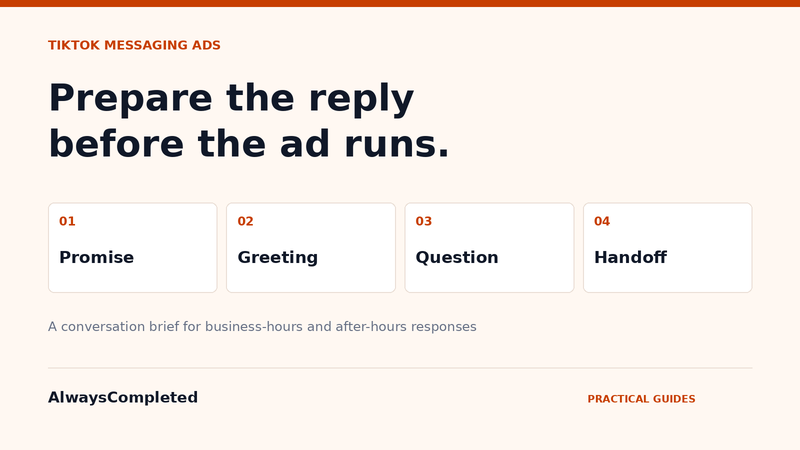
TikTok Direct Messaging Ads: Prepare the Conversation Before Launch
A direct-message campaign is ready when the first conversation delivers what the ad promised. If the ad invites someone to ask about instrument repair, the welcome message should help identify the instrument and the problem. It should not immediately demand a long form or claim a booking before a technician has checked availability.
Use the editable conversation brief to prepare identity, first replies, three service branches and a human handoff. The workshop in the example is fictional; no messages or bookings were created.
Confirm that the destination is TikTok Direct Messages
TikTok distinguishes Direct Messaging Ads from Instant Messaging Ads. Direct Messaging keeps the conversation inside TikTok. Instant Messaging routes people to an external messaging application. Name the intended destination in the brief before choosing the creative or asking an operator to configure the campaign.
This affects the visitor's expectation. “Message us here on TikTok” should not unexpectedly open another application. A general phrase such as “chat now” may still need clarification in the creative and first response, especially when the business operates several inboxes.
Record the receiving account and the person responsible for that inbox. A brand can have multiple accounts with similar names. Use the exact account reference and confirm the public identity matches the ad promise.
Verify the account and optimization goal
The current setup guide requires a TikTok Business Account. It describes Clicks, Conversations and Leads as distinct optimization choices. Leads requires auto lead capture and is documented for specified Southeast Asian markets: Indonesia, Singapore, Malaysia, the Philippines, Thailand and Vietnam, with conditions applying to both ad account and targeting countries.
Check the actual account's available goal and current regional requirements before promising a lead workflow. Do not assume that a Conversations option means the same result as captured lead information, or that availability in one country transfers to another. Record unknown access as unknown and ask the account owner to verify it.
If auto lead capture is part of the chosen route, review its privacy and setup requirements through the authorized business owner. The conversation script does not replace that configuration. Avoid collecting more information than is necessary to answer the person's request.
Match the promise to the first useful question
For a fictional instrument-repair studio, a focused ad could say: “Not sure which guitar repair you need? Message us on TikTok with the instrument type and the issue. Our team can explain the next inspection step.” This promises a conversation, not a diagnosis or guaranteed appointment.
The welcome message can continue: “Thanks for contacting Northline Repairs. Are you asking about a setup, an electrical issue or physical damage?” Each answer leads to a different useful follow-up. The question earns its place because it changes who should respond and what evidence the team needs.
Do not ask for date, budget, address and contact information all at once merely because the fields are available. Ask the smallest question that makes the next response more useful. A person asking whether a service is offered should be able to receive that answer before submitting unnecessary details.
Build three short branches
| Visitor's need | First follow-up | Intended next step |
|---|---|---|
| Routine setup | Which instrument type and what adjustment is needed? | Human confirms whether the service fits |
| Electrical issue | What happens when you connect or use it? | Technician decides what inspection information is useful |
| Physical damage | Which part is affected? | Human explains the inspection route and limits of remote assessment |
Keep the script within what the business can responsibly answer. A photo may help a technician understand the request, but it does not justify promising a repair price without inspection. If the service is unavailable, say so clearly and end the branch politely instead of forcing the visitor toward a booking.
Use labels in the working document to distinguish a welcome template from a human reply. The team should know which message can appear automatically and which requires someone to read the conversation first. The article does not assume a particular automation or branching feature has been enabled in the account.
Rehearse business-hours and after-hours paths
A campaign can generate conversations when the specialist is unavailable. Write an honest after-hours response: “Your message has reached our team. We review repair enquiries during [actual hours and time zone]. Please tell us the instrument type and issue; a team member will reply when available.”
Only include a response-time commitment the business can maintain. Do not say “a technician is joining now” if the next step is a queue for the following day. Define the owner and backup for unanswered conversations, and decide how the team records a request that needs follow-up.
Rehearse the flow with invented inputs in the worksheet before anyone configures it. Test a clear request, an ambiguous one and an unsupported service. Check that every branch ends in a useful answer or a human handoff, not a loop that asks the same question again.
Define what counts as progress
Keep conversation started, contact submitted, suitable enquiry and confirmed booking as separate states. A message containing “hello” is a conversation opening; it is not yet a qualified repair request. A supplied phone number does not prove that an appointment was agreed.
For each state, define the evidence and owner. The inbox can show the conversation; a staff member may assess suitability; the scheduling system records the booking. A report should name the stage it actually measures and avoid merging unlike states into a flattering “leads” total.
Capture only the minimum needed in a shared campaign record. Use synthetic examples and redacted references for review. Keep customer conversations in the systems where the authorized team normally handles them.
Use the conversation brief when comparing promotion methods
If native messaging advertising is required, ask for that scope explicitly when reviewing advertising and promotion. Confirm who owns the account, receiving identity, configuration and reporting. Separately compare any service on TikTok promotion by its actual target and unit.
A video-view or profile service does not itself establish a messaging campaign, captured leads or qualified bookings. Technical support can clarify the conditions of the selected service. The completed brief helps you ask a precise question instead of treating every form of TikTok promotion as the same product.
Documentation reviewed 26 November 2026. Examples are fictional; no customer account or campaign was tested for this guide.
