TikTok Website Traffic but No Leads: Diagnose the Click-to-Page Gap
When TikTok reports clicks but your business sees no leads, check the journey in order: the kind of click being counted, whether the destination loads, whether it delivers the video’s promise, whether the form works, and whether a successful submission is recorded correctly. Start with the first confirmed failure, not an assumption that the audience is wrong.
A click is not a loaded page, a loaded page is not a website session, and a form-button tap is not an accepted lead. Those distinctions determine which report you need and which change is worth testing.
Download the illustrative journey map, its source-number CSV, the mobile landing-page checklist and the reporting-discrepancy worksheet. All example figures are fictional teaching data. No campaign, page or form has been tested for this article.
First, identify what “clicks” means
TikTok defines Clicks (all) to include social interactions and Clicks (destination) as clicks leading to a specified destination. For a website investigation, confirm the exact destination and column rather than treating every interaction as a website visit. Source: TikTok’s basic metrics.
TikTok’s Landing Page View documentation, updated in November 2026, says an LPV requires an ad click followed by a successful landing-page load. TikTok computes this metric; it is distinct from website events an advertiser sends through Pixel or Events API. The guide also describes LPV as an optimization goal under the Traffic objective. Source: TikTok’s Landing Page View guide.
Record the campaign objective and actual optimization goal before making comparisons. A campaign designed to produce traffic is not evidence that the system was optimizing for your completed lead action. Improving the load step can help you inspect the journey, but it does not establish that a person submitted a form.
If you used an in-app promotion interface, preserve its exact report labels. Do not assume it exposes the same columns as Ads Manager. The analysis still works: write down what the available number measures, then identify which next stage remains unobserved.
Keep the measurement boundaries visible
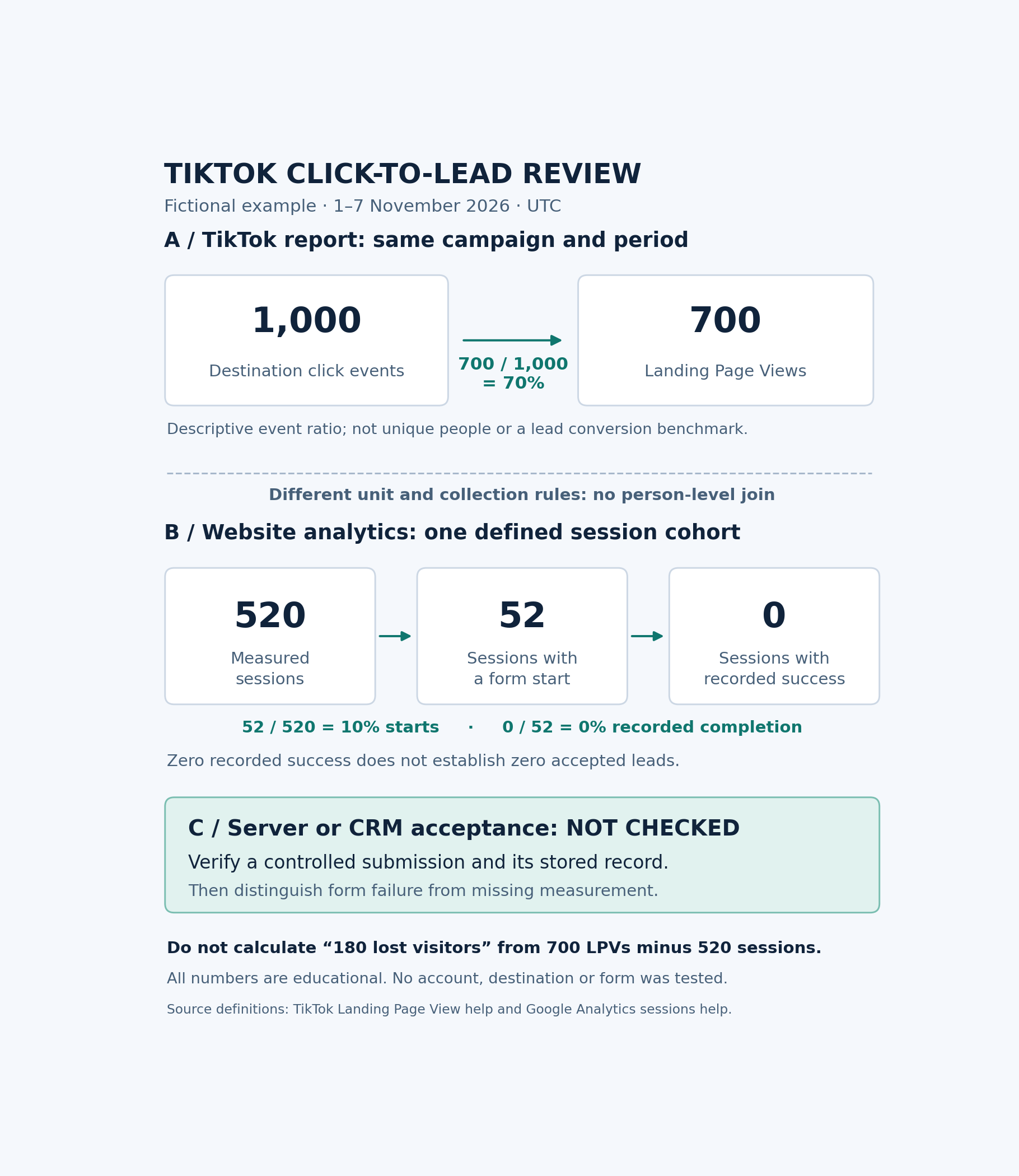
Here is a fictional seven-day example for November 1–7, 2026, using UTC reporting boundaries. It deliberately includes two reporting systems and an unverified backend result.
| System and scope | Measure | Example count | Valid interpretation |
|---|---|---|---|
| TikTok, same campaign and reporting period | Destination clicks | 1,000 | Click events toward the configured destination |
| TikTok, same campaign and reporting period | Landing Page Views | 700 | TikTok-recorded successful landing loads |
| Website analytics, defined TikTok-associated session cohort | Sessions | 520 | Measured website sessions under that system’s rules |
| Same website session cohort | Sessions with at least one form start | 52 | Sessions with the agreed start action |
| Same website session cohort | Sessions with a recorded successful submission | 0 | No success recorded by that measurement, pending validation |
| Server or CRM | Accepted lead records for the relevant scope | Not checked | Business outcome is still unknown |
Within the TikTok report, 700 divided by 1,000 is 70%. This is a descriptive LPV-to-destination-click ratio, not a benchmark, a percentage of unique people or a lead conversion rate. It leaves a gap to investigate without identifying the cause.
Within the defined website cohort, 52 divided by 520 is a 10% form-start rate. Zero recorded success sessions out of 52 start sessions is 0% recorded completion. That last number cannot tell you whether the form failed or the success measurement failed.
Do not subtract 520 sessions from 700 LPVs and declare that 180 visitors disappeared. Google defines a session as a period of interaction with a site or app, while TikTok’s LPV counts a different event. A person can also make multiple interactions within a session. Sources: Google’s session definition and TikTok’s explanation of reporting differences.
The map therefore keeps those systems in separate panels. You can investigate the difference, but the two totals are not a joined person-by-person funnel.
Test the actual destination in the in-app browser
Start from the actual ad destination, with its real path and parameters. Opening a clean homepage in a desktop browser is not a substitute for checking the landing route someone encounters after the ad.
Use a device and connection relevant to the intended audience. Record the device, operating system, network type, date and route used. Where the campaign’s preview permits it, follow the destination through TikTok’s in-app browser, then compare the same route in a normal mobile browser. Avoid generating repeated paid clicks as a testing method.
Check what appears before interacting: the correct page, the intended language, the actual offer, readable text and a usable primary action. Follow any redirect. If it changes the destination or drops the context the page needs, preserve the before-and-after URLs for the person responsible for the site.
Watch for specific failures: a blank screen, an endless loader, a consent overlay covering the button, an unexpected sign-in demand, a modal that cannot be closed, or a layout that hides the offer on a small screen. Record an observation instead of a conclusion such as “bad traffic.”
A slow experience is worth investigating, but one successful test on fast Wi-Fi does not establish reliability for every visitor. Likewise, one failure does not explain the entire campaign. Give the developer a reproducible route and conditions so they can determine its scope.
Check the promise before changing the audience
Write the ad’s promise in one sentence. Then compare it with what the landing page asks the person to do.
Suppose a fictional video offers a “two-minute release-budget checklist.” The click leads to a generic agency homepage with a long “request a consultation” form. The problem is visible before any audience analysis: the destination offers a different task from the one the viewer accepted.
A closer match would explain the checklist, provide it through the stated process and make any additional consultation offer clear. If an email address is required, say so consistently. Do not advertise an immediate download and reveal a mandatory sales call only after the click.
Check the details that can change the decision: language, eligibility, location served, actual price if relevant, what information is needed and what happens after submission. These are examples of message checks, not a claim that every page requires the same copy or form structure.
TikTok’s small-business advertising guide recommends connecting creative and measurement to the campaign’s goal. Apply that principle to the destination too: the video and page should lead toward the same intended action. Source: TikTok’s video advertising guide.
Follow the form through acceptance and recording
Identify what the team means by a lead. For this diagnostic exercise, use an accepted submission of the agreed form, with test and duplicate records handled explicitly. A button click, an opened form, a submitted request and a qualified sales opportunity are different stages.
Run a controlled submission using the site owner’s designated test procedure. Check whether the keyboard permits entering the expected information, required fields are understandable, errors are visible beside the relevant fields and an unsuccessful attempt preserves useful input.
Then inspect all three outcomes: what the visitor sees, whether the server accepts the submission, and whether the expected record reaches the team’s system. A “thank you” message can be misleading if the backend rejects the request; a missing analytics event can also coexist with a valid stored submission.
Record test entries so they can be excluded from business reporting. Do not submit real prospective customers’ details just to see what happens. If the site has no appropriate test route, arrange one with the person responsible for the form before sending a request that triggers operational follow-up.
In our example, the next evidence is the accepted-submission record. If valid records exist but the success count remains zero, investigate measurement. If a reproducible error blocks acceptance, fix the form. If the form works and measurement is confirmed, investigate the offer, required effort and audience relevance using a defined experiment.
Reconcile report definitions before comparing totals
Make a discrepancy record with the exact metric names, date ranges, time zones, campaign filters, destination and observation time. Save both reports. “TikTok says 20, analytics says 8” is not yet a diagnosable issue.
Check these boundaries in order:
- Object: Are you comparing a click, LPV, session, event count, unique lead or attributed conversion?
- Scope: Do both reports include the same campaign, page, market and relevant period?
- Time: Are dates aligned, and does each report assign the result to an interaction date or an event date?
- Credit: Which click-through or view-through attribution rules are active?
- Collection: Did the relevant event or record actually arrive, and were duplicates or test records handled consistently?
TikTok documents click-through attribution after an ad click and view-through attribution after an ad view without a click. Record the settings used by the campaign; a view-attributed result does not belong inside a click-only conversion denominator. Source: TikTok’s attribution-window guide.
Google describes attribution as assigning credit to interactions on the path to an important action, with different models applying different rules. Therefore a platform attribution total and a website session report can answer different questions even when they concern the same business. Source: Google’s attribution guide.
Do not force the reports to agree by changing definitions after seeing the numbers. Investigate a specific collection or configuration problem when the evidence supports it. Some differences remain expected because the units and credit rules differ.
This diagnosis does not require redesigning your entire analytics setup. First inspect existing events and records. A separate implementation task may be needed if a required stage is unmeasured, but its absence should be documented before new tracking is added.
Choose the next action from the largest verified problem
| Evidence you have | Useful next action | Conclusion to avoid |
|---|---|---|
| Repeatable failure before the landing page becomes usable | Fix the destination route or loading problem and retest that route | Every unmatched click was a low-quality user |
| Page loads, but the offer differs from the video | Align the page and creative around one honest promise | More clicks will solve the mismatch |
| People can start but a reproducible form error prevents acceptance | Repair the form and verify a controlled submission | The audience refuses to convert |
| Accepted records exist while the success measurement is absent | Correct the recording or reporting issue and preserve the evidence | The campaign produced no leads |
| Journey works and measurement is confirmed, but the intended action remains weak | Test one offer, form or audience hypothesis with an agreed outcome | One arbitrary conversion percentage is the universal target |
In the teaching example, the zero success count is the most urgent unresolved observation, because its interpretation changes the next decision. Confirm it before treating the 70% LPV ratio or 10% start rate as the main problem. Those ratios describe this invented dataset; they are not recommended thresholds.
For a planned experiment, write the change, the expected behavior, the comparison conditions and the evidence that will determine the decision. Changing the audience, video, destination and form simultaneously may improve the campaign, but it will make it harder to learn which change helped.
Before buying more delivery or choosing TikTok promotion services, agree whether the task is exposure, website traffic or accepted leads, and inspect the actual service conditions. Catalogue services are separate from TikTok’s native advertising tools. Neither an order count nor a click total guarantees the downstream business action your team needs.
