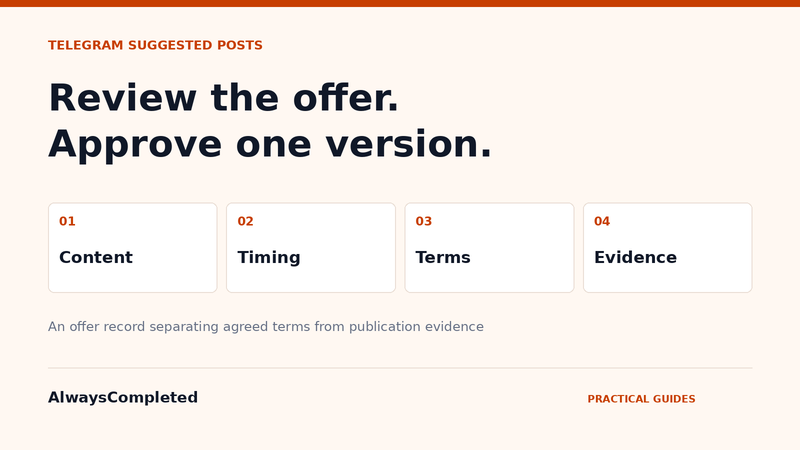
Telegram Suggested Posts: Review an Offer Before Approving It
A Telegram Suggested Post should be reviewed as a specific content-and-publication offer. Confirm the exact post version, destination, time, amount and unit, permitted edits and current payment conditions before both sides approve it. An agreeable conversation is not a substitute for a clear final offer.
Download the offer review sheet and two revision scenarios. They use a fictional educational channel and advertiser. No real channel, payment or publication is involved. The workflow states in the sheet are editorial labels, not invented Telegram interface statuses. Official sources were reviewed on 26 November 2026.
Establish which publication route is being discussed
Telegram's Suggested Posts announcement describes proposals sent through channel direct messages, with content, a publication time or “Anytime,” and an optional offer in Stars or Toncoin. It also describes revisions and approval by both sides before publication or scheduling.
This is a proposal to a channel owner. It should not be confused with configuring a sponsored message through Telegram Ads, or with ordering a catalogue metric for a channel or post. The route determines who approves the content, what the buyer is purchasing and which record proves the agreement.
At the top of the review sheet, identify the channel, the proposer, the reviewing editor and the offer reference. Keep the actual channel link rather than relying on its display name. Similar names, renamed channels and forwarded messages can otherwise lead the team to approve the wrong destination.
Freeze one content version for review
The proposed post should have a version reference that covers text, media, links and any disclosure. A media replacement can change the meaning even if the written caption is unchanged. Save the approved source files and specify who owns the rights to use them for this placement.
Separate factual corrections from editorial style changes. The channel editor may reasonably shorten a sentence, but changing the product's promised deliverable or adding an endorsement requires review by the relevant owner. A blanket “edit as needed” instruction makes those boundaries difficult to enforce.
Before approval, open each destination and compare it with the promise in the post. Record what a reader is expected to receive. If the post offers a worksheet, the destination should supply the stated worksheet under the stated conditions. If a price or deadline appears, confirm its source and currency or time zone.
Review timing and payment as displayed
Record a specific publication time with its time zone, or explicitly accept “Anytime” if that flexibility is intended. A note such as “Friday evening” can refer to different local times for the buyer and channel owner. Keep the agreed timing in the offer record and repeat it in the final approval block.
Copy the displayed amount and unit without inventing a fiat conversion. The reviewed Telegram announcement describes a reward after 24 hours of publication and an automatic return if the post is removed earlier. It also notes a separate refund-related risk for Stars purchased through third parties. Read the current offer conditions before accepting; those mechanics do not guarantee audience response or campaign performance.
Keep commercial questions separate from editorial acceptance. The team may agree that the content is accurate while the timing or amount remains unresolved. A final offer should not be marked agreed merely because the copy reviewer completed their part.
DEMO scenario one: the editor changes the text
The fictional advertiser proposes a post linking to a free sample release checklist. The channel editor replaces “inspect a sample checklist” with “get your complete release plan.” That revision changes the promise: a sample is not necessarily a complete plan.
The review record should show the original and proposed wording, the editor who made the change and the reason it requires approval. The advertiser can supply accurate revised copy or update the destination if the broader promise is genuinely intended and supported. Until then, the content state remains revised, awaiting agreement.
The useful outcome is a shared version that both sides can identify. Do not approve the original while assuming the editor's newer version will be used, or approve the new version while leaving the older asset attached to the offer.
DEMO scenario two: the advertiser changes the time
The fictional post is ready, but the advertiser moves the proposed publication from 18:00 to 20:00 in the same stated time zone. That is a change to the offer even if the content stays identical. The channel editor should confirm the new slot before the team treats it as agreed.
Record the old time, new time, change requester, reason and the response. If the channel can only offer “Anytime,” the buyer must decide whether that satisfies the campaign's purpose. Do not translate a preferred time into a guaranteed one without explicit agreement.
These scenarios use draft, revised and agreed as internal editorial states. The real interface may present its own wording. Record the actual platform state separately if you need it for an operational handoff.
Save agreement and publication evidence separately
The final approval record should identify the post version, media, destination, timing, amount/unit and each approving party. Save a reference to the offer as it existed when accepted. That gives the team a concrete comparison point if the eventual post differs.
After publication, record the actual post URL, observed time, visible text and media, and any material deviation. Publication evidence confirms that the post was observed in that state; it does not establish how many unique readers saw it or whether they acted.
If the team later reports views, joins or enquiries, identify the source and observation window for each. Keep a promised deliverable separate from a forecast. No native payment rule turns an unspecified audience or conversion assumption into a verified result.
Turn unresolved details into specific questions
Use a concise clarification: “Please confirm that offer version V3 includes these media, uses this destination and is scheduled for this time zone. The displayed amount is X in unit Y. The remaining question is Z.” Replace each placeholder with actual observed values.
The channel's direct-message feature can itself have a per-message fee, as described in Telegram's channel messaging announcement. Check the route and any displayed charge before sending repeated fragments. A compact, complete enquiry is easier for both sides to assess.
Is an approved post a performance guarantee?
It establishes the agreed offer and publication conditions. Audience reaction and business outcomes require their own evidence and any separately agreed terms.
Does an AlwaysCompleted Telegram service include this agreement?
Inspect the current Telegram promotion listing. A members, post-views or bot-start service does not itself establish a Suggested Post offer with a particular channel owner. Ask technical support to confirm the exact scope before treating them as the same purchase.
