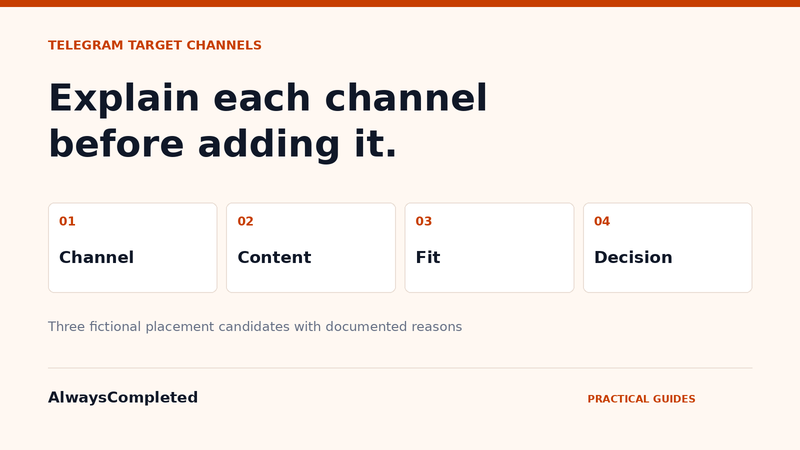
Telegram Ads Channel Targeting: Build a Defensible Placement List
Build a Telegram target-channel list by connecting each candidate to the reader's task, checking its language and current content, then confirming that it can be selected in the advertising route you are using. A familiar channel name or large subscriber count is not enough to establish that it belongs in the campaign.
The ten-candidate worksheet and version log include three fictional examples and seven blank rows. Placeholder references are not real Telegram channels and must not be submitted as targeting inputs. No channel eligibility or advertising account was tested. Official documents were reviewed on 26 November 2026.
Confirm the route before researching candidates
The reviewed Telegram Ad Platform guide describes selecting target channels by their unique links. It also says that targeting parameters cannot be changed after an ad is created in that described flow; a similar new ad can be created with revised parameters.
Treat those instructions as a reason to identify the actual account and route first. Telegram's broader documents can describe additional advertising contexts. Do not assume every interface, intermediary or commercial proposal exposes the same controls. Ask the operator to confirm that the proposed channel-targeting mechanism is available in the account that will run the campaign.
Record the account reference, route, document URL, observation date and the person who checked the interface. If the route cannot be confirmed, research can remain a candidate exercise, but the list is not ready for submission. A public channel being visible in Telegram does not prove it is selectable for the intended ad.
Keep target channels separate from the destination
The target-channel list describes where the native ad may be displayed in this route. The destination is what the ad opens. Those can be different channels or a permitted bot destination. Put them in separate fields so the operator does not accidentally enter the advertiser's channel as a placement requirement.
For the fictional example, the destination offers a release-planning checklist. The desired reading context is educational material about preparing music releases. A general entertainment channel could have many subscribers yet provide a weak explanation for that particular placement choice.
Write selection criteria before collecting links: relevant task, content language, current topic evidence, permitted destination relationship and any explicit exclusions. This helps the reviewer distinguish a reasoned shortlist from a collection of large channels.
Read a small, identified content sample
Choose a practical sample of recent posts and save their references and observation date. Record what they actually cover: release preparation, recording technique, music news or unrelated entertainment. Explain the connection to the proposed reader task in one sentence.
The sample is editorial evidence, not a statistical description of the audience. A few relevant posts do not prove the channel's subscribers are active buyers, unique individuals or likely converters. Keep those conclusions unknown unless appropriate evidence exists.
Read the language of the actual posts rather than guessing from the channel name. The Telegram advertising guidelines require language alignment between the targeted channel, ad and destination. For mixed-language content, record the ambiguity and ask the operator to confirm how the chosen route handles it.
Use three fictional candidates to test the reasoning
| Candidate | Fictional content observation | Provisional decision |
|---|---|---|
| DEMO-A | Educational posts about release artwork and approval planning, in the intended language | Content fit is plausible; account eligibility still needs checking. |
| DEMO-B | Mostly music news with no observed planning guidance in the sample | Clarify whether the offer is useful in that context; do not accept on size alone. |
| DEMO-C | Relevant production topics, but the sample uses a different language from the proposed ad and destination | Resolve language alignment before proceeding. |
The worksheet contains no fabricated follower counts, reach estimates or confirmed UI statuses. Its examples show how to record a reason, a limitation and the next action. “Plausible fit” is an editorial assessment, not platform approval.
For real candidates, retain the canonical channel reference and any alias used during research. Before submission, confirm that the approved reference still resolves to the intended channel. A copied display name or an old message link is not a reliable substitute for the actual channel identifier.
Make the decision explicit
Use a simple decision sequence. If the identity cannot be verified, clarify it. If the sampled content or language conflicts with the offer, reject or revise the candidate. If content fit is plausible but account availability is unknown, keep the item awaiting setup verification. Accept it for the final list only when the required evidence is complete.
“Reject” in this worksheet means unsuitable for this proposed campaign. It does not accuse the channel of low quality or artificial activity. “Clarify” means there is a specific question whose answer can change the decision. Keep that question and its owner beside the row.
Avoid turning the checks into an unexplained numerical score. A high average cannot repair a missing required condition such as an incompatible language or an unverified destination. The reviewer should see the reason for each inclusion rather than a decorative percentage.
Review and freeze the full list before creation
Give the approved list a version and date. Check duplicate references, unintended channels, unresolved rows and the destination field. Have the person responsible for the campaign confirm that the list matches the approved scope before creating the ad.
When a targeting change requires a new ad in the described route, retain the earlier list and ad reference. Record what changed and why. Do not overwrite version one with version two and later compare their results as though the targeting were identical.
The version log should include list version, candidate additions or removals, reason, reviewer, related ad reference and implementation time. A proposed revision becomes an implemented revision only when the actual setup is checked. Until then, mark it proposed.
Keep reporting claims within the evidence
After delivery, use the available native report for the relevant ad and observation period. If a channel-level breakdown is not available, do not invent one from the targeting list. A selected candidate is not proof of how many impressions it received.
If you compare list versions, retain the other material changes, including creative, timing and budget. A result difference may have several causes. The worksheet prepares a defensible selection and change history; it does not promise audience response.
Can the destination also be a target channel?
The concepts remain separate even if a particular setup happens to involve the same channel. Record each role explicitly and verify that the account accepts the proposed configuration.
How does this relate to a Telegram service order?
In an AlwaysCompleted Telegram listing, the target often identifies the destination of the ordered action. That is a different role from a native advertising placement list. Confirm the actual target, metric and scope with technical support before transferring terminology between the products.
