Why Your Song Is Missing from Release Radar: A Diagnostic Checklist
If your song is missing from Release Radar, check the exact recording and artist profile, reconstruct the delivery and pitch timeline, review the current role and version rules, and inspect the relevant Spotify for Artists reporting. One person's playlist or an empty report row is not enough to identify the cause.
Start by defining “missing.” Is the song absent from a particular listener's playlist, absent from the playlist report, or not live on Spotify at all? Those are different observations and need different next steps. Avoid changing the release or restarting a campaign until you know which problem you are investigating.
Use the diagnostic tree, editable review worksheet, and five-event date log. The diagram is an original workflow aid, not a screenshot of Spotify or evidence from an artist account. The two timing examples use fictional dates to show how to interpret the log.
First, identify the observation
Write a short issue statement before opening more dashboards. For example:
- “The track is live, but one follower did not see it in their playlist when they checked.”
- “We cannot see a Release Radar row in the report we reviewed.”
- “The release is missing from Upcoming and we have not confirmed delivery to the correct artist profile.”
Add the track URL or URI, release title, artist profile URL, observation date, and the exact page or report viewed. If someone supplied a screenshot, preserve the date and context rather than treating it as a view of every listener's account.
Spotify describes Release Radar as a personalised playlist updated on Fridays. Checking your own playlist is not a complete test of your release's distribution. Spotify's Release Radar guide.
The practical question is: what evidence would distinguish a delivery issue, an eligibility issue, a timing issue, and a reporting limitation? The steps below collect that evidence in order.
Check the recording, profile, and delivery record
Confirm that everyone is discussing the same recording. Save the song URI and release URI separately when available; a title alone can be ambiguous when there are singles, album appearances, remixes, and alternative versions.
Compare the artist profile attached to the release with the profile your team manages. If there is a mismatch, record both URLs and ask the label or distributor to verify the delivery. Keep that request focused on the factual mismatch rather than asking for playlist inclusion.
Spotify says unreleased music appears under Music → Upcoming after delivery, and that it can take around 48 hours to appear. If it is missing, its guidance is to confirm the correct artist profile with the distributor. Some releases, including featured-artist and track-level-only appearances, do not appear in that view. Upcoming release documentation.
The upload date in your distributor account and the delivery date to Spotify are not necessarily the same observation. In the log, distinguish “submitted to distributor,” if you have it, from “delivery to Spotify confirmed.” If the latter is unknown, mark it unknown and request the record. Do not calculate a lead time from an unverified substitute.
For a release that is already live, save what currently exists before proposing changes. This checklist does not recommend a takedown, new identifier, or metadata change merely to try to restart a promotional opportunity. Correct an established error through the appropriate delivery process.
Reconstruct five dates before judging the timing
Use a consistent time zone and preserve the source for each timestamp. The downloadable log separates the event time from the time you recorded it, so a screenshot taken today does not become a fabricated delivery date.
| Event | Evidence to retain | What it helps establish |
|---|---|---|
| Delivery to Spotify | Distributor or label confirmation, with the release identifier | Whether you know when the delivery occurred |
| First observed in Upcoming | Your dated note or screenshot and the selected artist profile | When your team could see the delivered release |
| Song pitch submitted | Submission record or dated team note identifying the song | Which track was pitched and when |
| Release | Confirmed release date, time convention, and current track URI | The reference point for lead-time calculations |
| First reporting review | Review time, report name, period, filters, and saved observation | What you actually checked after release |
Spotify's Upcoming documentation says its displayed date reflects the earliest date the release becomes available in any country; time zones can make it differ from the date a team expects. Confirm the release time convention with the label or distributor before treating a one-day discrepancy as a missed deadline. Release-date explanation.
Keep three timing statements separate
Delivery: Spotify's Release Radar guidance says to deliver at least seven days before release for first-week inclusion. Delivery guidance.
Song selection through pitching: Spotify says pitching an unreleased song at least seven days before release gets that song into followers' Release Radar playlists. Its pitching tool is for upcoming, unreleased music; a live song is no longer eligible for a song pitch. Pitching documentation.
Planning buffer: Spotify's broader New Releases guide advises pitching the focus track at least two weeks ahead. Treat that as a useful planning target with room to resolve delivery and metadata problems.
The seven-day condition above is not an absolute statement that every later unreleased submission is barred from editorial consideration. Also, a pitch does not guarantee editorial placement. Keep the documented Release Radar effect, editorial consideration, and your team's scheduling buffer as separate ideas. Spotify's pitching guidance.
If you did not pitch, Spotify says it chooses the song or songs from the release for followers' Release Radar. A missing pitch therefore does not, by itself, prove complete exclusion. Release Radar selection.
Two fictional timing examples
Both examples assume a release at 00:00 UTC on March 19, 2027. The dates demonstrate arithmetic and diagnosis; they are not service deadlines or observed campaign results.
| Event | Example A | Example B |
|---|---|---|
| Confirmed delivery | March 5 — 14 days before release | March 15 — 4 days before release |
| First observed in Upcoming | March 7 — 12 days before release | March 17 — 2 days before release |
| Song pitch submitted | March 10 — 9 days before release | March 18 — 1 day before release |
| Release | March 19 | March 19 |
| First reporting review | March 20 — 1 day after release | March 20 — 1 day after release |
Example A's recorded delivery and pitch dates provide no obvious shortfall against the seven-day checks described above. That does not establish the result for every listener. Continue with the recording, role, listener context, and reporting checks. The team also missed its more comfortable two-week pitch target, which is a process improvement for the next release.
Example B has a documented timing gap. Record it as a plausible explanation for the expected first-week outcome, not as proof of permanent exclusion. The useful next action is to preserve the evidence, review the actual reporting, and schedule the next delivery earlier. Changing the date log to the distributor upload date would hide the problem rather than solve it.
Check artist roles and release versions
Use the delivered credits and version information rather than the language in a promotional post. Spotify's current Release Radar rules include these distinctions:
- Main and featured artists qualify; a remixer-only role does not.
- Various Artists releases are excluded.
- Re-releases of songs already on Spotify are excluded.
- Some alternative versions, including acoustic, karaoke, and live versions, are excluded; remixes are included.
These are eligibility checks, not a reason to relabel a recording. If the factual credits or version are wrong, ask the delivery team to correct the error. If they are accurate, plan around what the release actually is.
There is also an important difference between appearing on a release and being able to pitch it. Spotify's song-pitch rules do not let you pitch a song on which you are a featured artist, and exclude compilations from song pitching. That restriction is separate from the Release Radar role rule above.
For a collaboration, record who owns the delivery, which artist team handled the song pitch, and what credit your artist has. Do not infer a broken release simply because a team with a different role cannot see the same pitching controls.
Allow for listener-specific differences
Spotify says it does not include a song a listener has already heard, limits Release Radar to one song per artist per listener each week, and may include an unheard song for up to four weeks. Listener-specific rules.
This changes how to interpret a complaint from one fan. Ask what they observed and when; do not turn an individual's experience into a claim about the whole audience. A listener's screenshot can help describe that specific case, but it does not replace the artist-side reporting.
Avoid collecting unnecessary personal account information from fans. For your internal investigation, a simple statement of the observation is usually enough to decide whether you need to inspect delivery records or reporting. Do not ask people to manufacture listening activity as a test.
Find the relevant evidence in Spotify for Artists
Spotify directs artists to the Playlists tab of the song's stats to review Release Radar activity. Where to check.
Choose the exact song and a period that covers the intended review. Record the view, metric, date range, and any filters before comparing two screenshots or exports. A narrow country filter or a different period can make two legitimate observations answer different questions.
The general Music → Playlists report has documented display limits: Spotify shows the top 100 playlists, requires at least three listeners for a playlist to appear, and makes that data available for the last 12 months. These are reporting conditions, not a three-listener eligibility requirement for Release Radar. Playlist reporting documentation.
Consequently, “no row visible in this report” is a narrower statement than “the song was never included for anyone.” Preserve the former if that is all you know. Do not replace missing evidence with a zero-exposure estimate.
Spotify's regular stats update daily and use UTC dates, while a new release has a separate live stream count during its first seven days. Check the report's freshness before expecting a current live total and a playlist breakdown to reconcile immediately. Stats-update documentation.
For a broader check, Source of streams groups Release Radar with other personalised sources, including other playlists, mixes, and autoplay. A rise in that combined category is not a Release Radar-only total. Keep the exact category label with the number. Source of streams documentation.
Useful review notes are specific: “Release Radar row visible for this song and period,” “row not visible in this selected report,” or “data not yet reviewed.” None requires inventing a reach number or diagnosing an algorithmic penalty.
Choose a correction that follows from the evidence
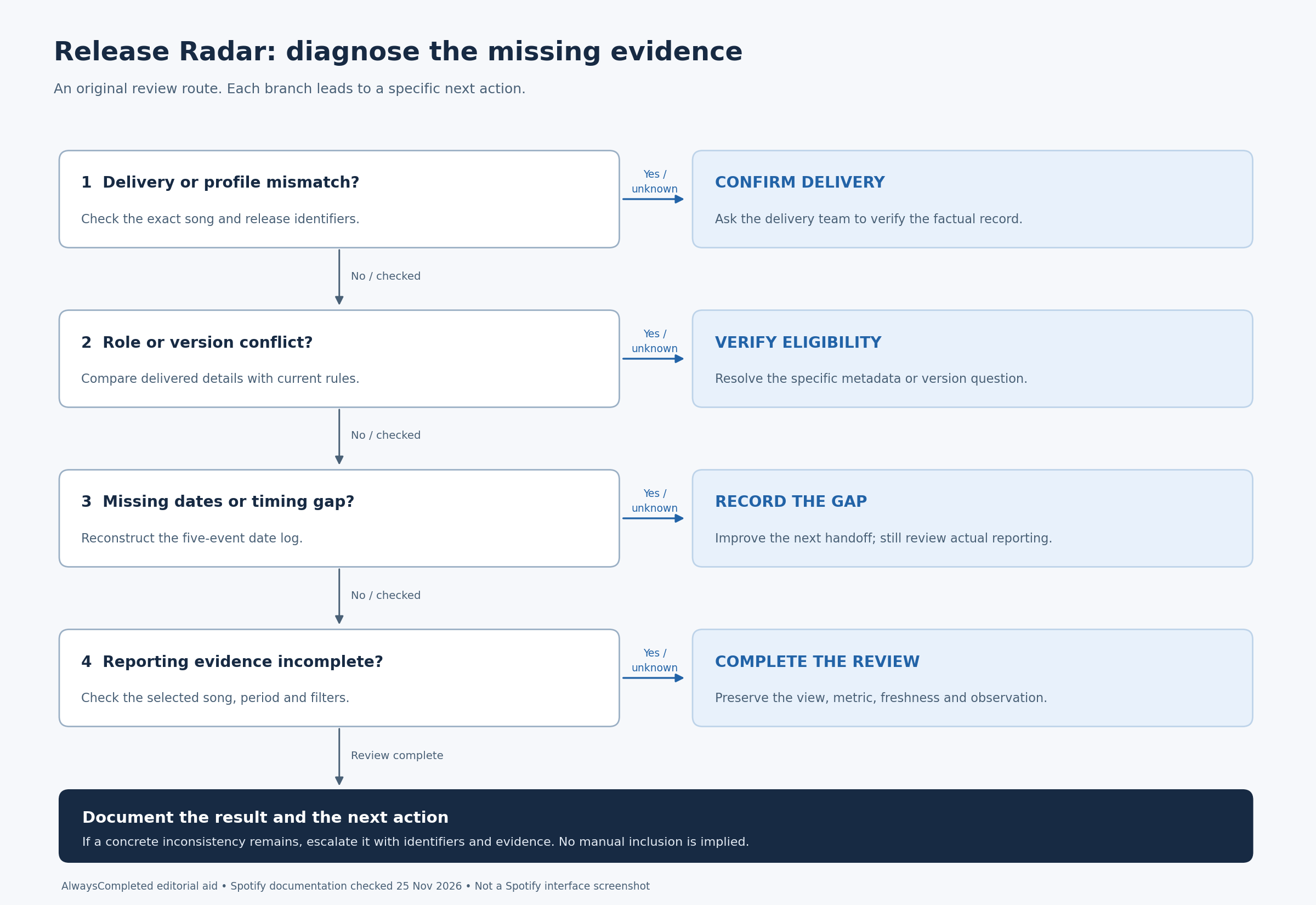
Use the diagnostic tree to route the issue, then assign a concrete next step:
- Delivery or profile mismatch: collect the identifiers and ask the delivery team to confirm or correct the factual record.
- Unclear role or version: compare the delivered metadata with the current documentation before drawing an eligibility conclusion.
- Timing gap: preserve the dates and build an earlier handoff into the next release plan.
- Incomplete reporting: recheck the correct song, period, filters, and report after its data has updated.
- Unexplained inconsistency: send the appropriate support team a concise issue statement with the identifiers and evidence already collected.
An effective support note says what differs: “The distributor confirms delivery on this date, but this release is associated with this other profile,” or “These are the song URI, review period, and report observations we cannot reconcile.” Asking for a manual playlist placement is not a diagnosis.
For the next release, nominate an owner for each event in the date log. Have the delivery owner confirm the handoff, the artist team verify the correct Upcoming entry, and the pitch owner preserve the submission record. Set a review date in advance so the team does not judge the result from an isolated screenshot minutes after release.
Spotify's Campaign Kit overview presents playlist pitching alongside other campaign tools. Treat those activities as distinct tasks with their own requirements. A campaign plan does not repair a missing delivery record or establish a playlist outcome.
If you are planning external support, compare the stated scope in the Spotify music promotion guide. For interpreting plays more broadly, use the existing Spotify plays guide. Keep those decisions separate from this diagnostic log: the immediate goal is to identify a verifiable issue and the action that can actually address it.
