Pinterest Paid Partnerships: A Creator-to-Brand Handoff
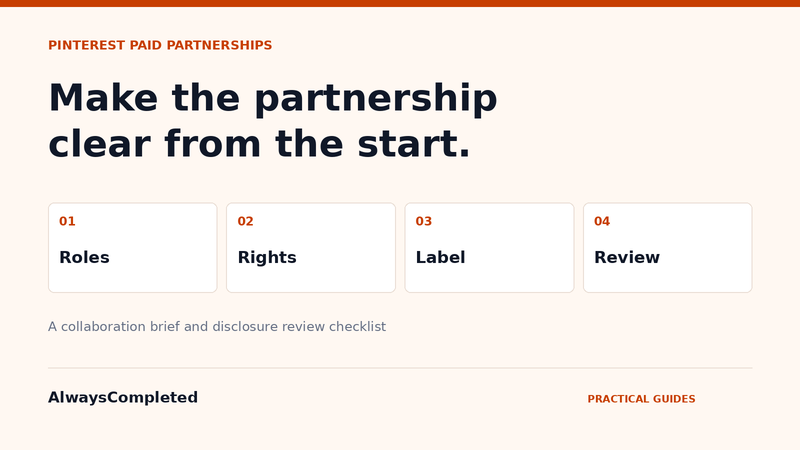
A Pinterest paid partnership needs a handoff between the person publishing the Pin and the brand that confirms the relationship. Agree on the creative first, prepare the label before publishing, send the exact published Pin to the responsible brand contact and verify the resulting label. Treat any advertising use as a separate stage with its own owner and checks.
The important sequence is easy to lose in a busy campaign. A brand can approve a draft outside Pinterest before publication, but its in-platform tag request is shared after the creator publishes. Those are two different approvals. Neither a message saying “the draft looks good” nor a generic paid partnership label proves that the brand's name has been approved on the published Pin.
This guide provides a ten-step creator, brand and agency handoff, plus three fictional scenarios covering approval, rejection and removal after an ad launch. No Pin, approval request, label change or advertisement was created in a private account. The examples describe expected handling; live results remain NOT_RUN.
Agree on the relationship and the exact creative
Pinterest describes paid partnerships as relationships established between the creator and brand outside Pinterest. Its tool displays the relationship; it does not negotiate the deliverables or settle the parties' commercial arrangement. Record the agreement reference, responsible people and approved asset version before preparing the Pin. Pinterest: paid partnerships for creators
The handoff should identify the publishing account, exact brand account, media version, caption, destination and intended publication window. Keep creator compensation and any later advertising budget in separate fields. A paid creative commission can exist without a media campaign, while advertising requires additional decisions about how the content will be used.
Name the person who can approve a creative change. If an agency coordinates the work, state whether it prepares the record, reviews the draft or has authority to operate an account. “Agency manages the campaign” does not explain who may publish or accept a brand request. Use the social media approval workflow for the broader version and decision record.
Consider the exact asset, not just the campaign concept. A replacement product, new claim, changed price or different destination can invalidate the earlier creative approval. Resolve that change before the creator publishes, then retain the version that was actually approved. The log should make it possible to compare the final Pin with that version.
Prepare the label before publishing
The current creator guide places the paid partnership tool in the Pinterest mobile app. It instructs creators to add the label and select the brand during Pin creation, and says a label cannot be added after publication. If it was omitted, the documented route is a new Pin. Pinterest's creator workflow
Put that check before the publish decision in your own process. Confirm the intended brand account and available controls in the actual app. Do not leave “add partnership later” as a routine task after launch. Some options have age-related availability limits, and the account and advertising market still need their own access checks.
The worksheet records the selected account rather than relying only on a brand's display name. Similar names, regional profiles and agency-owned accounts can make a hurried selection ambiguous. Have the responsible brand contact confirm the correct destination before the request is sent.
Keep the offline draft approval and planned platform action separate. The brand can review the creative in advance, but the actual request should remain “not sent” until publication has occurred. That gives the team an accurate picture of what is ready and what still depends on the next action.
Pass the published Pin to the brand reviewer
After publication, save the exact Pin URL and the publication time. Compare the visible media, caption and destination with the approved version. Then provide that reference to the assigned brand reviewer through the team's agreed channel.
Pinterest says the initial label appears without the brand's name. The brand's acceptance adds its name; rejection removes the label. A generic label is therefore an intermediate state that needs interpretation, not automatic evidence of failure or completion. Pinterest: paid partnerships for brands
The brand help page currently says approval is available from a desktop device. Plan a reviewer who can use that route and has the appropriate business-account access. Do not promise a mobile approval walkthrough when the official instruction specifies desktop. Recheck the actual account if the available controls differ from the documentation.
The agency's useful role is to preserve the handoff context: which Pin, which creative version, which request and which decision owner. It should not substitute “notification sent” for “request approved.” If the reviewer cannot find the request, inspect the exact account and publication reference before sending a second Pin into the process.
Verify the final label and record the decision
After the brand acts, inspect the published Pin again. Record whether the expected brand name appears with the label and whether the content still matches the agreed creative. Keep the action time and the observation time separate if another person verifies the result later.
Use narrow statuses such as draft approved, Pin published, brand decision pending, brand accepted, brand declined and label verified. These are suggested manual labels, not asserted Pinterest interface fields. They show the difference between an intended action, an action taken and a visible result checked.
If the label appears differently from the expected state, leave the verification open. A team member's recollection that they clicked a control is useful context, but it is not the same as a current observation of the Pin. The record should name the person resolving the discrepancy rather than letting each party assume the other has finished.
The ten-step table in the download assigns creator, brand and agency responsibilities without requiring three separate organisations. One person may hold several roles, provided the authority is clear. What matters is that the publishing action and the brand's decision are not merged into an undefined “approved” checkbox.
Keep advertising permission and activation separate
Pinterest's current help documentation calls the advertising route an Idea ad with paid partnership. It says the brand partner can promote the partnership Pin and the creator cannot promote that Pin independently as a paid partnership ad. Confirm the available format and eligibility in the brand's actual advertising account before planning a launch. Pinterest's advertising distinction
A visible partnership label does not demonstrate that an ad has been created, reviewed or started spending. Record the intended advertiser, creative-use permission, destination, media settings, budget and actual campaign status separately. If the parties agreed only to the creator's publication, seek the relevant advertising decision through their existing arrangement before assuming broader use.
Do not combine a creator fee and media spend into one unexplained total. The first concerns the agreed creative work; the second concerns distribution through the advertising system. The campaign owner needs to know which amount and action have been approved before execution.
If no ad is planned, the handoff can finish with the verified publication and its maintenance owner. There is no requirement to manufacture an advertising stage just because the tool supports one. Mark the stage not planned, which is different from an eligible campaign that has not yet been launched.
Handle rejection without recycling an invalid state
The creator guide says a declined tag is removed and the same brand cannot be tagged again in that Pin; a new Pin is required. It also says a removed partnership tag cannot be added back. Treat rejection and removal as consequential decisions, not harmless switches to use while discussing a draft. Declined and removed partnerships
If the brand rejects the request, preserve the original Pin reference, the reason supplied and the decision owner. Establish what must change before preparing any replacement. A wrong account, unapproved product claim and cancelled collaboration are different situations; a new upload alone does not resolve all of them.
Keep a replacement's URL and version separate from the original. Decide how the original publication should be handled under the parties' actual agreement and platform requirements. Do not silently overwrite the record or assume that the original Pin disappeared when its label changed.
In the fictional rejection scenario, the creative included an unapproved claim. The proposed response is to resolve the claim and obtain a new creative decision before preparing a new Pin. The example does not invent an automatic second approval or treat the first rejection as permission to publish another version.
Review removal after an ad has started
Pinterest says that removing the partnership from an Idea ad sets the ad to Archive in Ads Manager. The creator documentation also distinguishes the label from the underlying Pin, which can remain live unless it violates Pinterest policies. Record both states instead of assuming that the entire publication and advertisement share one outcome. Brand removal and ad consequences
Before a planned removal, the responsible parties should understand the effect on any active advertising use and agree who checks the result. If removal has already happened, inspect the current Pin and ad record, preserve the observation and establish the next decision. Do not report continued delivery from an old screenshot of an active campaign.
Pinterest says a creator is notified when a brand declines a request, but not when the brand removes a previously approved tag. Build a direct change handoff into the working arrangement instead of relying on a notification that the documented flow does not supply. Creator notification distinction
The third DEMO scenario therefore has two unfinished verification tasks after proposed removal: inspect the Pin's current label and inspect the ad's current status. Its actual results remain NOT_RUN. It does not claim that an archived ad was restored, that a deleted tag was reattached or that the campaign delivered a particular result.
Close the handoff with a usable record
Retain the final Pin reference, approved creative version, brand decision, visible-label check and any separate ad reference. Add a maintenance owner and a change trigger, such as a product becoming unavailable or the agreed publication period ending. Keep any unresolved action visible to the next person who opens the record.
The AlwaysCompleted Pinterest service guide and advertising service guide describe separate service options. A panel order does not approve a Pinterest brand tag, establish advertising permission or activate a partnership ad. Verify the publication handoff first, then discuss a selected listing's actual deliverable and conditions with technical support.
